Have you ever met someone who gets angry over a small problem? Maybe they become upset when someone makes a simple mistake, interrupts them, or keeps them waiting. In English, you can describe this person as having a short fuse. But what exactly does short fuse meaning refer to, and how do people use this expression in everyday conversations?
What Is the Short Fuse Meaning?
The short fuse meaning is tending to become angry, annoyed, or irritated very quickly. A person with a short fuse may react strongly to situations that other people would consider minor.
For example:
“My boss has a short fuse, so be careful when discussing mistakes.”
This means the boss gets angry easily, especially when something goes wrong.
The phrase is usually used to describe someone’s temper or emotional reaction. It is often informal and can be used in casual conversations, stories, social media posts, and everyday speech.
A person with a short fuse may:
- Get angry over small problems.
- Become irritated very quickly.
- React strongly to criticism.
- Lose patience easily.
- Raise their voice during disagreements.
- Have difficulty staying calm under pressure.
However, having a short fuse does not automatically mean that someone is a bad person. People can become easily irritated for many reasons, including stress, tiredness, frustration, or difficult circumstances.
What Does “Short Fuse” Mean in Simple English?
In simple English, a short fuse means someone who gets angry quickly.
Think of a fuse used in an explosive device. A short fuse burns for only a brief time before the explosion happens. The idiom uses this image to describe a person whose anger can “explode” quickly.
For example:
“Don’t tease Jake. He has a short fuse.”
The speaker means that Jake becomes angry easily when people tease him.
Another example is:
“She usually has a calm personality, but she has a short fuse when she is tired.”
Here, the phrase suggests that the person’s patience becomes very limited when she is tired.
The expression can describe a temporary situation or a person’s usual personality. Context tells you which meaning is intended.
What Does It Mean to Have a Short Fuse?
To have a short fuse means to have a low level of patience before becoming angry.
People with a short fuse may move quickly through several emotional stages. A small problem may irritate, irritation may become frustration, and frustration may turn into anger.
For example:
“He has a short fuse, so even a small disagreement can make him angry.”
The expression focuses on how quickly anger appears, rather than how serious the anger is.
This distinction is important. Someone can become angry quickly but calm down just as quickly. Another person may rarely become angry but stay angry for a long time.
Therefore, a short fuse mainly describes quick emotional reactions.
Short Fuse vs. Short Temper
The expressions short fuse and short temper have very similar meanings.
A short temper describes someone who becomes angry easily or quickly.
A short fuse also describes someone who becomes angry quickly.
For example:
“Mark has a short temper.”
and:
“Mark has a short fuse.”
Both sentences tell us that Mark can become angry easily.
The difference is mostly in style and imagery. Short fuse creates a stronger image of anger suddenly “exploding,” while short temper directly describes someone’s temper.
Both are common, but short fuse is especially useful when you want to emphasize how quickly someone reacts.
Short Fuse Meaning and the Opposite Expression
The opposite of having a short fuse is having a long fuse.
Someone with a long fuse is generally patient and does not become angry quickly.
For example:
“My sister has a long fuse. It takes a lot to make her angry.”
This means the sister can tolerate frustration for a long time before becoming angry.
The two expressions create a useful comparison:
| Expression | Meaning |
| Short fuse | Gets angry quickly |
| Long fuse | Remains patient for a long time |
| Short temper | Becomes angry easily |
| Lose one’s temper | Become angry |
| Keep one’s cool | Remain calm |
For example, imagine two coworkers dealing with the same problem. One immediately starts shouting and complaining. The other calmly looks for a solution. You could say the first coworker has a short fuse, while the second has a long fuse.
Examples of “Short Fuse” in Sentences
Learning an idiom becomes easier when you see it in different situations.
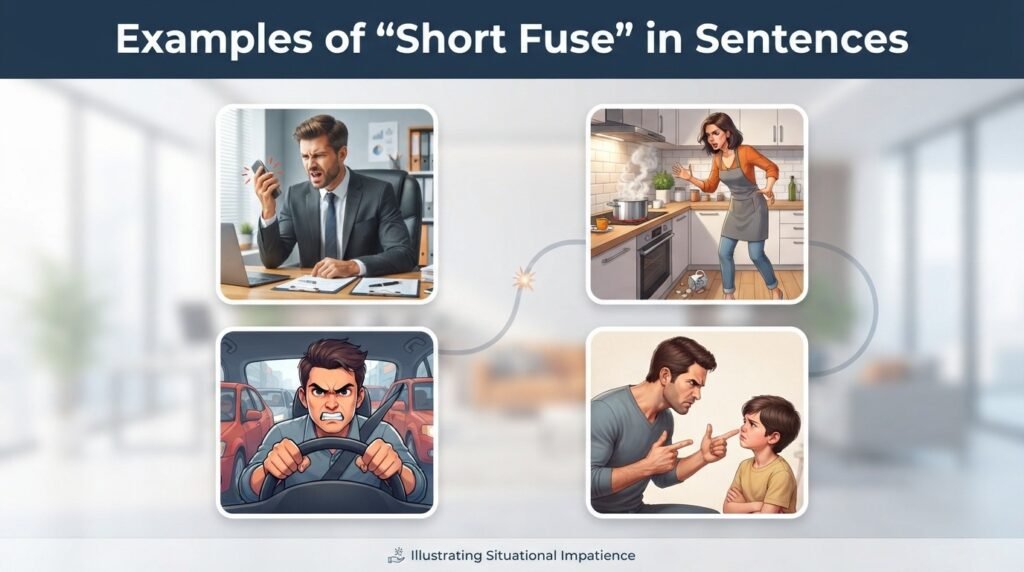
At Work
“Be patient with the new manager. He has a short fuse when deadlines are missed.”
The manager becomes angry quickly when employees miss deadlines.
In a Family
“My brother has a short fuse when someone touches his computer.”
This means his brother becomes irritated very quickly in that situation.
During an Argument
“She has a short fuse, so the conversation became heated very quickly.”
The discussion became intense because she reacted with anger.
While Driving
“People with a short fuse may become frustrated by heavy traffic.”
The sentence describes people who lose patience quickly when driving.
Among Friends
“Don’t take his reaction personally. He has a short fuse.”
The speaker is explaining that the person’s quick anger may be part of his personality.
At School
“The coach has a short fuse when players ignore instructions.”
The coach gets angry quickly when players do not follow directions.
In Daily Life
“I have a short fuse when my phone keeps freezing.”
This can be a casual or humorous way to say that repeated technical problems are frustrating.
Is Having a Short Fuse Always Bad?
Not necessarily. The phrase usually has a negative meaning because it suggests that a person becomes angry too quickly. However, the seriousness depends on the situation.
Sometimes people use it casually to describe minor irritation.
For example:
“I have a short fuse when people chew loudly.”
This may simply mean that loud chewing is annoying to the speaker.
In other situations, a short fuse may describe a more serious pattern of frequent anger, arguments, or aggressive reactions.
It is also important to understand that anger itself is a normal human emotion. Everyone becomes angry sometimes. The concern is more about how often anger occurs, how intense the reaction is, and how a person behaves while angry.
A person can recognize that they have a short fuse and work on responding more calmly.
Common Situations That Can Trigger a Short Fuse
Different people have different triggers. A situation that irritates one person may not bother another.
Common triggers can include:
- Traffic and long delays
- Lack of sleep
- Work pressure
- Repeated mistakes
- Noise
- Arguments
- Criticism
- Waiting for a long time
- Technical problems
- Feeling ignored
- Miscommunication
- Unexpected changes
For example, someone who normally stays calm may become impatient after a stressful day at work. In that situation, tiredness and pressure may make their fuse seem shorter than usual.
This is why context matters when using the expression. Saying that someone “has a short fuse” suggests a tendency, but it does not explain the reason behind the person’s reaction.
Common Mistakes When Using “Short Fuse”
Although the phrase is simple, learners can make a few common mistakes.
Mistake 1: Taking It Literally
A short fuse usually does not refer to an actual physical fuse in everyday conversation.
If someone says:
“She has a short fuse.”
They are talking about her temper, not an object.
Mistake 2: Using It for Someone Who Is Always Angry
A person with a short fuse does not have to be angry all the time.
The key idea is that they become angry quickly.
Someone who is constantly angry may be described differently depending on the situation.
Mistake 3: Confusing It With Being Impatient
Impatience and anger are related but not identical.
Someone may be impatient without becoming angry. A short fuse specifically suggests a quick movement toward anger or irritation.
Mistake 4: Using It in Very Formal Writing
Short fuse is an informal idiom. It works well in conversations, blogs, stories, and casual writing.
For highly formal writing, alternatives such as “easily irritated,” “quick to anger,” or “has difficulty managing frustration” may be more appropriate.
How to Respond to Someone With a Short Fuse
If you regularly deal with someone who becomes angry quickly, communication can become difficult. You cannot control another person’s emotions, but you can control your own response.
Useful approaches include:
- Stay calm instead of matching their anger.
- Speak clearly and avoid unnecessary provocation.
- Give the person time to cool down when appropriate.
- Focus on the problem rather than attacking their personality.
- Avoid turning a small disagreement into a larger argument.
- Set reasonable boundaries if their behavior becomes disrespectful.
For example, if someone becomes angry during a disagreement, responding with more anger may make the situation worse. A calm response can sometimes help reduce tension.
However, there is an important distinction between ordinary irritability and harmful behavior. If someone’s anger includes threats, intimidation, violence, or repeated abusive behavior, simply “staying calm” is not a complete solution. Safety and appropriate support should come first.
Frequently Asked Questions
What is short fuse meaning?
Short fuse means that someone becomes angry, annoyed, or frustrated very quickly. It is an informal English idiom commonly used to describe a person’s temper.
Is short fuse a negative expression?
Usually, yes. It often suggests that a person reacts to frustration too quickly. However, people may also use it casually or humorously to describe minor irritations.
What is the opposite of a short fuse?
The opposite expression is a long fuse. A person with a long fuse is patient and does not become angry easily.
Is short fuse the same as short temper?
They have almost the same meaning. Both describe someone who becomes angry easily or quickly. Short fuse emphasizes how quickly the anger can “explode.”
Can I use short fuse in a sentence about myself?
Yes. For example:
“I have a short fuse when I’m tired.”
This means you become irritated or angry more quickly when you are tired.
Is short fuse formal English?
No. Short fuse is an informal idiom. It is very natural in everyday conversations, casual writing, stories, and social media. In formal writing, phrases such as “quick to anger” or “easily irritated” may be more suitable.
Conclusion
The short fuse meaning is simple: a person with a short fuse becomes angry, irritated, or frustrated very quickly. The expression comes from the image of a fuse that burns for only a short time before an explosion. In everyday English, it is mainly used to describe someone’s temper or quick emotional reactions. Understanding this idiom can help you recognize natural English in conversations, movies, books, and social media. You can also use it when describing your own reactions or another person’s behavior. Remember that short fuse is informal, so it works best in everyday communication rather than highly formal writing.