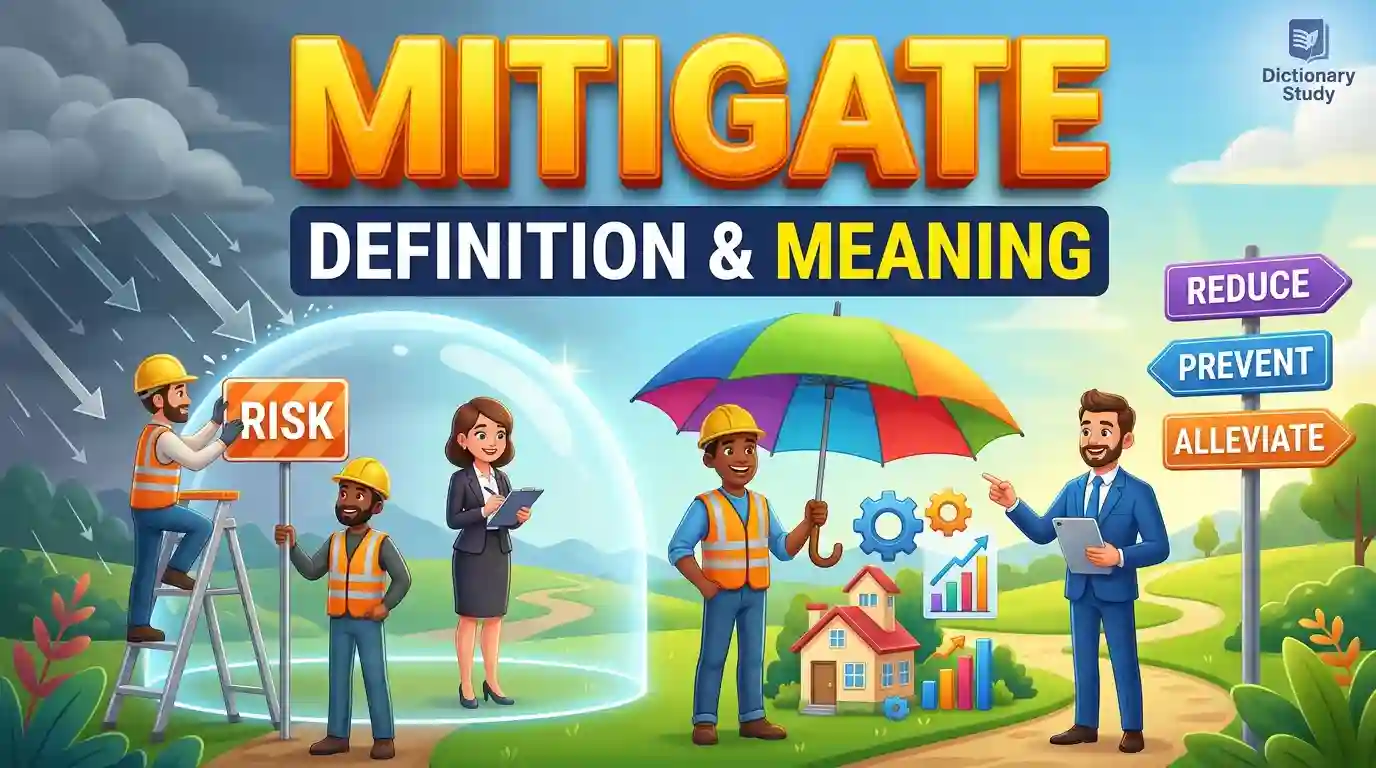
Although these words share similar meanings, they do not always express the same idea. This guide explains mitigate definition & meaning in simple English. You will learn its pronunciation, grammatical forms, synonyms, antonyms, and common expressions. You will also find practical examples that show how to use this word correctly in speaking and writing.
What Is the Mitigate Definition & Meaning?
The word mitigate means to make something less severe, harmful, painful, or serious. It describes an action that reduces the negative effects of a problem without necessarily removing the problem completely.
For example, a company may introduce safety rules to mitigate workplace risks. These rules cannot remove every possible danger, but they can lower the chances of accidents.
Here are some simple meanings:
- To make something less serious.
- To reduce the harmful effects of a situation.
- To ease pain, difficulty, or suffering.
- To lessen the impact of a negative event.
- To make an unpleasant condition more manageable.
Simple example: Drinking enough water can help mitigate the effects of hot weather.
In this sentence, water does not stop the weather from being hot. Instead, it helps reduce some of its uncomfortable effects.
The word often describes situations where complete prevention is difficult. People use it when they want to explain how an action can make a problem easier to manage.
How to Pronounce Mitigate
Pronunciation helps you use unfamiliar vocabulary with greater confidence. Although the spelling may look complicated, the word has a straightforward pronunciation.
Pronunciation: MIT-uh-gayt
Phonetic spelling: /ˈmɪtɪɡeɪt/
The word contains three syllables:
- Mit: The first syllable sounds like “mit” in the word mitt.
- I: The middle syllable sounds like a short “uh.”
- Gate: The final syllable sounds like the word gate.
The stress falls on the first syllable. Say the word slowly at first, then combine its sounds into one smooth pronunciation.
Example: The new policy will mitigate financial risks.
You can practise this word by reading short sentences aloud. Repeating it in different contexts also helps you remember its pronunciation and meaning.
Mitigate Definition & Meaning in Different Contexts
The mitigate definition & meaning stays similar across different situations, but the problems and solutions change. Understanding these contexts helps you recognize when the word fits naturally.
In Everyday English
In everyday conversations, people use this word when discussing ways to reduce discomfort, stress, or difficulty.
For example:
- Taking breaks can mitigate work-related stress.
- A warm blanket may mitigate the discomfort of cold weather.
- Planning can mitigate travel problems.
- Talking openly can mitigate misunderstandings between friends.
These examples show how simple actions can make difficult situations easier. The problem may still exist, but its negative effects become smaller.
For instance, a person cannot always avoid a stressful day. However, proper rest and healthy habits can help reduce its impact.
In Business and Management
Businesses often use this word when discussing risks, financial losses, and operational challenges. Managers develop plans to limit possible damage and protect their organizations.
Examples include:
- Companies create backup plans to mitigate financial risks.
- Regular staff training helps mitigate workplace accidents.
- Strong security systems mitigate the risk of data theft.
- Clear contracts can mitigate disagreements between business partners.
Suppose a company depends on one supplier for essential materials. If that supplier stops delivering, the company may face serious delays. Working with additional suppliers can mitigate this risk.
The business still faces uncertainty, but it has more ways to handle unexpected problems.
In Health and Medicine
Healthcare professionals may use this word when discussing ways to reduce symptoms, discomfort, or complications.
For example:
- Proper treatment can mitigate pain.
- Healthy eating may help mitigate certain health risks.
- Rest can mitigate tiredness after physical activity.
- Following medical advice may mitigate the risk of complications.
It is important to understand that reducing symptoms does not always mean curing a condition. A treatment may improve comfort without removing the underlying cause.
In Environmental Discussions
Environmental experts use the word when discussing ways to reduce pollution, climate-related risks, and damage to natural resources.
Examples include:
- Planting trees can help mitigate soil erosion.
- Cleaner energy sources may mitigate air pollution.
- Better waste management can mitigate environmental damage.
- Coastal barriers can mitigate the effects of flooding.
For example, planting trees cannot stop every environmental problem. However, trees can help protect soil, absorb carbon dioxide, and support healthier ecosystems.
Mitigate Definition & Meaning With Real-Life Examples
Real-life examples make unfamiliar vocabulary easier to understand. The following sentences demonstrate how the word works in different situations, from personal challenges to professional decisions.
Simple Sentences
Here are some easy examples:
- A good night’s sleep can mitigate tiredness.
- Exercise may mitigate daily stress.
- The new rules will mitigate safety concerns.
- Better planning can mitigate travel delays.
- Rainwater systems help mitigate flooding.
- Kind words can mitigate someone’s sadness.
- Insurance can mitigate financial losses.
- Proper preparation helps mitigate exam anxiety.
- Strong passwords mitigate security risks.
- Regular maintenance can mitigate equipment problems.
Professional Sentences
The word also appears frequently in formal communication.
- The management introduced new policies to mitigate operational risks.
- The organization developed a strategy to mitigate potential losses.
- Improved security measures can mitigate the threat of cyberattacks.
- The company hired additional staff to mitigate service delays.
- Emergency planning helps mitigate the consequences of natural disasters.
Conversation Examples
Person A: The weather forecast predicts heavy rain tomorrow.
Person B: We should prepare early to mitigate possible travel problems.
These conversations demonstrate how the word fits into natural discussions. It sounds especially appropriate when someone explains a solution to an existing or possible problem.
Common Synonyms of Mitigate
Synonyms are words with similar meanings. Learning them helps you avoid repetition and choose vocabulary that matches your intended message.
Here are some useful alternatives:
| Synonym | Meaning | Example |
| Reduce | Make something smaller or lower | Reduce unnecessary expenses. |
| Lessen | Make something less intense | Lessen the emotional impact. |
| Ease | Make something more comfortable | Ease the pain. |
| Relieve | Reduce discomfort or pressure | Relieve stress. |
| Alleviate | Make suffering less severe | Alleviate symptoms. |
| Diminish | Make something weaker or smaller | Diminish the risk. |
| Moderate | Keep something within reasonable limits | Moderate the effects. |
| Soften | Make something less harsh | Soften the criticism. |
| Minimize | Reduce something as much as possible | Minimize potential losses. |
| Decrease | Make something lower in amount | Decrease pollution. |
How to Choose the Right Synonym
Not every synonym works in every sentence. Your choice depends on the situation and the type of effect you want to describe.
Reduce: Use this word when discussing a general decrease in size, amount, or intensity.
Example: The company wants to reduce its expenses.
Ease: Choose this word when something becomes more comfortable or manageable.
Example: A short walk can ease tension.
Alleviate: This word often describes reducing pain, suffering, or difficult conditions.
Example: The treatment helped alleviate discomfort.
Minimize: Use it when someone wants to make a risk, cost, or problem as small as possible.
Example: Careful planning can minimize mistakes.
Lessen: This word works well when describing a reduction in emotional or physical intensity.
Example: Her support helped lessen his worries.
For readers interested in understanding how expressions communicate different ideas, exploring the meaning of common text abbreviations can also build useful vocabulary knowledge.
Antonyms of Mitigate
Antonyms are words with opposite meanings. They help you understand a word more clearly by showing what it does not mean.
The following words express an increase in severity, intensity, or harm rather than a reduction.
| Antonym | Meaning | Example |
| Aggravate | Make something worse | Noise can aggravate stress. |
| Worsen | Make a situation more serious | Delays may worsen the problem. |
| Intensify | Make something stronger | Heavy rain may intensify flooding. |
| Escalate | Increase in seriousness or size | The argument began to escalate. |
| Exacerbate | Make an existing problem worse | Poor planning can exacerbate delays. |
| Increase | Make something greater | Costs may increase over time. |
| Heighten | Raise the level or intensity | Uncertainty can heighten anxiety. |
| Amplify | Make something stronger or louder | Rumours can amplify public concern. |
Example comparison:
- Regular maintenance can mitigate equipment problems.
- Poor maintenance can aggravate equipment problems.
The first sentence describes an action that reduces difficulties. The second explains an action that makes them worse.
Understanding these opposites helps you select the right word when describing problems, solutions, and their effects.
Mitigate vs. Reduce vs. Prevent: What Is the Difference?
These three words (mitigate definition & meaning) have related meanings, but they describe different actions. Knowing their differences helps you avoid mistakes in formal writing and everyday conversations.
Mitigate vs. Reduce
Both words describe making something smaller or less severe. However, mitigate often focuses on reducing the harmful effects of a problem.
Mitigate: The company introduced safety measures to mitigate workplace risks.
Reduce: The company introduced safety measures to reduce workplace accidents.
The first sentence focuses on limiting risks. The second focuses on lowering the number of accidents.
In many situations, these words can replace each other, but their emphasis may differ.
Mitigate vs. Prevent
The main difference is that preventing something means stopping it from happening. Mitigating something means making its effects less harmful.
Mitigate: A backup generator can mitigate the effects of a power outage.
Prevent: Regular equipment checks can prevent some power outages.
A backup generator does not stop a power outage. It helps a building continue operating when one occurs.
Prevention aims to stop a problem before it happens. Mitigation focuses on limiting its impact.
Mitigate vs. Eliminate
To eliminate something means to remove it completely. Mitigation does not necessarily remove the problem.
Mitigate: Security training can mitigate the risk of online attacks.
Eliminate: Removing an unsafe system may eliminate a particular security weakness.
The distinction matters because many real-world problems cannot be removed entirely. People often need practical measures that reduce their effects.
How to Use Mitigate Correctly in a Sentence
Using this word (mitigate definition & meaning) correctly requires understanding its grammatical role and the sentence structure that usually follows it.
The verb generally takes a direct object. That object identifies the problem, risk, effect, or difficulty that someone wants to make less severe.
Basic structure:
Subject + mitigate + object
Examples:
- The new law may mitigate financial risks.
- Better communication can mitigate workplace conflicts.
- These measures will mitigate environmental damage.
You can also use it with helping verbs:
- Companies should mitigate potential risks.
- Governments must mitigate the effects of natural disasters.
- We can mitigate the problem through careful planning.
Use It With the Right Nouns
Some nouns commonly appear with this verb.
| Common phrase | Example |
| Mitigate risk | Training helps mitigate risk. |
| Mitigate damage | Quick action can mitigate damage. |
| Mitigate stress | Exercise may mitigate stress. |
| Mitigate pain | Treatment can mitigate pain. |
| Mitigate effects | Planning can mitigate negative effects. |
| Mitigate losses | Insurance may mitigate financial losses. |
| Mitigate concerns | Clear information can mitigate concerns. |
| Mitigate consequences | Preparation helps mitigate consequences. |
These combinations are useful in business reports, academic writing, professional emails, and everyday discussions.
For example, if you are choosing between several possible actions, you can explain which option may reduce the negative effects most effectively. Learning how different expressions convey meaning can also help you communicate choices more clearly.
Use the Correct Verb Forms
The word has several grammatical forms:
| Form | Example |
| Base form | Mitigate the problem. |
| Third-person singular | She mitigates the risk. |
| Past tense | They mitigated the damage. |
| Present participle | We are mitigating the effects. |
| Past participle | The risks have been mitigated. |
The adjective form is mitigating when it describes an action or factor that makes something less serious.
For example:
- The company is taking mitigating measures.
- Several mitigating factors influenced the decision.
The noun form is mitigation.
Example: Risk mitigation remains an important part of business planning.
Common Mistakes to Avoid When Using Mitigate
Although this verb is useful, some people use it incorrectly or confuse it with similar vocabulary. These common mitigate definition & meaning mistakes are easy to avoid once you understand the differences.
Confusing Mitigation With Elimination
One common mistake is assuming that mitigation removes a problem completely.
Incorrect understanding: Mitigation always stops a problem from happening.
Correct understanding: Mitigation reduces the severity or harmful effects of a problem.
For example, wearing protective equipment can mitigate workplace injuries, but it cannot guarantee that accidents will never happen.
Using It Without a Clear Object
The sentence should make it clear what someone wants to reduce.
Unclear: The company plans to mitigate.
Clear: The company plans to mitigate financial risks.
The second example gives readers the information they need to understand the action.
Replacing Every Similar Word With Mitigate
Although the word has several synonyms, they do not always fit naturally into the same sentence.
For example, saying “mitigate the temperature” may sound unnatural when you mean “lower the temperature.”
Choose vocabulary based on the exact situation rather than replacing every occurrence of reduce with a more formal word.
Using It in Casual Conversations Too Often
This is a relatively formal word. It works well in professional discussions, reports, and serious conversations.
In relaxed conversations, simpler alternatives such as ease, reduce, or make better may sound more natural.
For example:
Formal: We need to mitigate the effects of this delay.
Casual: We need to make this delay less troublesome.
Both sentences communicate a similar idea, but their tones differ.
Why Learning Mitigate Is Useful
Building a strong vocabulary helps you express complicated ideas with fewer words. This particular verb is useful because it describes practical solutions to difficult situations.
Understanding mitigate definition & meaning can improve your communication in several ways.
- Better professional writing: You can explain risk management strategies clearly.
- Stronger academic vocabulary: The word fits naturally into research papers and formal discussions.
- Clearer problem-solving: You can describe actions that reduce harmful effects.
- Improved reading comprehension: You can understand business reports, news articles, and technical documents more easily.
- More precise communication: You can distinguish between reducing a problem and eliminating it.
It also helps you understand conversations about safety, healthcare, finances, and environmental protection.
For example, when someone discusses ways to mitigate a problem, they usually describe practical steps that make the situation less harmful. Recognizing this idea helps you follow the discussion and respond appropriately.
You can strengthen your vocabulary further by learning how people use informal expressions in everyday messages. You may also explore the meaning of unfamiliar online expressions to understand how language changes across different communication settings.
Conclusion
Understanding mitigate definition & meaning helps you describe actions that make problems less serious or harmful. The word appears in many areas, including business, healthcare, education, environmental protection, and everyday communication.
Remember that mitigation does not always remove a problem completely. Instead, it reduces its severity, limits its negative effects, or makes a difficult situation easier to manage.
You can use this verb with words such as risk, damage, stress, pain, losses, and consequences. Its synonyms include reduce, ease, lessen, alleviate, and minimize. However, each alternative has a slightly different use.
The best way to learn this word is to practise it in meaningful sentences. Compare it with similar verbs, study its grammatical forms, and notice how writers use it in different contexts. You can also improve your understanding of the meanings behind everyday expressions as you continue building your English vocabulary.
With regular practice, you can use this word naturally and confidently in both professional and everyday writing.
Frequently Asked Questions
What does mitigate mean in simple words?
It means to make something less harmful, serious, painful, or difficult. For example, wearing sunscreen can help mitigate the effects of sun exposure.
What is an easy synonym for mitigate?
Reduce is one of the simplest synonyms. Other alternatives include ease, lessen, relieve, alleviate, and minimize. The best choice depends on the sentence.
Does mitigate mean prevent?
No. Prevention means stopping something from happening, while mitigation means reducing its severity or harmful effects. For example, a backup generator mitigates the effects of a power outage rather than preventing the outage itself.
What is the opposite of mitigate?
Common antonyms include aggravate, worsen, intensify, escalate, and exacerbate. These words describe actions that make a situation more serious or difficult.
What is the noun form of mitigate?
The noun form is mitigation. For example, the phrase “risk mitigation” describes actions taken to reduce the possibility or impact of potential problems.
Is mitigate a formal or informal word?
It is generally considered a formal or moderately formal word. People commonly use it in professional reports, academic writing, business discussions, and serious everyday conversations.