Shapes are everywhere, and things that are round are some of the most familiar forms we see in nature, science, food, and everyday life. From planets moving through space to wheels helping us travel, circular shapes appear in countless places around us. A circle often represents balance, unity, movement, and completeness across different cultures.
This guide explores 70 examples of circular objects and natural forms, helping kids and adults discover why these shapes appear so often. You will find examples from nature, animals, birds, household items, food, technology, sports, and more.
Why Things That Are Round Are So Special
Circular forms are common because they often provide strength, balance, and efficient movement. A circle spreads pressure evenly, which is why many natural structures and human inventions use this shape.
In nature, many objects become circular because of physical forces. Gravity pulls planets into spheres, surface tension shapes water droplets, and biological growth patterns can create curved forms.
Did you know? A sphere has the smallest surface area compared with other shapes holding the same volume, making it an efficient form in many natural systems.
Examples in Nature
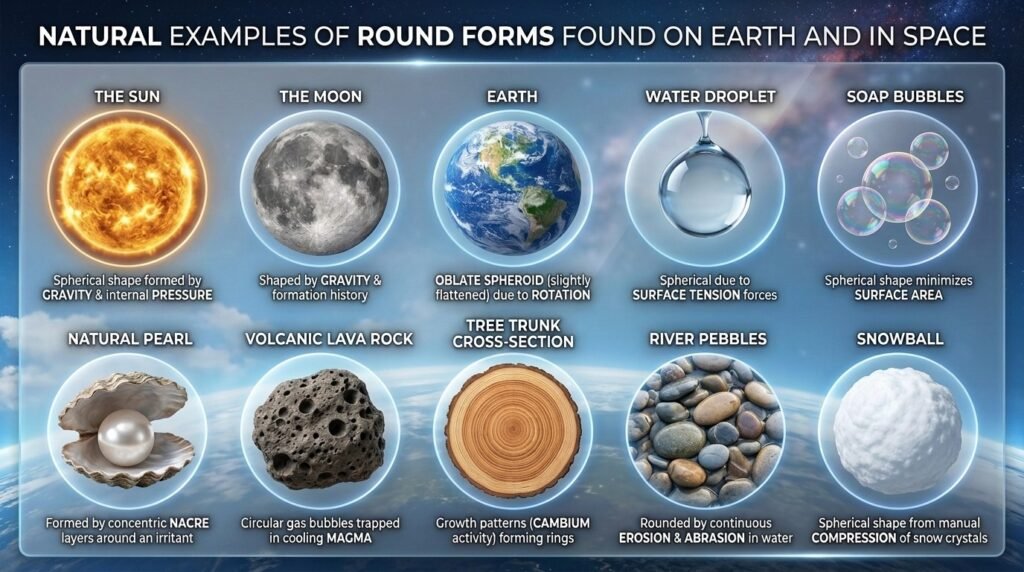
- Sun – The Sun appears spherical because gravity pulls its massive amount of gas evenly toward its center.
- Moon – Earth’s Moon has a nearly circular shape because its own gravity shaped it over billions of years.
- Earth – Our planet is a slightly flattened sphere caused by rotation and gravity.
- Water Droplet – Surface tension pulls water molecules together, creating a circular droplet shape.
- Pearl – Natural pearls often develop a smooth spherical shape inside oysters.
- Bubbles – Soap bubbles form spheres because this shape uses the least surface energy.
- Volcanic Lava Bubble – Cooling lava can trap gases and create circular cavities.
- Tree Rings – Growth patterns inside tree trunks form circular layers that record age and environmental changes.
- Pebbles – River stones become smooth and curved after years of erosion.
- Snowballs – Packed snow naturally forms a ball-like shape because pressure compresses loose flakes.
Birds With Round Features
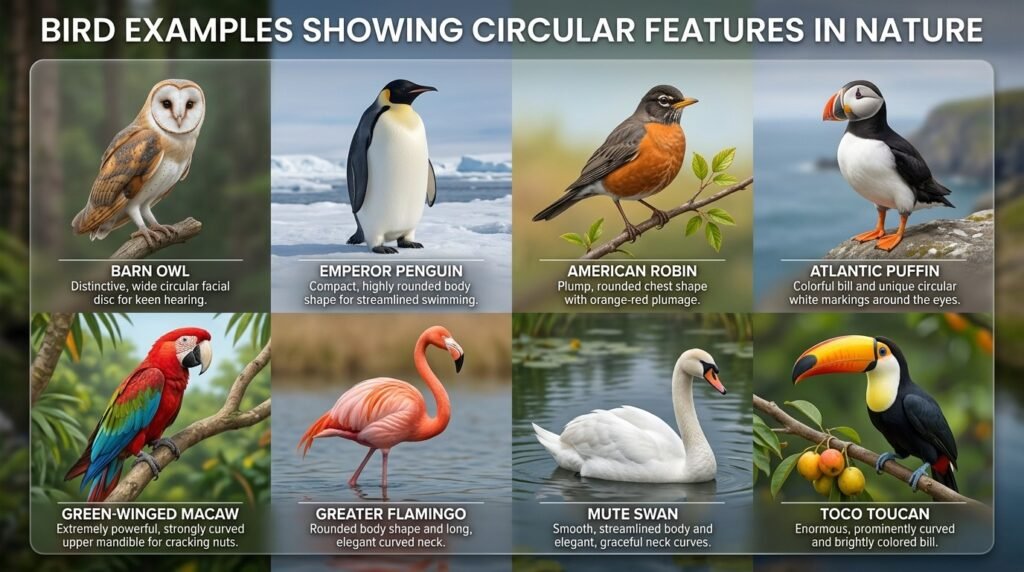
- Owl – Owls have large circular facial discs that help direct sound toward their ears.
- Penguin – Penguins have compact bodies that help conserve heat in cold environments.
- Robin – Robins have curved bodies and a rounded chest shape.
- Puffin – Puffins have a compact body and colorful circular eye markings.
- Parrot – Many parrots have curved beaks designed for cracking seeds and nuts.
- Flamingo – Flamingos have rounded bodies and curved neck structures.
- Swan – Swans are known for smooth body shapes and graceful curves.
- Toucan – Toucans have a large curved bill that balances their body structure.
Animals With Circular Shapes or Features
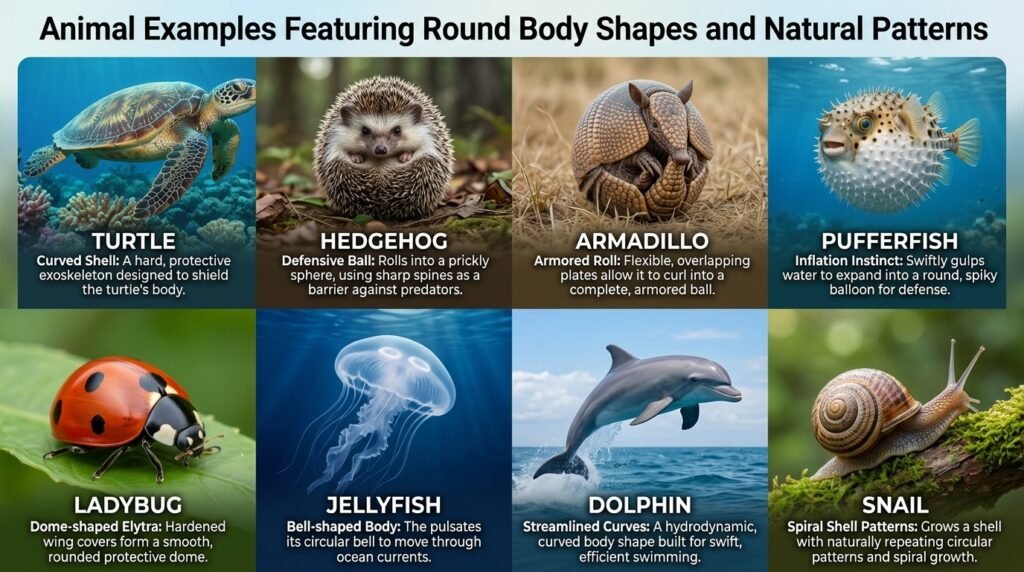
- Turtle – A turtle’s shell protects it with a curved protective structure.
- Hedgehog – When threatened, hedgehogs curl into a ball-like shape.
- Armadillo – Armadillos can roll into a protective shape using their armored plates.
- Pufferfish – Pufferfish expand their bodies into a balloon-like form when threatened.
- Ladybug – Ladybugs have a small curved shell with a dome-like appearance.
- Jellyfish – Many jellyfish species have circular bell-shaped bodies.
- Dolphin – Dolphins have smooth curved bodies designed for efficient swimming.
- Snail – Snail shells often develop spiral patterns with circular curves.
Everyday Objects
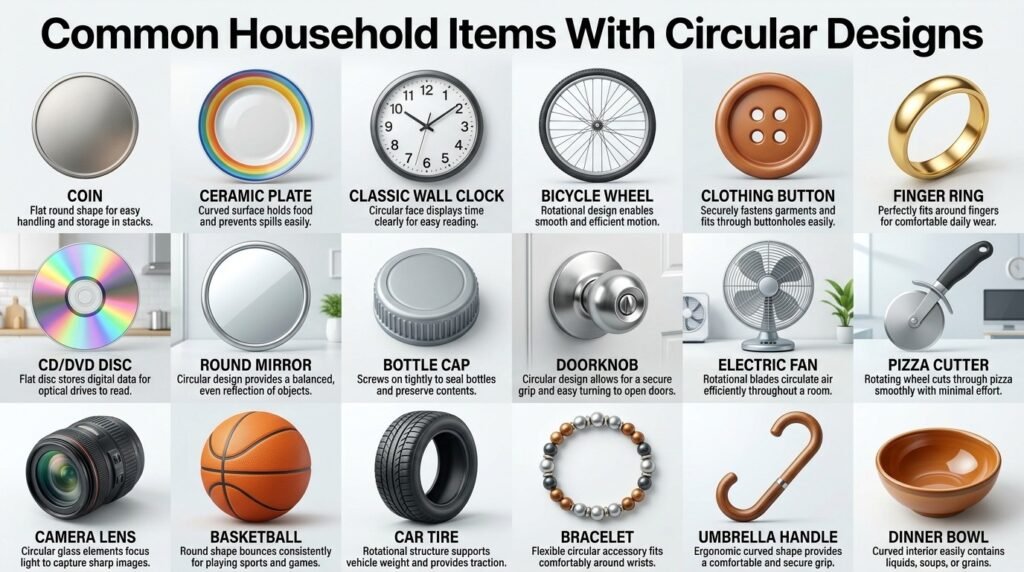
Many everyday objects use circular designs because they are easy to move, stack, rotate, or manufacture. The shape is also visually pleasing and familiar.
- Coin – Coins are commonly made circular because they are easy to handle and recognize.
- Plate – Plates often use a circular design for practical food serving.
- Clock – Traditional clocks commonly feature circular faces for easy reading.
- Wheel – Wheels use a circular shape to create smooth movement.
- Button – Clothing buttons are often small circles because they are simple and durable.
- Ring – Rings are designed in a circular form to fit around fingers.
- CD or DVD – Discs use a circular design to spin evenly in players.
- Mirror – Decorative mirrors often use circular frames for visual balance.
- Bottle Cap – Caps are commonly circular because they twist easily.
- Doorknob – A curved knob allows comfortable gripping and turning.
- Fan Blade Hub – Many fans rotate around a central circular point.
- Pizza Cutter – The rotating blade works because of its circular movement.
- Camera Lens – Lenses often appear circular because they control light entering the camera.
- Basketball – The ball shape allows predictable bouncing and movement.
- Tire – Tires are designed for continuous rolling on roads.
- Bracelet – Bracelets often follow the shape of the wrist.
- Umbrella Handle – Many umbrella handles use curved designs for comfort.
- Dinner Bowl – Bowls commonly have curved surfaces for holding liquids.
Food Examples
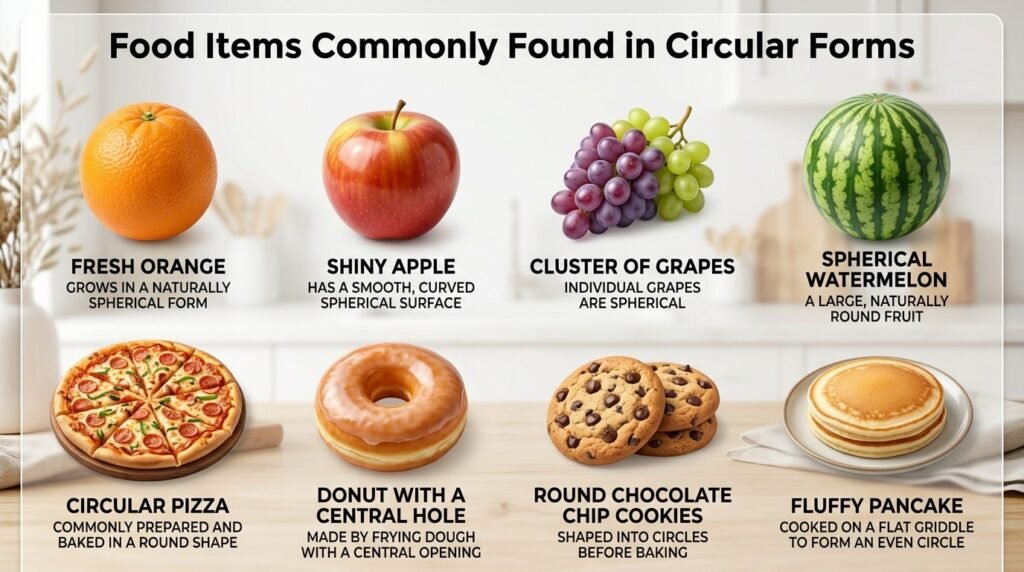
Food often uses circular shapes because they are easy to prepare, share, and recognize.
- Orange – This citrus fruit naturally grows with a spherical shape.
- Apple – Many apple varieties develop a curved, compact form.
- Grapes – Individual grapes are naturally small spheres.
- Watermelon – Some watermelon varieties grow into large spherical fruits.
- Pizza – Pizza is traditionally prepared in a circular shape for easy slicing.
- Donut – Donuts have a circular shape with a hole in the center.
- Cookie – Many cookies are shaped into circles before baking.
- Pancake – Pancakes often become circular because batter spreads evenly.
Fun fact: The hole in a donut helps heat reach the center more evenly during cooking.
Science and Technology
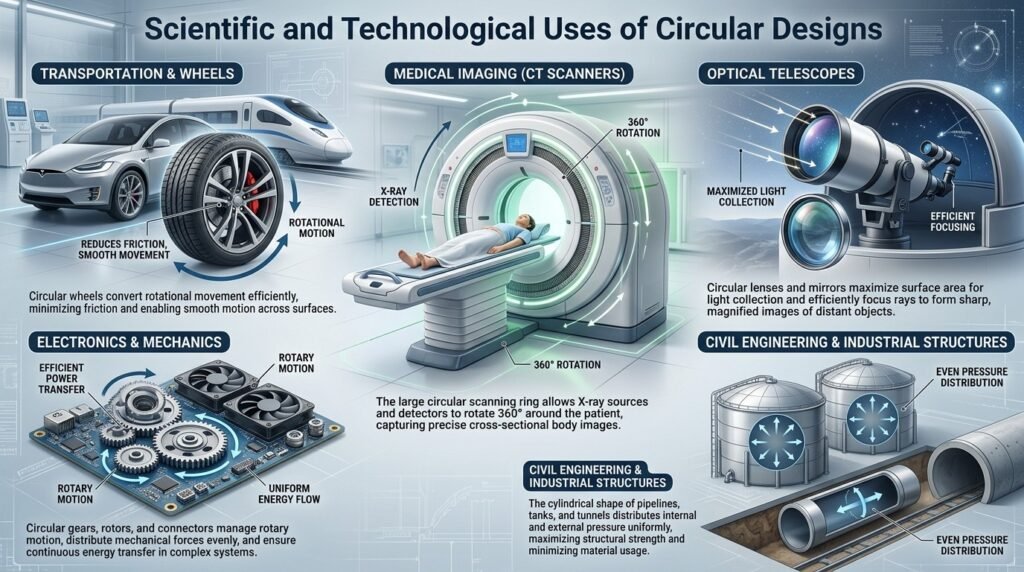
1. Wheels and Transportation
Vehicles rely on circular wheels because they convert rotational movement into efficient forward motion.
2. Medical Imaging
Machines such as CT scanners use circular structures to collect detailed images of the human body.
3. Telescopes
Many telescope lenses and mirrors use circular designs to gather and focus light.
4. Electronics
Many electronic components use circular parts because they rotate, connect, or distribute energy efficiently.
5. Engineering Structures
Pipes, tunnels, and tanks often use circular designs because they handle pressure effectively.
Sports and Recreation
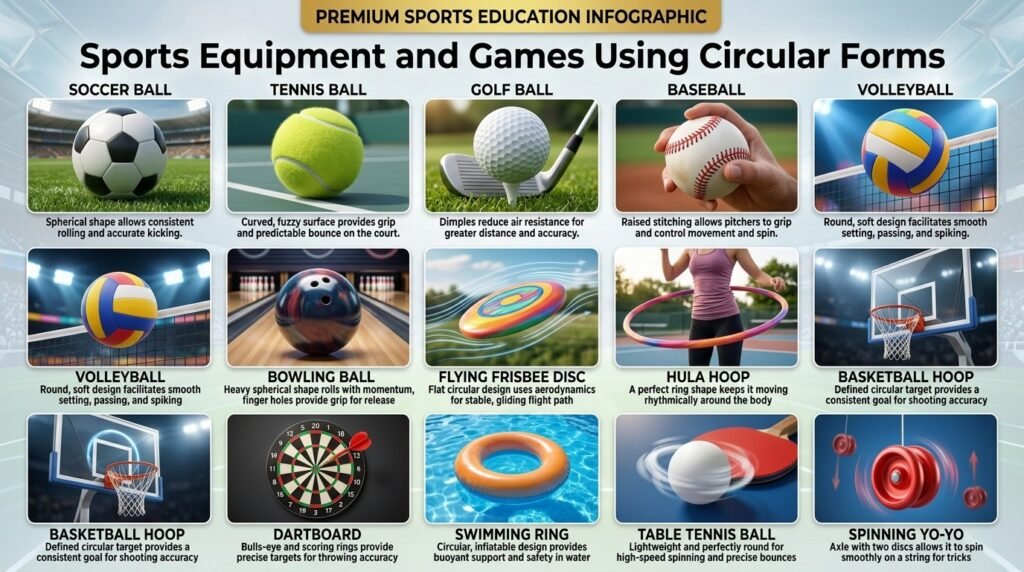
- Soccer Ball – A soccer ball uses a spherical design for balanced movement.
- Tennis Ball – Its curved surface allows predictable bouncing.
- Golf Ball – Dimples on the surface improve flight performance.
- Baseball – The ball shape allows pitching, hitting, and throwing.
- Volleyball – A curved form supports different playing techniques.
- Bowling Ball – Its heavy spherical design helps players roll it accurately.
- Frisbee – The circular disc shape helps it glide through the air.
- Hula Hoop – A circular ring rotates around the body during play.
- Basketball Hoop – The ring design creates a clear target.
- Dartboard – The circular board allows organized scoring sections.
- Swimming Ring – Inflatable rings help people float.
- Table Tennis Ball – The small ball shape creates fast movement.
- Yo-Yo – Circular discs allow controlled spinning motion.
Why Industries and Branding Prefer Circular Designs
Image Caption: Circular Shapes in Business, Design, and Branding
Companies often choose circular logos and designs because they can communicate positive ideas such as:
- Friendliness – Curved shapes often feel welcoming.
- Trust – Smooth forms can suggest reliability and stability.
- Connection – Circles can represent community and unity.
- Movement – Circular designs can suggest progress and energy.
- Simplicity – Clean shapes are easy to recognize.
Industries such as technology, automotive, food, and entertainment frequently use circular symbols because they are memorable and visually balanced.
Interesting Facts About Circular Forms
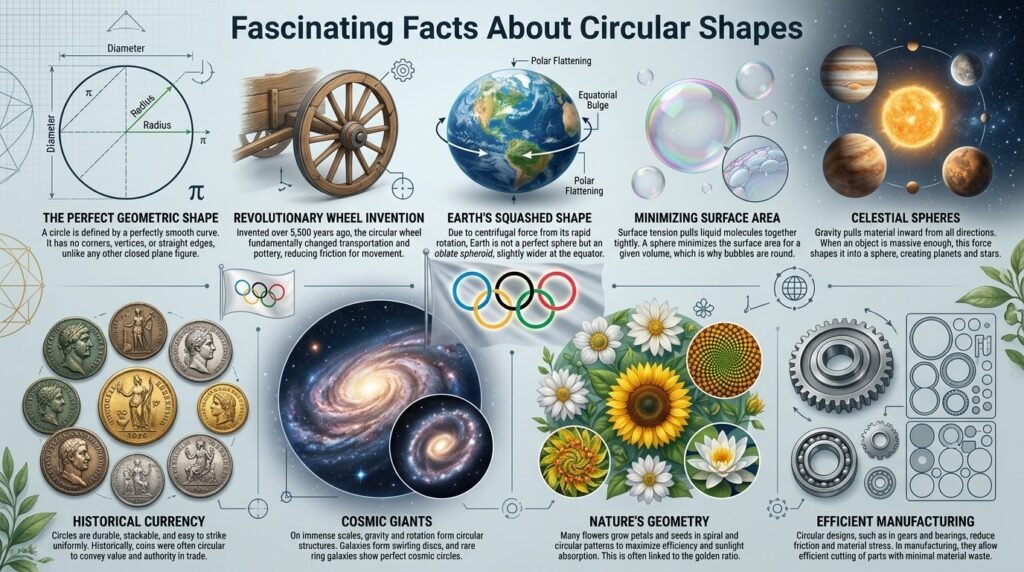
- A circle has no corners or edges.
- The wheel is considered one of the most important inventions in human history.
- Earth is not a perfect sphere because rotation slightly changes its shape.
- Bubbles naturally become spheres because of surface tension.
- Many planets and stars appear circular because gravity pulls matter inward.
- The Olympic rings are a famous example of circular symbolism.
- Ancient coins were often circular because they were easier to carry.
- The largest known structures in space can appear circular due to gravity.
- Many flowers grow in patterns based on circular arrangements.
- Circular designs often reduce wasted material in manufacturing.
Educational Importance of Learning About Things That Are Round
Learning about things that are round helps children develop observation skills, vocabulary, and scientific thinking. Students can connect geometry with real-world examples by exploring nature, objects, and technology.
This topic also encourages curiosity because children can discover shapes in their homes, classrooms, and outdoor environments.
FAQs About Circular Objects
1. Why are planets round?
Planets become spherical because gravity pulls their material equally toward the center.
2. Why are bubbles round?
Bubbles form spheres because surface tension creates the smallest possible surface area.
3. Why are wheels circular?
Wheels use a circular design because it allows smooth rolling with less resistance.
4. Why do fruits grow in curved shapes?
Many fruits develop curved forms because of natural growth patterns and internal structures.
5. Why are coins usually circular?
Coins are often circular because they are easy to handle and produce without sharp corners.
6. Why do scientists study circular shapes?
Scientists study these shapes because they appear in physics, biology, astronomy, and engineering.
Final Thoughts
From galaxies in space to simple household items, things that are round show how nature and human creativity often follow patterns of balance and efficiency. These shapes connect science, design, and everyday experiences in fascinating ways.
Exploring circular objects helps us notice the hidden geometry around us and understand why certain forms appear again and again throughout the world.