When it comes to unusual English expressions, sling your hook meaning can seem confusing because the phrase does not refer to a real fishing hook. It is an informal way to tell someone to leave. The expression often sounds humorous, sharp, or slightly rude, depending on the situation. You may hear it in British English, especially in casual conversations, films, books, and older forms of speech.
What Is the Sling Your Hook Meaning?
The basic meaning of sling your hook meaning is “go away,” “leave,” or “get out.” It usually tells another person that they should stop staying in a place or situation.
The phrase is informal and direct. It does not usually sound polite. A speaker may use it when they feel annoyed, want someone to leave, or simply want to make a playful joke.
For example:
“You have been sitting here all afternoon. Sling your hook!”
In this sentence, the speaker wants the listener to leave. The words do not suggest that the person should literally throw a fishing hook.
The phrase can also appear more lightly between friends:
“Come on, sling your hook. The movie is about to start.”
Here, the expression may sound teasing rather than seriously hostile.
The meaning depends heavily on tone. A person who says it with a smile may simply be joking. Someone who says it angrily may be ordering another person to leave.
Is “Sling Your Hook” Rude?
Sling your hook can sound rude because it gives a strong command to leave. However, it is often less aggressive than some harsher phrases.
The expression has a colorful and somewhat old-fashioned feel. That quality can make it sound humorous in modern conversations. Still, you should consider your relationship with the listener before using it.
It may work between close friends who understand each other’s humor. It can also appear in fictional dialogue when a writer wants to show an impatient or lively character.
It is less suitable for formal situations. You would normally avoid it when speaking to a manager, customer, teacher, client, or someone you do not know well.
Instead, use a softer phrase such as:
- “Could you please leave?”
- “Would you mind heading out?”
- “I think it is time to go.”
- “Could you give me some space?”
- “Please leave when you can.”
These alternatives communicate the same basic idea without the strong informal tone.
Sling Your Hook Meaning in Everyday English
In everyday English, the phrase means that someone should leave a particular place or stop hanging around. It can describe a direct command or a playful suggestion.
Imagine a shop owner notices a friend standing around after closing time. The owner might say:
“We are closing now, so sling your hook!”
The listener understands that it is time to leave.
The phrase can also describe leaving quickly:
“We heard the police were coming, so we slung our hooks.”
This use changes the grammatical form. Instead of telling someone else to leave, the speaker describes their own departure.
The expression therefore has two common patterns:
Command:
“Sling your hook!”
Past-tense description:
“We slung our hooks and went home.”
The plural form hooks may appear when talking about several people. However, the singular expression is common when addressing one person.
What Does “Sling” Mean Here?
The verb sling has several meanings in English. It can mean to throw, carry, hang, or move something quickly. In this expression, it contributes to the idea of moving away.
A hook can also suggest fishing equipment. Because of this, learners sometimes imagine that the phrase describes throwing a fishing hook.
English idioms often work this way. Their individual words may have clear meanings, but the complete phrase develops a separate meaning.
For example:
- “Break the ice” does not normally mean breaking frozen water.
- “Hit the road” does not mean physically hitting a road.
- “Spill the beans” does not mean dropping beans.
- “Sling your hook” does not mean throwing a fishing hook.
Learning the whole expression is therefore more useful than translating each word separately.
Where Did “Sling Your Hook” Come From?
The exact history of sling your hook meaning is not completely certain, so it is better to avoid claiming one definite origin.
The expression has strong associations with British informal speech. Its wording likely draws on the idea of removing or throwing away a hook and moving on. Fishing imagery may have helped give the phrase its colorful character.
The phrase belongs to a wider group of English expressions that use movement to express departure. English has many such phrases, including “hit the road,” “move along,” and “be off.”
Its continued appearance in British books, television, films, and casual speech has helped preserve it. Modern speakers may use it partly because it sounds funny or old-fashioned.
How to Use “Sling Your Hook” in a Sentence
Understanding sling your hook meaning becomes easier when you see it in different situations. The sentence pattern is simple, but the tone can change depending on the context.
Here are several examples:
“It is getting late, so sling your hook and get home.”
This is a direct command. The speaker wants the listener to leave.
“The manager told the noisy customers to sling their hooks.”
This sentence reports that someone ordered other people to leave.
“We finished our work and slung our hooks before the rain started.”
Here, the phrase describes people leaving.
“Come on, sling your hook. I need to lock the office.”
This could sound mildly annoyed but not necessarily hostile.
“He saw the storm coming and slung his hook.”
This means he left quickly because he saw the storm approaching.
The phrase can therefore work in dialogue, narration, informal storytelling, and humorous writing.
Examples in Friendly Conversations
Friends sometimes use strong expressions without intending serious offense. Context and tone matter greatly.
For example:
“You have eaten all my snacks. Now sling your hook!”
If said with laughter, this can sound playful.
Another example is:
“Sling your hook, mate. I have got work to finish.”
The word “mate” can make the sentence feel more familiar. Still, the phrase remains informal.
You should not assume that every listener will find it funny. Someone unfamiliar with the expression may interpret it as a genuine command.
Examples in Angry Situations
The phrase can also carry irritation.
“You have caused enough trouble. Sling your hook!”
Here, the speaker clearly wants the other person to leave. The phrase may sound dismissive or confrontational.
This shows why idioms should not be judged only by dictionary meaning. The same words can feel friendly, humorous, impatient, or hostile depending on the speaker’s voice and the situation.
Sling Your Hook Meaning vs. Similar Expressions
The phrase has many English alternatives, but they do not all have the same tone. Choosing the right expression depends on how direct or polite you want to sound.
| Expression | Basic meaning | Typical tone |
| Sling your hook | Leave or go away | Informal, direct |
| Go away | Leave | Direct |
| Move along | Continue elsewhere | Firm but less personal |
| Head off | Leave | Neutral and casual |
| Take off | Leave | Casual |
| Hit the road | Leave | Informal |
| Get out | Leave immediately | Strong |
| Be off | Leave | Informal, sometimes old-fashioned |
| Could you leave? | Leave | Polite when phrased calmly |
The important difference is not the basic action. Most of these expressions communicate departure. The difference lies in attitude, formality, and emotional strength.
For example, “Could you please leave?” sounds much more suitable for a formal setting than “Sling your hook!”
“Sling Your Hook” vs. “Hit the Road”
Both expressions can tell someone to leave, but they have different flavors.
“Hit the road” is widely understood in modern English and can sound casual. “Sling your hook” has a stronger British and old-fashioned character.
Compare:
“We have finished here, so hit the road.”
“We have finished here, so sling your hook.”
The first sounds more broadly familiar. The second sounds more colorful and distinctly informal.
“Sling Your Hook” vs. “Get Out”
“Get out” is much more direct and can sound angry. It can also mean leaving a building or escaping a place.
“Sling your hook” can express annoyance, but it often has a humorous or playful edge.
For example:
“Get out of my house!”
This sounds forceful.
“Sling your hook and let me finish my dinner!”
This can sound lighter, especially between friends.
Still, both expressions can become harsh when spoken angrily.
When Should You Use “Sling Your Hook”?
Knowing sling your hook meaning is only part of learning the phrase. You also need to know when it is appropriate.
The expression generally works best in casual settings where informal language feels natural.
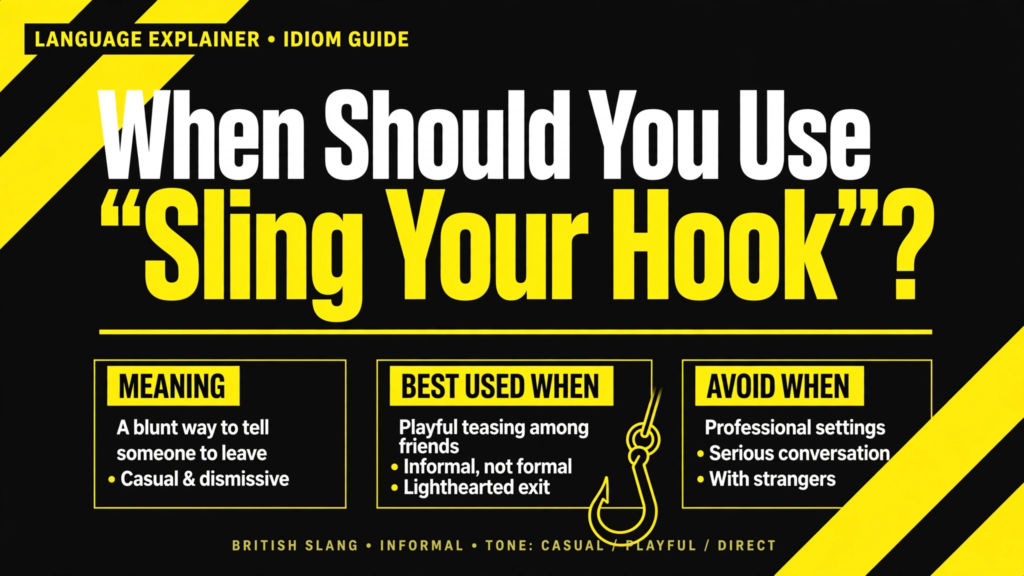
You might use it when:
- Talking with close friends
- Writing humorous dialogue
- Discussing British slang
- Creating a fictional character
- Making a playful comment
- Describing someone leaving in an informal story
You should think twice before using it when:
- Speaking with a customer
- Talking to your employer
- Addressing a teacher
- Speaking to a stranger
- Writing a formal email
- Handling a serious workplace issue
- Asking someone to leave in a sensitive situation
A simple rule helps: if you would normally use polite language, do not choose this phrase.
Can You Use It at Work?
It depends on the workplace and your relationship with the people involved.
Among close colleagues, a joking use may be understood. For example:
“It is Friday afternoon. Sling your hook and enjoy the weekend!”
Even then, the speaker relies on a friendly relationship and a playful tone.
In a formal workplace message, however, it would be safer to say:
“Please head out when you are finished.”
or:
“You can leave once the meeting ends.”
The goal is not to avoid colorful English altogether. The goal is to match the expression to the situation.
Common Mistakes With “Sling Your Hook”
Learners often make mistakes because the phrase looks literal. The most common problem involves translating every word separately.
Mistake 1: Taking It Literally
Someone may think the phrase means throwing a fishing hook.
That interpretation misses the idiomatic meaning. The complete expression means leaving or telling someone to leave.
Mistake 2: Using It in Formal Writing
A learner might write:
“Please sling your hook from the meeting.”
This sounds unusually informal and may even sound rude.
Formal writing usually needs clearer and more respectful language.
Mistake 3: Assuming It Is Always Funny
The phrase can sound humorous, but it can also sound irritated.
Tone, relationship, and context all affect how listeners understand it.
Mistake 4: Using It With Everyone
An idiom that works with a close friend may not work with a stranger.
Before using informal slang, consider who is listening and what relationship you have with that person.
Mistake 5: Confusing It With “Sling Your Hooks”
Both singular and plural forms can appear, but the context determines the correct form.
When speaking to one person directly, you commonly see:
“Sling your hook!”
When describing several people leaving, you may see:
“They slung their hooks.
The grammatical form changes with the subject and sentence structure.
Is “Sling Your Hook” Still Used Today?
Sling your hook meaning remains understandable, but its use is more limited than everyday phrases such as “go away,” “leave,” or “head out.”
It survives partly because idioms can remain useful even when they become less common in ordinary speech. Writers may use the phrase to create a particular voice or mood.
For example, a British character in a novel might say:
“You have got what you came for. Now sling your hook.”
The phrase immediately gives the dialogue an informal and somewhat colorful quality.
Modern speakers may also use it jokingly because it sounds distinctive. A person who wants to sound playful may deliberately choose an expression that feels old-fashioned.
This is common with many idioms. Language does not replace every older expression at once. Some phrases remain alive because they offer a style or emotional effect that simpler words cannot provide.
How to Respond When Someone Says “Sling Your Hook”
Your response depends on the speaker’s tone and your relationship.
If a friend says it jokingly, you might respond:
“All right, all right. I am going!”
If someone says it seriously, you can simply leave if appropriate.
If you feel that the expression was rude, you could calmly say:
“You could ask me more politely.”
The phrase itself does not tell you exactly how the speaker feels. Their facial expression, voice, and surrounding conversation provide important clues.
English learners should therefore listen to the complete situation rather than focusing only on the words.
Why English Uses So Many Expressions for Leaving
English has a rich collection of informal phrases for movement and departure. These expressions often make speech more vivid.
Instead of saying only:
“Leave.”
People can say:
- “Head off.”
- “Move along.”
- “Take off.”
- “Hit the road.”
- “Be off.”
- “Make a move.”
- “Clear out.”
- “Sling your hook.”
These phrases can express different degrees of urgency, humor, friendliness, or irritation.
Idioms also help speakers show personality. A character who says “sling your hook” may sound different from one who simply says “please leave.”
This makes idioms useful for storytelling. They can communicate both information and character.
Frequently Asked Questions
What is the sling your hook meaning?
The phrase means “go away,” “leave,” or “get out.” It is an informal expression, often associated with British English. Depending on tone, it can sound humorous, teasing, impatient, or rude.
Is “sling your hook” an insult?
Not necessarily. The phrase is mainly a command or request for someone to leave. However, its direct wording can sound rude when spoken seriously or angrily.
Is “sling your hook” British slang?
Yes. It is strongly associated with informal British English. People outside Britain may recognize it through books, television, films, or exposure to British expressions.
Can I use “sling your hook” with friends?
You can use it with friends when the relationship supports playful or informal language. However, consider the person’s sense of humor because the expression can still sound dismissive.
What is another way to say “sling your hook”?
Depending on the situation, you can say “go away,” “move along,” “head off,” “take off,” “hit the road,” or “be off.” For polite situations, say “Could you please leave?” instead.
Final Thoughts
Understanding sling your hook meaning gives English learners another useful example of how idioms differ from literal language. The phrase means “leave” or “go away,” and it usually carries an informal tone. It is strongly linked with British English and can sound humorous, playful, impatient, or rude depending on the speaker and situation.
The key point is context. You would not normally use this expression in a formal email or a serious professional conversation. With close friends or in humorous dialogue, however, it can add personality and color to a sentence.