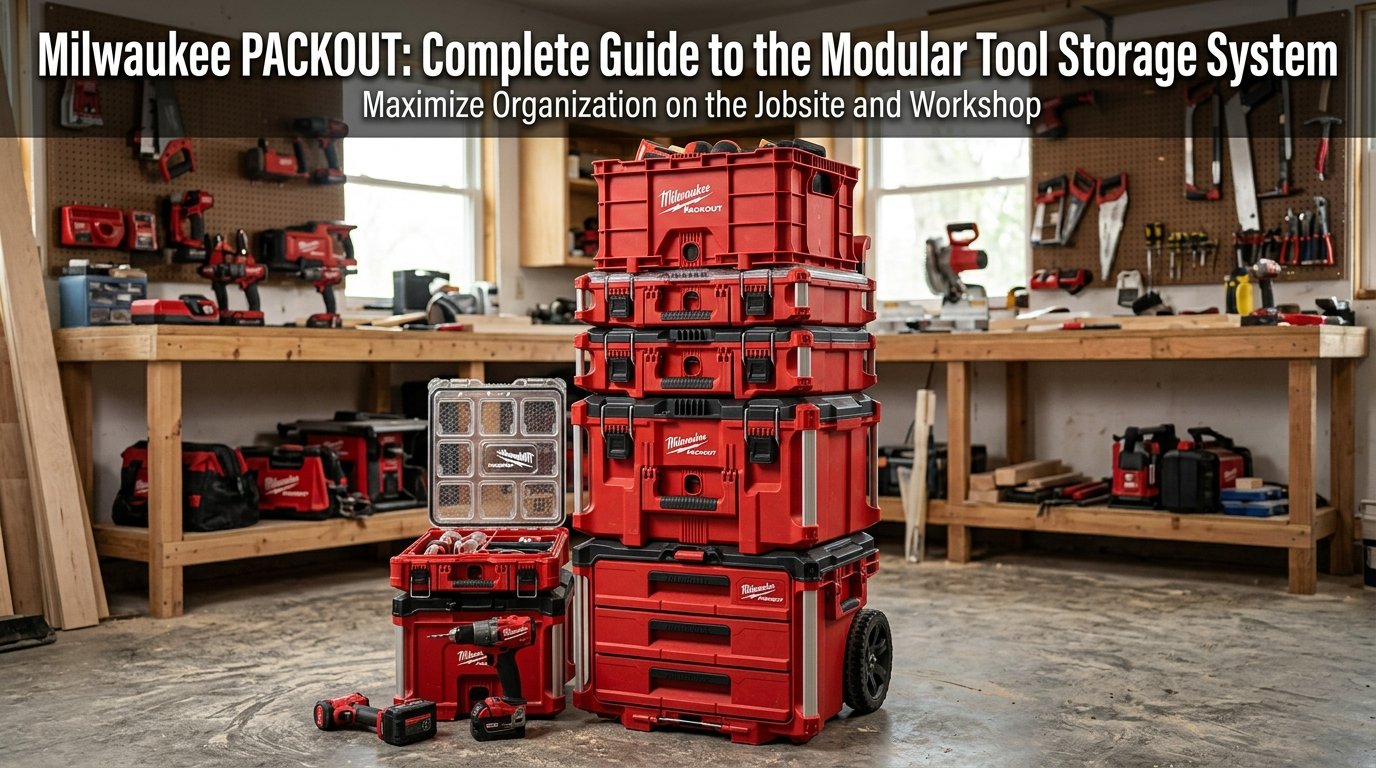
Milwaukee PACKOUT has become a popular modular storage choice for contractors, tradespeople, DIY users, technicians, and anyone who needs a dependable way to move and organize tools. Instead of relying on one large toolbox, the system lets users combine tool boxes, organizers, crates, bags, totes, rolling storage, racks, and mounting solutions into a setup that matches their workflow. This guide explains how the system works, which components matter most, how to build a practical setup, and where its strengths and limitations appear. You will also learn how to choose between organizers, rolling boxes, crates, drawers, and wall-mounted options without buying more storage than you actually need.
What Is Milwaukee PACKOUT?
Milwaukee PACKOUT is a modular storage platform designed around connected storage components that can be stacked, transported, mounted, and rearranged according to different jobsite and workshop needs.
The core idea is simple: instead of carrying several unrelated boxes, users can connect compatible storage units into one organized system. Milwaukee describes the platform as a modular storage system for transporting and organizing tools at jobsites, in transit, and in shops.
The system includes many different storage formats, including:
- Rolling tool boxes
- Standard tool boxes
- Rolling drawer boxes
- Organizers
- Low-profile organizers
- Crates
- Compact crates
- Totes
- Tool bags
- Backpacks
- Racks
- Wall plates
- Hooks and holders
- Drinkware and coolers
- Tool box attachments
This variety is important because different trades need different storage approaches. An electrician may prioritize small organizers for connectors and fittings. A carpenter may need larger boxes for drills, saws, batteries, and accessories. A service technician may prefer drawers and compact cases for fast access.
The system also allows users to expand gradually. You can begin with a rolling base and one or two storage boxes, then add organizers or specialty storage later.
That modular approach separates it from a traditional toolbox. You are not locked into one fixed interior layout.
How Milwaukee PACKOUT Works
The connection system allows compatible storage components to lock together, creating a stack that can move as one unit while still allowing users to customize the arrangement around specific tools and materials. A typical setup starts with a rolling toolbox or another suitable base. Additional boxes, organizers, or bags connect above it. The result creates a vertical storage tower that can be moved around a worksite.
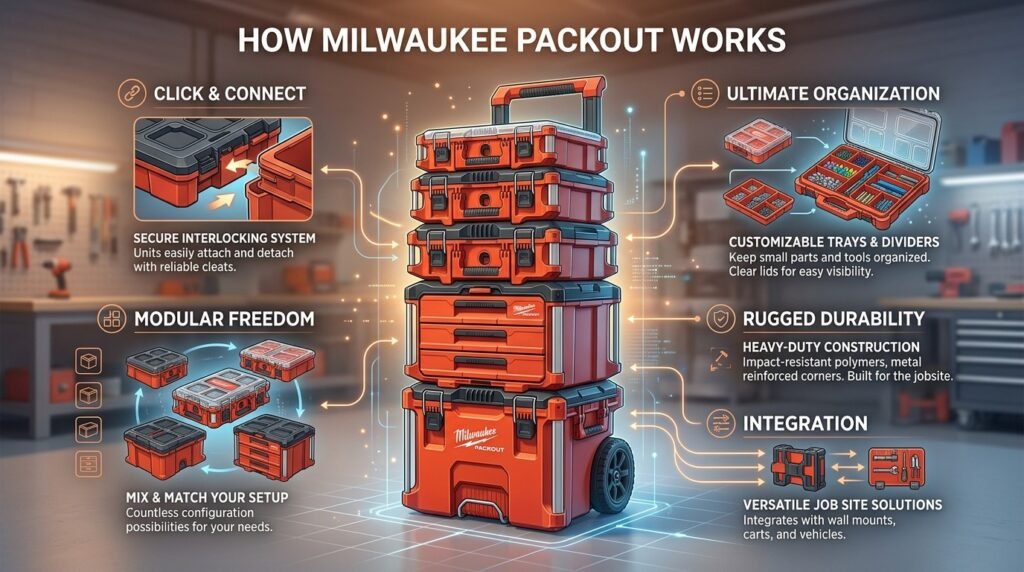
The rolling tool box is particularly useful for transporting heavier loads. Milwaukee lists a 250-pound capacity for its PACKOUT rolling tool box, along with 9-inch all-terrain wheels, an industrial-grade extension handle, impact-resistant construction, and an IP65-rated weather seal.
The Interlocking Design
The locking connection is one of the main reasons users choose PACKOUT over ordinary storage containers. Compatible components can attach securely to each other, helping prevent individual boxes from separating during transportation.
This design creates several practical advantages:
- One transport point: Multiple boxes can move together.
- Flexible organization: Each box can serve a different purpose.
- Easy expansion: Additional components can be added later.
- Better separation: Small parts stay away from larger power tools.
- Job-specific setups: Users can create different stacks for different tasks.
The system is particularly useful when a worker regularly moves tools between a workshop, vehicle, and jobsite.
Choosing the Right Starting Point
New users should avoid buying a large collection immediately. Start by identifying what you carry every day and what creates the biggest organization problem.
A practical starter setup might include:
- One rolling storage base
- One large toolbox
- One organizer for small accessories
- One compact case for frequently used tools
From there, you can add storage based on actual needs.
This approach reduces unnecessary spending and keeps the final system easier to manage.
Best Milwaukee PACKOUT Components for Different Jobs
The best component depends on the size of your tools, the amount of small hardware you carry, and how often you need to move everything between vehicles, workshops, and job sites.
Rolling Tool Boxes
Rolling boxes work best as the foundation for mobile setups because wheels and an extension handle make heavy stacks easier to transport across uneven surfaces.
The rolling tool box uses impact-resistant polymers, metal-reinforced corners, heavy-duty latches, and an IP65-rated weather seal. Milwaukee also includes an interior organizer tray for smaller equipment.
This style makes sense for:
- General contractors
- Electricians
- Plumbers
- HVAC technicians
- Remodelers
- Maintenance workers
- Construction crews
A rolling base becomes especially valuable when a stack contains batteries, power tools, hand tools, accessories, and other heavy equipment.
Tool Boxes
Standard tool boxes provide enclosed storage for larger tools and equipment that do not fit efficiently inside shallow organizers.
They work well for drills, impact drivers, grinders, hand tools, batteries, chargers, and job-specific equipment.
A large box can also serve as a transition point between heavy equipment and smaller organizers. For example, you could keep power tools inside the main box while placing screws, drill bits, anchors, and blades inside an organizer above it.
Organizers
Organizers are ideal for small parts. Screws, nuts, washers, electrical connectors, drill bits, anchors, blades, and other accessories become much easier to locate when they have dedicated compartments.
The standard organizer includes removable bins, a transparent lid, heavy-duty latches, and an IP65-rated weather seal. Milwaukee also states that the lid design helps prevent contents from moving between compartments during transport.
That last feature matters more than it might seem. Small hardware can become difficult to manage when separate compartments allow pieces to mix together.
Low-Profile Organizers
Low-profile organizers provide shallow storage for smaller accessories while consuming less vertical space.
Milwaukee’s low-profile organizer includes removable bins and dividers, a clear lid, reinforced hinges, and an IP65-rated weather seal. Its shallow design suits small parts that do not need a deep container.
These organizers are useful for:
- Drill bits
- Driver bits
- Fasteners
- Electrical terminals
- Small plumbing fittings
- Anchors
- Blades
- Measuring accessories
They also make useful top-level storage because you can often identify the contents without opening multiple deep boxes.
Crates
Crates offer open or semi-open access when speed matters more than complete enclosure. They are useful for frequently accessed tools and materials that workers grab repeatedly throughout the day.
The PACKOUT crate uses an impact-resistant polymer body and can connect with other system components. Milwaukee lists a 50-pound capacity for its full-size crate and provides options for stacking or wall mounting.
Crates work particularly well for:
- Extension cords
- Hand tools
- Plumbing supplies
- Caulking materials
- Spray bottles
- Frequently used accessories
The main advantage is accessibility. You do not need to repeatedly open and close a traditional box.
Compact Crates
Compact crates provide a smaller alternative for users who want quick access without carrying a large open container.
The compact version includes a wide front opening, a metal-reinforced handle, customizable dividers, and a 30-pound weight capacity.
They can be useful for a smaller daily tool load or for organizing one particular category of equipment.
Milwaukee PACKOUT for Jobsite Organization
A well-planned PACKOUT setup can turn a mixed collection of tools into a logical workflow where frequently used equipment stays accessible, and specialized equipment remains protected until needed.
Consider an electrician who regularly performs residential service calls. Carrying everything in one box creates several problems. Wire connectors can disappear beneath hand tools. Drill bits can mix with fasteners. Test equipment can become difficult to reach.
A modular setup solves those problems by assigning each storage level a role.
For example:
Rolling base: Heavy equipment and larger tools.
Middle toolbox: Drills, impact drivers, batteries, and chargers.
Organizer: Wire connectors, screws, anchors, terminals, and small fittings.
Top organizer: Frequently used bits and accessories.
This arrangement reduces unnecessary searching.
Organizing by Frequency
A simple rule works well: store the most frequently used items closest to the top.
Items used several times every day should not sit underneath three heavy boxes.
Use the lower sections for:
- Backup tools
- Heavy equipment
- Infrequently used accessories
- Bulk materials
Use upper sections for:
- Drill bits
- Fasteners
- Measuring tools
- Small hand tools
- Daily-use accessories
This approach improves efficiency without requiring complicated labeling systems.
Organizing by Trade
Another method involves creating separate configurations for different jobs.
A carpenter could build a stack around:
- Circular saw accessories
- Drill and impact tools
- Blades
- Fasteners
- Measuring equipment
An HVAC technician could prioritize:
- Electrical connectors
- Diagnostic accessories
- Hand tools
- Fasteners
- Consumable supplies
A plumber might focus on:
- Fittings
- Threading accessories
- Sealants
- Hand tools
- Repair components
The key is to build around workflow rather than simply collecting every available storage component.
Milwaukee PACKOUT for Trucks, Vans, and Workshops
Mobile workers can use modular storage to create a consistent system between their vehicle and jobsite, while workshops can use wall-mounted components and racks to keep equipment organized without wasting floor space.
Vehicle organization is one of the strongest use cases for modular storage. A van can hold multiple configurations without requiring every tool to remain loose on shelves or floors.
The system also includes rack solutions designed for vans, shops, and other storage environments. Milwaukee states that its PACKOUT rack can expand across walls and support connected components while allowing drawer access without unstacking the entire system.
Vehicle Setup Tips
When installing storage in a vehicle, place heavier equipment lower whenever possible. This helps create a more stable arrangement.
Keep frequently accessed items near the door.
For example:
- Daily hand tools → closest access point
- Small parts → organizers
- Heavy power tools → lower boxes
- Backup equipment → deeper storage
- Rarely used accessories → upper or remote areas
Do not build a tall stack simply because the system allows it. A smaller configuration may work better if you frequently load and unload individual components.
Workshop Storage
Wall mounting can turn vertical space into usable storage. PACKOUT mounting plates provide a way to attach compatible components to walls and create a customized storage area.
Milwaukee lists a 150-pound capacity for its large wall plate, along with metal-reinforced mounting tracks and quick-alignment tabs.
This can be valuable in smaller workshops where floor space is limited.
Milwaukee PACKOUT Advantages and Disadvantages
The strongest benefit is flexibility, but that same modular design can encourage users to buy more components than they actually need, increasing both cost and overall system weight.
Major Advantages
Modularity: You can build a configuration around your actual tools.
Durability: Many components use impact-resistant materials designed for demanding environments.
Weather protection: Several enclosed components use IP65-rated sealing, providing protection from rain and jobsite debris when properly closed.
Organization: Separate boxes and bins reduce clutter.
Mobility: Rolling storage makes heavy loads easier to move.
Expansion: You can add components as your tool collection grows.
Vehicle compatibility: Rack and mounting options extend the system beyond basic tool boxes.
Potential Disadvantages
Cost: Building a large modular system can become expensive.
Weight: A fully loaded stack may become difficult to move, even with wheels.
Overbuying: The large selection of components can encourage unnecessary purchases.
Stacking inconvenience: If an item is buried low in a tall stack, you may need to remove components above it.
Space requirements: Large configurations can consume significant vehicle or workshop space.
Brand commitment: Once you invest heavily in one modular ecosystem, switching systems becomes less attractive.
The best solution is therefore not the biggest setup. It is the smallest configuration that solves your organization’s problems effectively.
Milwaukee PACKOUT vs Traditional Tool Boxes
Traditional tool boxes remain useful because they often provide simple, inexpensive storage, while a modular system offers greater flexibility for users who regularly transport different groups of equipment.
A traditional toolbox can be ideal for a homeowner who keeps a basic collection in one workshop. One container may hold screwdrivers, pliers, a hammer, a tape measure, and a few accessories.
A modular system becomes more valuable when your needs change frequently.
| Feature | Modular Storage | Traditional Toolbox |
| Customization | High | Usually limited |
| Expansion | Easy | Often requires another box |
| Small-part organization | Strong with organizers | Depends on internal trays |
| Mobility | Excellent with rolling bases | Varies |
| Vehicle integration | Strong | Basic |
| Wall mounting | Available with compatible components | Less common |
| Initial cost | Can be higher | Often lower |
| Job-specific setups | Very practical | Less flexible |
The right choice depends on how you work.
If your tools stay in one place, a traditional toolbox may be enough. If you transport different tool groups every day, modular storage can provide a more useful long-term structure.
How to Build a Milwaukee PACKOUT Setup
The smartest approach starts with your tools, workflow, and transportation needs rather than starting with a shopping list of storage products.
Begin by making three categories:
Daily-use tools: Items you reach for constantly.
Occasional tools: Equipment needed for particular jobs.
Consumables: Fasteners, blades, bits, connectors, and similar supplies.
Next, determine how you transport your equipment.
If you walk long distances across job sites, rolling storage may provide the greatest benefit. If you work mostly from a van, drawers and organizers can improve accessibility.
A Practical Three-Level Setup
For many users, a simple three-level arrangement provides a strong starting point.
Bottom: Use the rolling base for heavy equipment and larger loads.
Middle: Keep power tools and larger hand tools in the main toolbox.
Top: Store small parts, fasteners, and daily-use accessories in an organizer.
You can expand from there.
Do not automatically add another box whenever you have unused space. Empty capacity can be useful. It prevents the system from becoming unnecessarily heavy.
Label Everything
Clear labeling becomes increasingly important as the system grows.
Use labels based on function rather than vague descriptions.
For example:
- Masonry Bits
- Wood Bits
- Electrical Connectors
- Fasteners
- Blades
- Plumbing Fittings
- Measuring Tools
Good labels reduce searching time and make it easier to return equipment to the correct location.
Common Mistakes to Avoid
Many storage problems come from poor system design rather than inadequate equipment, so planning the layout before purchasing additional components can save money, space, and unnecessary weight.
Buying Too Much Too Soon
A large collection may look impressive, but unused storage does not improve productivity.
Start small and expand only when a genuine storage problem appears.
Making the Stack Too Heavy
A rolling box can carry substantial weight, but that does not mean every trip should involve maximum capacity.
Heavy stacks can become harder to maneuver over stairs, uneven ground, ramps, and narrow work areas.
Ignoring Access Order
If the tool you need most often sits at the bottom, the modular system loses part of its convenience.
Think about access before deciding what goes into each level.
Mixing Small Parts
Do not combine unrelated fasteners simply because they fit in the same bin.
Separate parts by size, type, and application. Transparent lids can make identification faster.
Forgetting Workshop Storage
Many users think only about portable boxes. Wall plates and racks can also help organize fixed work areas and vehicle storage.
Is Milwaukee PACKOUT Worth It?
Milwaukee PACKOUT is worth considering if you regularly transport tools, need modular organization, or want storage that can grow as your equipment collection expands.
The value depends heavily on your workflow.
For a professional contractor who moves tools every day, durable rolling storage, organizers, crates, and vehicle-mounted solutions can provide meaningful convenience.
For a homeowner with a small tool collection, the investment may be harder to justify. A simple toolbox could perform the same basic job for less money.
The strongest case for the system comes from users who have three characteristics:
- Many tools
- Frequent transportation
- A need for organized access
If those conditions describe your work, modular storage can reduce clutter and make tool transportation more predictable.
Frequently Asked Questions
These common questions help clarify how the system works, who benefits most, and what buyers should consider before building a modular storage setup.
Is Milwaukee PACKOUT only for professional contractors?
No. DIY users, hobbyists, maintenance workers, technicians, and serious home workshop owners can also benefit from modular storage, especially when they own many tools.
Can Milwaukee PACKOUT components be mixed and matched?
Yes. The system is designed around modular connectivity, allowing compatible storage components to connect and form customized configurations. Milwaukee offers boxes, organizers, crates, bags, racks, and mounting products within the platform.
Is Milwaukee PACKOUT waterproof?
Individual enclosed products can provide weather protection, but users should check the rating for each specific component. Several organizers and rolling boxes carry an IP65-rated weather seal.
What should I buy first?
Start with storage that solves your biggest problem. For mobile users, a rolling base and toolbox make a practical foundation. Add an organizer if small accessories create clutter.
Can PACKOUT be mounted on a wall?
Yes. Milwaukee offers wall plates and rack solutions that allow compatible components to be organized vertically. Always follow the mounting instructions and rated load limits for the specific product.
Is Milwaukee PACKOUT better than a regular toolbox?
It depends on your needs. A regular toolbox can be cheaper and simpler. Modular storage offers greater flexibility, expansion, transport options, and organization for larger or changing tool collections.
Conclusion
For professionals and serious DIY users, Milwaukee PACKOUT offers more than a collection of tool boxes. It provides a flexible storage ecosystem that can adapt to different jobs, vehicles, workshops, and tool collections. The biggest advantage is the ability to separate tools, accessories, and materials into purpose-built containers while keeping compatible components connected for transportation.
A good setup does not need every available component. Start with the tools you use most, identify where your current organization fails, and select storage that solves those problems. Rolling boxes suit heavy mobile loads, organizers handle small parts, crates provide quick access, and racks or wall plates can improve fixed storage. The system makes the most sense when mobility and organization matter every day. It can also grow with your collection, which makes it easier to adapt as your trade or projects change.