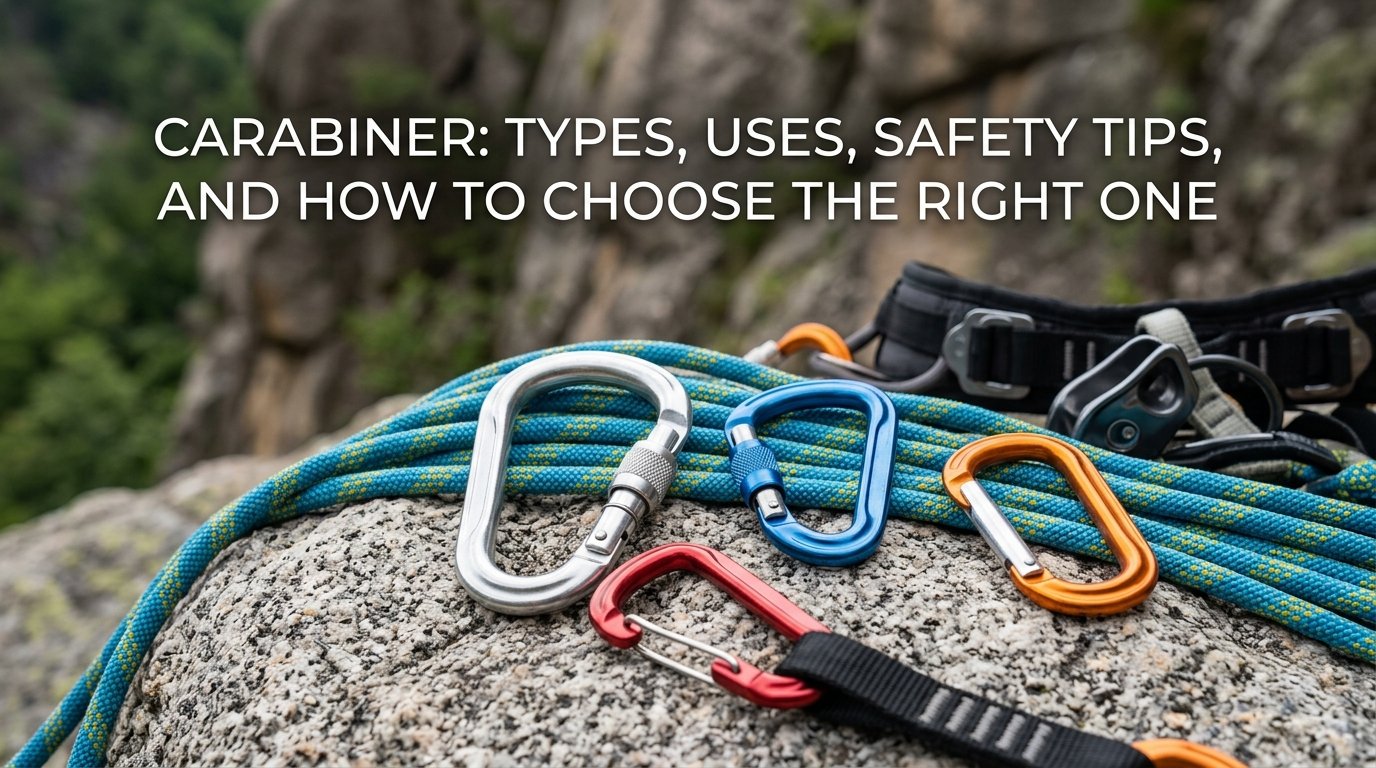
A carabiner is a small connector with a spring-loaded gate, but its role can be much bigger than its size suggests. Climbers use these connectors to link ropes, protection, harnesses, and anchors. Campers may use them for gear organization, while rescue teams rely on certified versions for demanding technical work. Because designs vary widely, choosing the right connector requires more than picking the shape or color you like.
This guide explains what a carabiner is, how it works, the main designs available, where each type fits, and what safety markings mean. You will also learn how aluminum and steel compare, how locking gates differ from non-locking gates, which mistakes to avoid, and how to inspect a connector before use. The goal is simple: help beginners and general outdoor users understand the equipment well enough to make safer, more informed choices.
What Is a Carabiner?
A carabiner is a metal connector designed to join equipment quickly while allowing a gate to open and close. The basic design has a solid body and a movable gate. When the gate is released, a spring normally returns it to the closed position.
The word comes from German and French terms associated with a carbine-carrying soldier, which explains the familiar name Safety connector. Modern versions, however, are strongly associated with climbing and mountaineering.
A connector used for life-safety applications is not simply a convenient clip. It is engineered to handle loads in specific directions and under defined test conditions. Certified climbing equipment is normally marked with strength ratings and standards information.
Main Parts
Although shapes differ, most models include:
- Body: The main load-bearing frame.
- Gate: The movable section that opens for clipping.
- Hinge: The pivot point that lets the gate swing.
- Nose: The end where the gate meets the frame.
- Locking mechanism: Found on locking models and designed to reduce accidental gate opening.
- Spine: The strongest continuous section opposite the gate.
Understanding these parts helps explain why orientation matters. A connector is generally strongest when the load runs along its major axis, with the gate closed and the equipment loaded correctly.
How a Carabiner Works?
The operating principle is straightforward. Press the gate inward, clip the connector onto an appropriate attachment point, and release the gate. The spring closes the opening so the connector can retain the attached item.
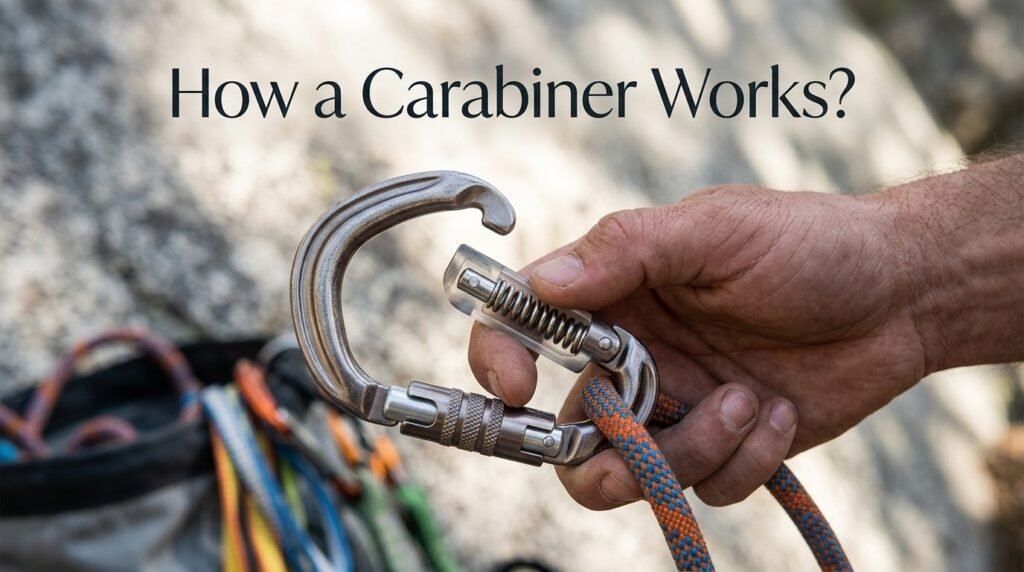
The important detail is that the gate is not intended to carry the primary load. The frame is designed to support the rated load when used in the correct orientation.
In climbing, the connector may be loaded along its major axis, across its minor axis, or against the gate. These positions do not have equal strength. A side-loaded or improperly positioned connector can be significantly weaker than its major-axis rating.
Gate movement also matters. During a fall or sudden movement, vibration and contact can sometimes cause a gate to move or become temporarily open. This is one reason proper clipping technique, equipment selection, and regular inspection are essential.
Major-Axis and Minor-Axis Loading
Manufacturers commonly provide multiple strength ratings. The major-axis rating represents the strongest intended loading direction. Minor-axis and gate-open ratings are lower because the equipment is less capable of handling force in those positions.
For example, if a model is marked with three strength figures, they may correspond to:
- Closed-gate major-axis strength.
- Closed-gate minor-axis strength.
- Open-gate strength.
Always read the markings and instructions for the exact model rather than assuming every connector uses identical ratings.
Types of Carabiners
Different activities call for different designs. The best choice depends on the intended use, required strength, ease of handling, and whether accidental opening must be minimized.
Non-Locking Models
Non-locking versions use a standard spring gate. They are common in climbing quickdraws and other situations where speed matters.
Their main advantages include:
- Fast one-handed clipping.
- Low weight.
- Simple operation.
- Easy visual inspection.
- Good compatibility with many climbing systems.
Their limitation is that the gate is not mechanically locked. That does not make every non-locking model unsafe; it means the user must understand where and how it is appropriate.
Locking Models
Locking versions add a mechanism that helps prevent the gate from opening unintentionally. Common mechanisms include screw-lock, twist-lock, and auto-lock systems.
A locking gate can be especially useful for applications such as:
- Belay connections.
- Attaching certain devices to a harness.
- Anchoring systems.
- Rescue applications when the equipment is specifically rated for that purpose.
- Situations where an unintended gate opening would create serious consequences.
Locking does not mean the connector can be used without checking. The gate must still be fully closed and the mechanism properly engaged.
Screw-Lock Designs
A screw-lock sleeve is manually rotated over the gate. This design is simple and generally easy to understand. It can be useful when the connector does not need frequent opening and closing.
The trade-off is speed. A screw sleeve requires deliberate handling, so it may be slower than an automatic mechanism.
Auto-Lock Designs
Auto-locking gates close and lock through a spring-assisted mechanism. Different products use different sequences, such as twist-and-release or other manufacturer-specific actions.
They can be convenient when repeated secure connections are needed, but users should practice with the exact mechanism before relying on it.
Shapes and Their Uses
Shape influences handling, rope movement, clipping behavior, and how equipment sits inside the frame.
Oval Shape
Oval designs have a balanced profile that keeps gear relatively centered. They are useful for certain equipment-racking tasks and applications where a symmetrical shape is helpful.
D Shape
D-shaped models direct much of the load toward the spine. They often provide a useful balance between strength, weight, and handling.
Asymmetric D Shape
An asymmetric D has a narrower gate end and a broader spine area. This shape is common in modern climbing equipment because it offers efficient strength while leaving a generous gate opening.
Pear or HMS Shape
Pear-shaped models have a wider upper section. Many are designed for belay techniques and are often called HMS connectors when their geometry is suitable for the Munter hitch and compatible belay systems.
Not every pear-shaped model is automatically an HMS device. Check the manufacturer’s specifications before using one for a particular belay method.
Materials: Aluminum vs. Steel for a Safety connector
Material affects weight, durability, corrosion behavior, and typical application.
Aluminum
Aluminum alloy is widely used for climbing and recreational outdoor equipment because it offers a strong combination of low weight and useful strength.
Benefits include:
- Lower weight for carrying multiple pieces.
- Good resistance to many forms of corrosion.
- Comfortable handling.
- Excellent suitability for many climbing applications.
Aluminum can be damaged by abrasion, sharp edges, severe impact, or improper loading. It should be retired if its condition no longer meets the manufacturer’s requirements.
Steel
Steel connectors are generally heavier but can provide excellent durability in demanding environments. They are often chosen for industrial, work-at-height, or rescue applications where weight is less important than ruggedness.
Steel is not automatically better for every task. The correct material depends on the equipment system, applicable standards, and manufacturer’s intended use.
Carabiner Strength Ratings Explained
Strength markings are among the most important details on certified climbing connectors. Ratings are usually expressed in kilonewtons, abbreviated kN. A kilonewton is a unit of force. On a carabiner label, it provides a standardized way to describe tested strength rather than simply stating a mass in kilograms.
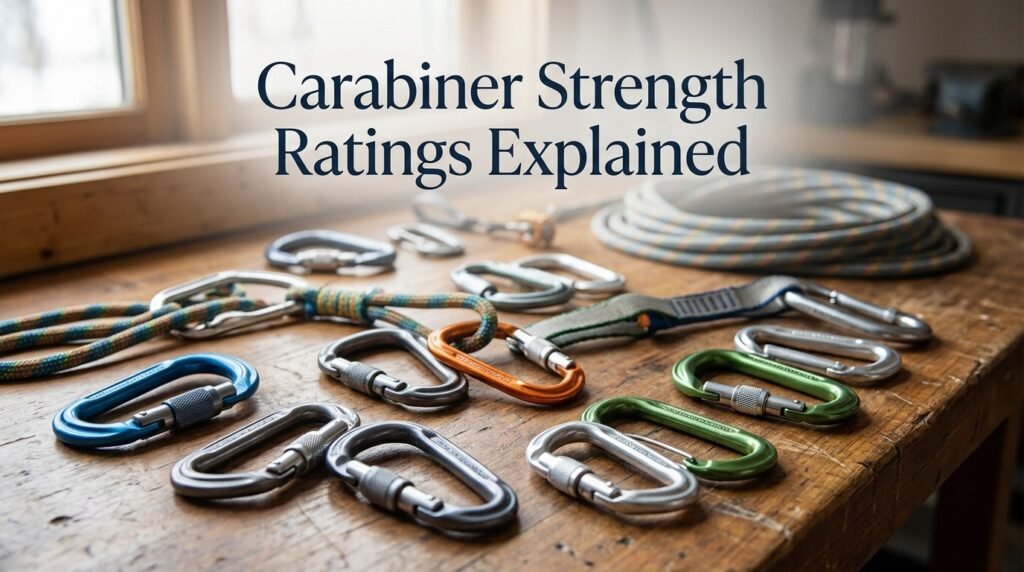
You may see markings such as:
- A number beside a symbol indicating major-axis strength.
- A second number for minor-axis strength.
- A third number for gate-open strength.
- Standard or certification markings.
These values are not permission to exceed the product’s intended application. They are part of a controlled testing and certification system.
A higher rating also does not make poor technique safe. Sharp edges, gate interference, excessive wear, incompatible hardware, and incorrect orientation can all create problems.
For life-safety use, follow the manufacturer’s instructions and the relevant equipment standard. Do not treat a general-purpose hardware-store clip as equivalent to certified climbing or fall-protection equipment.
Common Uses Beyond Climbing
Although climbing is the most familiar application, metal connectors appear in many outdoor and industrial settings.
Camping and Hiking
Small accessory clips can attach water bottles, pouches, gloves, or other lightweight items to a backpack. These are convenient for organization, but ordinary accessory clips should not be used for climbing, rappelling, suspension, or fall protection.
Rescue and Rope Work
Professional rescue systems may use specialized connectors with appropriate ratings and certifications. These systems require training because connector selection is only one part of a much larger rope system.
Industrial Work
Workers at height may use certified connectors as part of personal fall-arrest or work-positioning equipment. In these environments, the connector must match the harness, lanyard, anchor, and applicable regulations.
Everyday Organization
Key rings, dog leashes, gear storage, and equipment organization often use similar clip-style hardware. These products can be practical, but their intended load should never be assumed from appearance alone.
How to Choose the Right One
Start with the activity, not the shape. Before buying a Safety connector, identify the exact task and the equipment it must connect.
Ask these questions before buying:
- Is it for life safety? If yes, use equipment specifically designed, tested, and certified for that application.
- What system will it connect to? Check compatibility with ropes, slings, devices, harnesses, and anchors.
- Do you need a locking gate? Consider how much accidental opening could matter.
- How often will you clip and unclip? Frequent use may favor easy-to-operate gates.
- Does weight matter? For multi-piece climbing racks, lighter aluminum models can reduce overall carried weight.
- What standards apply? Look for the standards and certification information relevant to your region and activity.
- What environment will it face? Salt, moisture, dirt, abrasion, and chemicals can influence equipment life.
For beginners, buying from a reputable outdoor-equipment manufacturer and following the supplied instructions is far safer than selecting hardware based only on a product photograph or a high-strength number.
Inspection, Care, and Retirement
Inspection should become a routine habit. Before each use, look for cracks, deformation, deep scratches, corrosion, unusual gate movement, damaged springs, or problems with the locking mechanism.
Check that:
- The gate opens smoothly.
- The gate returns to the closed position.
- The locking sleeve or mechanism functions correctly.
- The frame has no obvious distortion.
- Markings remain readable where applicable.
- There is no damage that conflicts with the manufacturer’s retirement criteria.
Keep equipment clean according to the manufacturer’s instructions. Avoid harsh chemicals unless the manufacturer specifically approves them. Store equipment dry and away from damaging substances.
Retirement is also important. A connector that has suffered a major fall, serious impact, deformation, contamination, or other significant damage may need to be removed from service even if it still looks usable. Manufacturers may also specify retirement criteria based on wear, age, or inspection findings.
When there is uncertainty about life-safety equipment, consult the manufacturer or a qualified equipment professional rather than taking a chance.
Common Mistakes to Avoid
Many problems come from misuse rather than from a manufacturing defect.
Using accessory hardware for climbing: A decorative or lightweight clip may look similar but lack the required strength and certification.
Cross-loading: Allowing the connector to rest against a rope, bolt hanger, device, or harness component in a way that places force across the weaker direction can reduce strength.
Clipping the gate over an edge: Poor positioning can interfere with gate closure and create an unintended loading condition.
Ignoring the locking mechanism: A locking model still needs to be checked. A partially closed sleeve is not the same as a properly secured connection.
Mixing incompatible equipment: Hardware should fit together as intended. Do not assume that every rope device, sling, anchor, and connector combination is automatically compatible.
Continuing to use damaged gear: Visible deformation, cracks, severe wear, or a questionable history are reasons to stop and assess the equipment.
Safety connectors vs. Other Connectors
A useful comparison is between a standard climbing connector, a quick link, and a general-purpose accessory clip.
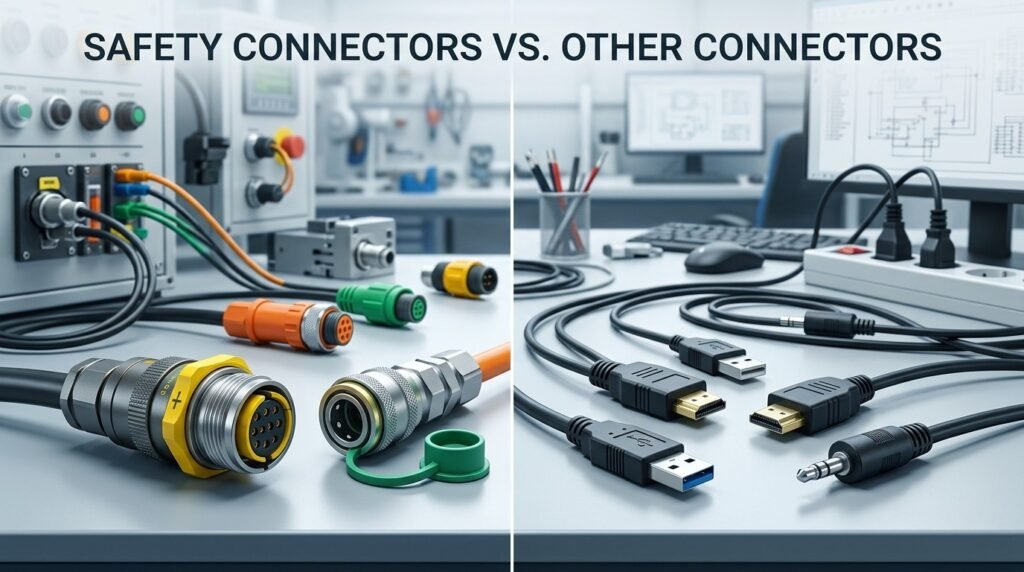
A standard climbing connector is designed for repeated opening and closing and, when properly certified, for specific life-safety applications. A quick link typically closes with a threaded nut and is intended to remain connected for longer periods. An accessory clip is mainly for organization and convenience.
The differences are not cosmetic. They involve materials, testing, gate design, intended loads, standards, and failure behavior.
That is why shoppers should never judge safety equipment by appearance alone. Two clips can look almost identical while having completely different engineering and approved uses.
Final Thoughts
The most important lesson is that this small piece of equipment should be selected according to its intended job. For climbing, mountaineering, rescue, or work at height, use certified equipment from a reputable manufacturer and learn the correct techniques for your system.
Look beyond color, shape, and price. Check the strength markings, locking system, material, certification, compatibility, and manufacturer’s instructions. Inspect the connector regularly and retire it when its condition or history makes its reliability uncertain.
A well-chosen connector can make a rope system efficient and easy to manage, but it cannot compensate for poor technique or unsuitable equipment. If your application involves life safety, training and correct system design matter just as much as the hardware itself.
Frequently Asked Questions
What is a carabiner mainly used for?
A carabiner is mainly used as a connector. In climbing and mountaineering, certified models connect ropes, protection, slings, harnesses, and other components. Similar-looking clips are also used for camping and general gear organization.
Are all Safety connectors safe for climbing?
No. Only products specifically designed, tested, and certified for climbing or another appropriate life-safety application should be used that way. General-purpose accessory clips are not substitutes.
Is a locking Safety connector safer?
A locking model can reduce the chance of accidental gate opening when used correctly, but it is not automatically safer in every situation. Correct selection, loading, inspection, and technique remain essential.
What does kN mean on a carabiner?
kN means kilonewton, a unit of force. Strength markings commonly show tested resistance in different loading directions. Always interpret those values according to the manufacturer’s instructions.
How long does a Safety connector last?
There is no single universal service life. Durability depends on use, impacts, abrasion, environment, inspection results, manufacturer guidance, and the product’s history. Follow the manufacturer’s retirement criteria.
Can a Safety connector be used for lifting?
Only if the specific product and complete system are designed, rated, and approved for that lifting application. A climbing connector should not automatically be treated as lifting hardware.