If you are searching for animals that start with D, you will find a surprisingly diverse group of creatures. From powerful predators and desert survivors to deep-sea fish and colorful insects, the letter D introduces us to animals from almost every part of the natural world.
Some are familiar, such as the dog and dolphin, while others, including the duiker, dragonet, and dromedary, may be less familiar. This guide explores these animals by habitat and group, making it easy to discover new species while learning interesting facts about their behavior, appearance, and adaptations.
Land Animals That Start With D
Land animals show just how varied life on Earth can be. The following animals live mainly on land and represent mammals, birds, and other terrestrial creatures.
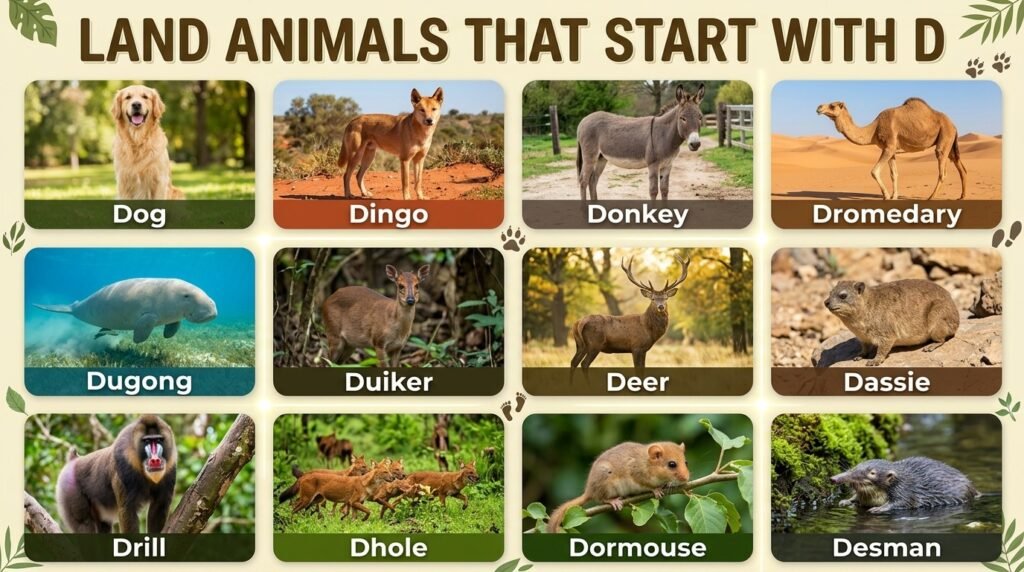
- Dogs descended from ancient wolf populations, and humans domesticated and bred them for companionship, hunting, herding.
- Dingo — The dingo is a wild canid associated with Australia. It has adapted to a wide range of environments, including deserts.
- Donkey — Donkeys are domesticated members of the horse family. Their strong bodies and sure-footed nature have made them.
- Dromedary — The dromedary, or one-humped camel, thrives in hot and dry environments. Its hump stores fat, which the body can use as an energy source when food is scarce.
- Dugong — Although dugongs spend their lives in water, they are mammals rather than fish.
- Duiker — Duikers are small antelopes found mainly in sub-Saharan Africa. Their compact bodies help them move quickly.
- Deer — Deer belong to the family Cervidae and occur across many parts of the world. Many male deer grow and shed antlers.
- Dassie — People commonly find the rock hyrax, also known as a dassie, in rocky areas across Africa and parts of the Middle East.
- Drill — The drill is a large African monkey related to baboons. Males can have striking facial and rump coloration.
- Dhole — The dhole is a social wild canid that lives in parts of Asia. It forms packs and uses coordinated hunting strategies.
- Dormouse — Dormice are small rodents known for their long periods of inactivity. Some species enter hibernation, dramatically.
- Desman — Desmans are small, semi-aquatic mammals related to moles. Their unusual appearance and sensitive snouts help them.
Did you know? Despite their very different appearances, hyraxes and elephants share surprisingly close evolutionary relationships. Both belong to the mammalian group Paenungulata.
Water Animals That Start With D
Oceans, rivers, lakes, and wetlands contain many fascinating animals beginning with D. Some are marine mammals, while others are fish and aquatic invertebrates.
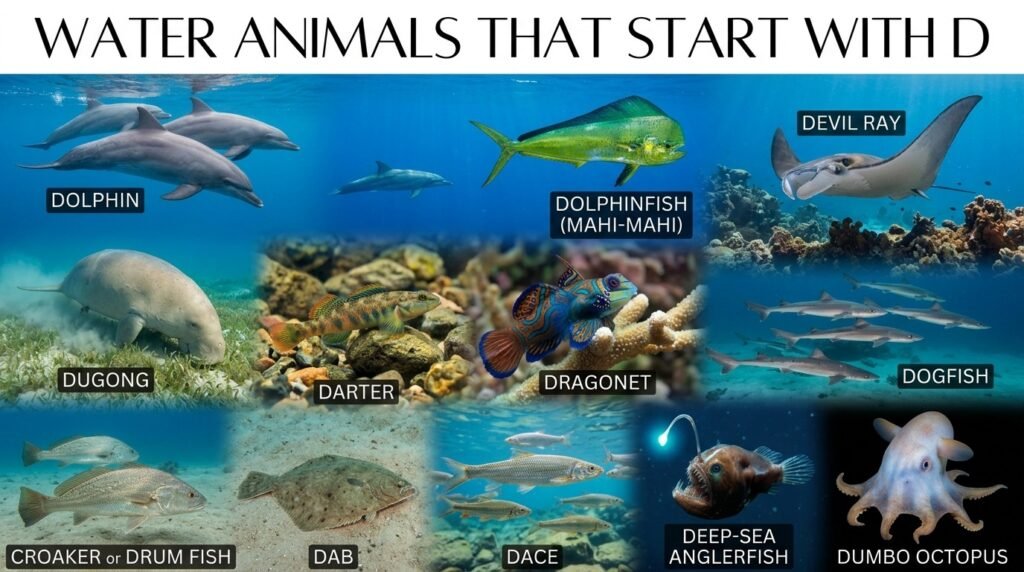
- Dolphin — Dolphins use communication, social behavior, and echolocation to navigate and interact with their environment.
- Dugong — The dugong is a herbivorous marine mammal that feeds mainly on seagrass. It lives in warm coastal waters of the Indian.
- Darter — Darters are fish found mainly in freshwater environments. They often live near the bottom of streams and rivers.
- Dragonets — Dragonets have unusual body shapes and, in some species, bright colors. They commonly live near the seafloor.
- Dogfish — Dogfish are small sharks belonging to several groups of shark species. Many are relatively slender and live in marine environments around the world.
- Drum Fish — Drum fish produce low-frequency sounds using specialized muscles connected to their swim bladders.
- Dab — The dab is a flatfish found in northern Atlantic and nearby waters. Like other flatfish, it has both eyes positioned.
- Dace — Dace are small freshwater fish found in rivers, streams, and lakes. Their streamlined bodies help them swim efficiently.
- Deep-sea anglerfish — Several deep-sea anglerfish species use a specialized structure called an esca and illicium to attract prey.
- Devil ray — Devil rays are large rays related to manta rays. They use broad fins to glide through the water and often feed on plankton.
- Dolphinfish — The dolphinfish, commonly called mahi-mahi, is a fast-growing marine fish. It should not be confused with dolphins.
- Dumbo octopus — Dumbo octopuses have rounded fins that resemble ears, inspiring their famous nickname.
Insects and Reptiles That Start With D
The letter D also appears in the names of many insects and reptiles. These creatures often have impressive adaptations for feeding, hiding, hunting, or surviving difficult environments.
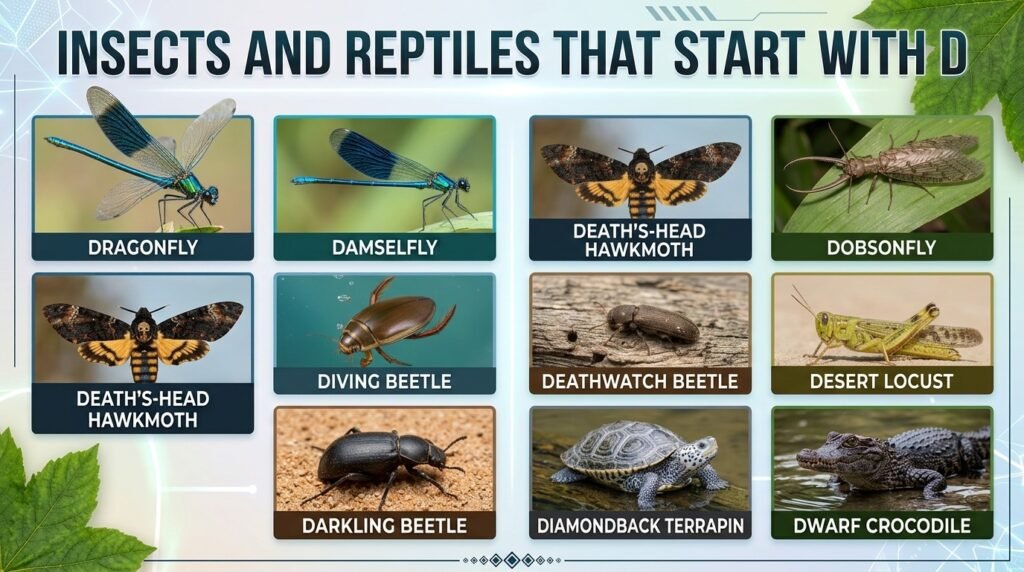
- Dragonfly — Dragonflies are powerful flying insects with large eyes and two pairs of transparent wings. Their excellent vision helps them detect and capture prey while flying.
- Damselfly — Damselflies are close relatives of dragonflies. Many rest with their wings folded along or above their bodies, unlike most dragonflies.
- Death’s-head hawkmoth — This striking moth is known for a skull-like marking on its thorax. The pattern has helped inspire legends and cultural symbolism.
- Dobsonfly — Dobsonflies are large insects associated with clean, flowing freshwater habitats. Adult males of some species have remarkably long mandibles.
- Darkling beetle — Darkling beetles belong to the family Tenebrionidae. Many species have adapted to dry environments and can survive in deserts.
- Diving beetle — Diving beetles spend much of their lives in freshwater. They can carry an air supply beneath their bodies when they dive.
- Deathwatch Beetle — Deathwatch beetles bore into wood and produce tapping sounds that people have historically associated with old wooden buildings.
- Desert locust — The desert locust is famous for its ability to change behavior and form enormous swarms under favorable conditions. Large swarms can travel considerable distances.
- Diamondback terrapin — This turtle lives in coastal salt marshes and estuaries along parts of the Atlantic coast of North America. Its patterned shell gives it a distinctive appearance.
- Dwarf Crocodile — The African dwarf crocodile lives in forest streams and swampy habitats across western and central Africa. It is one of the smaller crocodilian species.
Interesting Facts About Animals That Start With D
The world of D animals becomes even more fascinating when you look beyond names and appearances. Their biology reveals clever solutions to survival, feeding, communication, and environmental change.
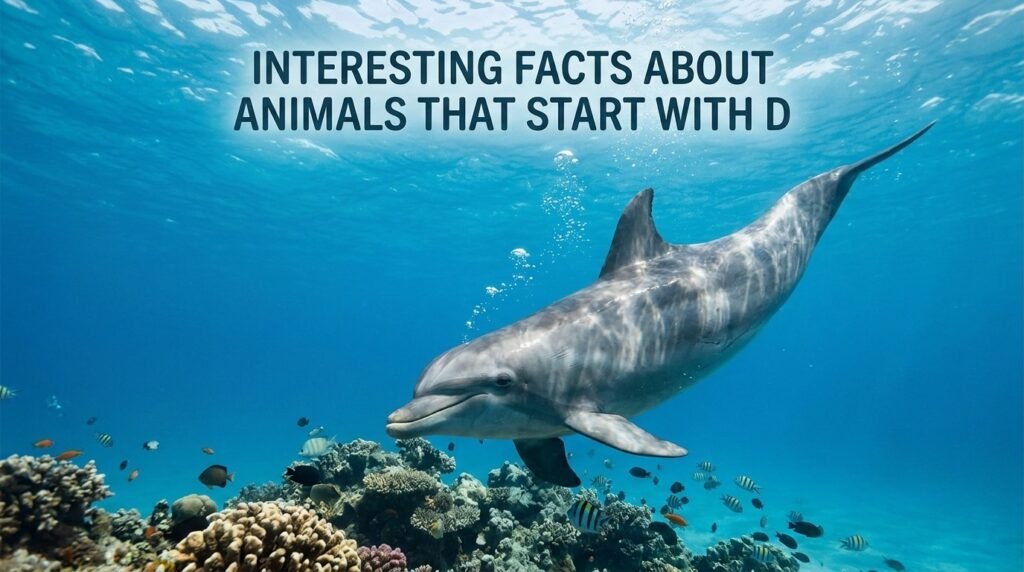
- Dolphins use echolocation. They produce sounds and listen for returning echoes to gather information about objects and animals around them.
- Dromedaries have one hump. Their hump does not store water; it stores fat, which provides energy when food is limited.
- Dogs have an extraordinary sense of smell. Their scent-detection abilities vary by breed, but their noses are far more sensitive.
- Dragonflies are ancient insects. Their evolutionary history stretches back hundreds of millions of years, long before humans appeared.
- Dugongs are herbivores. They graze on seagrass beds and can influence coastal ecosystems through their feeding activity.
- Dholes are cooperative hunters. Their social structure allows members of a pack to work together when searching for and pursuing prey.
- Dace can live in moving water. Their streamlined bodies help many species cope with river and stream currents.
- Diving beetles carry air underwater. A stored bubble of air can provide access to atmospheric oxygen for the beetle.
- Deer replace their antlers. In species that grow antlers, the structures are shed and regrown, making them one of the fastest.
- Dumbo octopuses live in the deep sea. Their ear-like fins help them move through dark, high-pressure environments far below the ocean surface.
- Dromedaries are excellent desert travelers. Their bodies conserve water through several physiological adaptations.
- Dragonflies are skilled aerial hunters. They can intercept flying prey in midair rather than simply chasing it from behind.
Science aside: Many animal abilities that seem almost magical are based on specialized anatomy. Echolocation, camouflage, heat regulation, and pressure tolerance all evolved because they helped animals survive in particular environments.
FAQs About Animals That Start With D
Why is the dromedary called a one-humped camel?
The dromedary has one hump, which distinguishes it from the two-humped Bactrian camel. Its hump stores fat rather than water.
Why is the dolphin a mammal?
Dolphins are mammals because they breathe air with lungs, give birth to live young, and feed their babies with milk. They also maintain a relatively stable internal body temperature.
Why is the dugong called a sea cow?
Dugongs are sometimes called sea cows because they graze on seagrass as large marine herbivores. Their feeding habits resemble the grazing behavior of land-based herbivores.
Why is the dragonfly called a fly?
The name reflects its appearance and flight, but dragonflies are not true flies. True flies belong to the insect order Diptera, while dragonflies belong to Odonata.
Why does the dolphin use echolocation?
Dolphins use echolocation to locate and identify objects, prey, and other features around them. This ability is especially useful in dark or murky water where vision becomes less effective.
Why does a deer grow antlers?
Male deer commonly grow antlers, which they use to compete with other males and gain access to mates. Many species shed and regrow their antlers as part of a natural yearly cycle.
Final Thoughts
The variety of animals that start with D shows how much life exists across forests, deserts, rivers, oceans, and even the smallest habitats. From the loyal dog and adaptable dromedary to the intelligent dolphin and ancient dragonfly, each animal has evolved traits that help it meet the challenges of its environment. Learning these names is more than a vocabulary exercise—it is a simple way to notice the fascinating science behind everyday nature and appreciate how differently animals survive and thrive on Earth.