When it comes to understanding everyday English, idioms can feel confusing because their literal words often differ from their real meaning. Behind the Eight Ball Meaning describes a difficult situation where someone starts at a disadvantage and must work harder to succeed. The phrase often appears in conversations about work, money, school, relationships, deadlines, and personal problems.
What Does Behind the Eight Ball Mean?
Behind the eight ball meaning being in a difficult position, especially when circumstances put someone at a disadvantage. It often suggests that a person has limited options and must deal with a problem quickly.
For example:
“We are behind the eight ball because the project deadline is tomorrow.”
This sentence means the team has a problem because very little time remains.
Another example is:
“After missing several classes, Jake was behind the eight ball before his final exam.”
Here, Jake has a disadvantage because he missed important lessons.
The Simple Definition
In simple terms, the expression means to be in trouble or at a disadvantage because of your current situation.
It often carries the idea that you must make extra effort to recover your position. The person may still succeed, but the path becomes more difficult.
Consider these situations:
- A student starts studying one day before a major exam.
- A company loses important time before launching a product.
- A worker receives an urgent assignment with very little time.
- A family faces an unexpected expense without enough savings.
- A team begins a competition after falling far behind.
All these situations involve a disadvantage. The person or group has less time, fewer resources, or fewer choices than they would normally have.
What Does “Behind” Suggest?
The word “behind” gives the expression an important clue. It suggests that someone is not in the position they want to be in.
Being behind can mean lacking progress, time, money, preparation, or support. The exact meaning depends on the context.
For example, someone may say:
“I am behind on my work.”
That means the person has not completed tasks on schedule.
However, when someone says:
“I am behind the eight ball.”
The meaning becomes stronger. The person is not simply late. They are facing a difficult position that may require immediate action.
Behind the Eight Ball Meaning in Everyday English
The phrase is common in informal English and works well when someone wants to describe pressure without giving a long explanation. It can make ordinary conversations more expressive.
Imagine a student who has three assignments due on the same day. The student might say:
“I am really behind the eight ball this week.”
The listener immediately understands that the student feels pressured and has a lot to handle.
At work, a manager might say:
“We are behind the eight ball after the supplier delayed the shipment.”
This tells the team that the delay has created a disadvantage.
The expression also works in personal situations:
“I was behind the eight ball after my car broke down before work.”
The speaker faced an unexpected problem that made the day harder.
Examples in Different Situations
Understanding examples makes idioms easier to remember. Here are several natural uses:
At school:
“Maria was behind the eight ball because she missed two weeks of classes.”
At work:
“The design team is behind the eight ball because the client changed the requirements.”
In business:
“The company found itself behind the eight ball after its main supplier raised prices.”
With money:
“After several unexpected bills, we were behind the eight ball financially.”
In sports:
“The team was behind the eight ball after giving up two early goals.”
In daily life:
“I was behind the eight ball when my phone stopped working during my trip.”
These examples show that the phrase can fit many areas of life. The common idea remains the same: someone faces an unfavorable situation and needs to recover.
Behind the Eight Ball Meaning and Its Origin
The phrase has a strong connection to the game of pool. In pool, players use a cue ball to hit other balls into pockets. The eight ball has a special role because players usually need to sink it at the correct stage of the game.
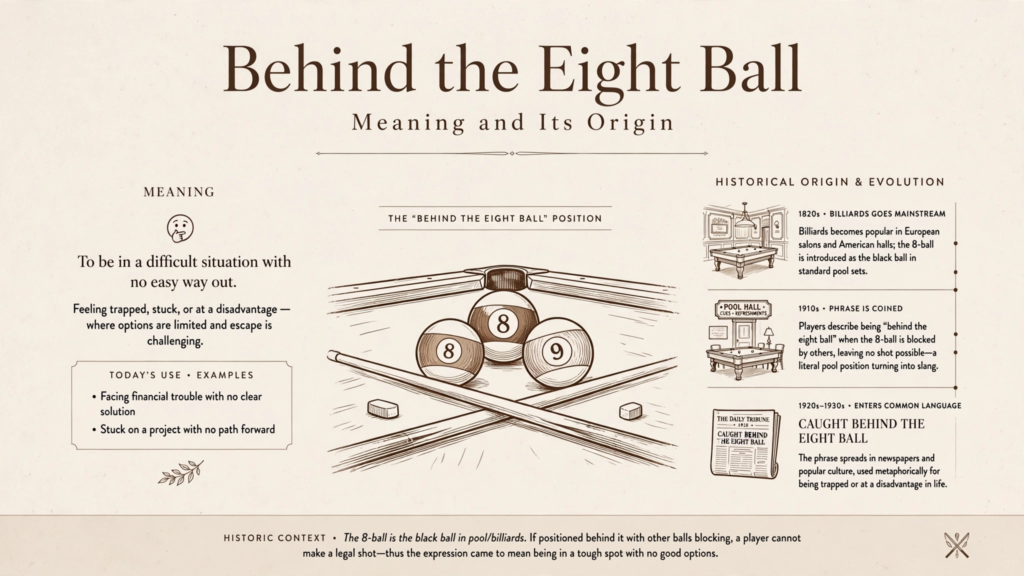
The exact path from the literal pool situation to the modern idiom is not completely certain. However, the pool image helps explain why the phrase suggests disadvantage and difficulty.
Imagine a player whose cue ball ends up in a poor position behind the eight ball. The player may have trouble making the next shot. The eight ball can block a direct path and force the player to find another solution.
That physical problem provides a useful image for the modern expression.
Over time, the phrase developed a broader figurative meaning. People began using it outside pool to describe situations where someone had limited choices or faced an obstacle.
Why Pool Fits the Expression
The pool connection makes the idiom easy to visualize.
A player wants a clear shot. A ball blocking the path creates a problem. The player must think carefully and find a way around the obstacle.
The same basic idea appears in everyday life.
A worker wants to finish a project, but a delay removes valuable time. A student wants to prepare for an exam, but unexpected responsibilities interfere. A business wants to meet a deadline, but a supplier causes a delay.
In each case, something creates an obstacle.
The expression therefore uses a simple physical image to describe a much wider type of problem.
Behind the Eight Ball Meaning vs. Similar Expressions
Several English expressions share a similar idea, but they are not always interchangeable. Understanding the differences helps you choose the right phrase.
“In a Tight Spot”
“In a tight spot” means being in a difficult situation. It can describe an immediate problem without necessarily suggesting that the person started with a disadvantage.
Example:
“I am in a tight spot because my car will not start.”
The phrase focuses on the current difficulty.
“In Hot Water”
“In hot water” usually means being in trouble because of something a person did or because of a situation that may lead to consequences.
Example:
“He is in hot water after missing the important meeting.”
This expression often has a stronger connection to trouble or blame.
“Up Against the Wall”
“Up against the wall” suggests that someone has very few options or very little time left.
Example:
“We are up against the wall with only one day left.”
This phrase emphasizes pressure and limited choices.
“At a Disadvantage”
“At a disadvantage” is more direct and formal. It does not have the colorful imagery of an idiom.
Example:
“The smaller company was at a disadvantage because it had fewer resources.”
This wording works well in professional and academic settings.
“Fighting an Uphill Battle”
“Fighting an uphill battle” describes a task that is difficult because conditions strongly work against success.
Example:
“The new business is fighting an uphill battle against larger competitors.”
The phrase emphasizes sustained difficulty rather than one specific setback.
Common Mistakes to Avoid
Learning an idiom involves more than memorizing its definition. You also need to understand how native speakers use it.
One common mistake is using the phrase for every minor inconvenience. Losing a pen, forgetting a snack, or waiting five minutes usually does not create the kind of disadvantage the expression suggests.
Another mistake is treating it as a literal pool phrase in every situation. Modern speakers normally use it figuratively.
A third mistake is assuming that the phrase means failure. It does not. A person can be in a difficult position and still succeed.
For example:
“We were behind the eight ball, but we finished the project on time.”
The sentence shows that the disadvantage did not guarantee a bad result.
You should also avoid adding unnecessary words between “the” and “eight ball.” The standard expression uses the fixed phrase Behind the Eight Ball Meaning.
How Beginners Can Remember the Meaning
A simple mental picture can make this idiom easy to remember. Imagine a pool table where one ball blocks your path.
You want to make your next move, but the eight ball is in the way. You cannot take the easiest route. You must think carefully and find another option.
Now connect that image to daily life.
If you have a deadline tomorrow and have barely started, you are in a difficult position. If your team loses valuable time because of a technical problem, it faces a disadvantage. If an unexpected bill arrives when money is already tight, you have fewer choices.
A useful memory formula is:
Behind the eight ball = facing a difficult situation + starting from a disadvantage.
You can also remember three key ideas:
- There is a problem.
- The situation puts pressure on you.
- You need to take action to recover.
This simple formula can help beginners recognize the idiom when they hear it.
Real-Life Conversation Examples
Here are short conversations that show how the expression sounds naturally.
Example 1: At work
Sam: “Can we finish the report today?”
Lisa: “It will be difficult. We are behind the eight ball after the data arrived late.”
Example 2: At school
Tom: “Have you started studying?”
Ben: “Not yet. The exam is tomorrow, so I am behind the eight ball.”
Example 3: During a project
Manager: “Why is the launch delayed?”
Employee: “The software problem put us behind the eight ball.”
Example 4: Personal life
Alex: “Why are you working this weekend?”
Chris: “I missed several deadlines last week, so I am behind the eight ball now.”
These conversations show that the idiom usually appears when a person explains why something has become difficult.
Why Learning Idioms Matters
Idioms are important because everyday English often relies on expressions that do not have purely literal meanings. Understanding them can make conversations, books, articles, movies, and workplace communication easier to follow.
The phrase also teaches an important lesson about context. You cannot always understand an idiom by translating each word separately.
If someone says they are “behind the eight ball,” they are not normally describing their physical location. They are explaining that circumstances have placed them in a difficult position.
Learning idioms this way can improve both reading comprehension and speaking skills. Instead of memorizing hundreds of expressions at once, beginners can learn each phrase through its meaning, context, examples, and common sentence patterns.
Frequently Asked Questions
What is the simple definition of Behind the Eight Ball Meaning?
The simple definition is being in a difficult situation or facing a disadvantage. It often means someone has limited time, choices, or resources and must work harder to solve a problem.
Is behind the eight ball an idiom?
Yes. It is an English idiom. Its modern use is usually figurative rather than literal. The expression describes a difficult position instead of referring directly to a pool game.
Where did behind the eight ball come from?
The expression is associated with pool, and the difficult position created when the eight ball blocks the cue ball or makes a shot harder. The exact historical development of the idiom is less certain than its pool connection.
Can I use the phrase at work?
Yes. The phrase works well in casual or conversational workplace communication. In highly formal writing, “at a disadvantage” or “facing a setback” may sound more appropriate.
Does the phrase mean that someone will fail?
No. It describes a disadvantage or difficult position, not a guaranteed result. Someone can face a major obstacle and still solve the problem successfully.
What is another way to say the expression?
Depending on the context, you can say “at a disadvantage,” “in a difficult position,” “in a tight spot,” “under pressure,” or “up against the wall.” Each expression has slightly different nuances.
Conclusion
Understanding Behind the Eight Ball Meaning becomes much easier when you connect the expression to its pool-related image. The phrase describes a person or group that faces a disadvantage, difficult circumstances, limited choices, or strong pressure. It does not mean that failure is certain. Instead, it shows that someone must work harder or find another strategy to improve the situation.
The expression can appear in conversations about school, work, business, money, deadlines, sports, and everyday problems. Beginners should remember its basic formula: a problem creates a disadvantage, and the person must respond to it.