When it comes to understanding everyday English expressions, a stone’s throw meaning is easy to learn once you know the image behind the phrase. This common idiom describes a place that is very close to another place. It does not usually mean that someone can literally throw a stone and reach the location. Instead, it creates a simple picture of two nearby places.
What Does A Stone’s Throw Mean?
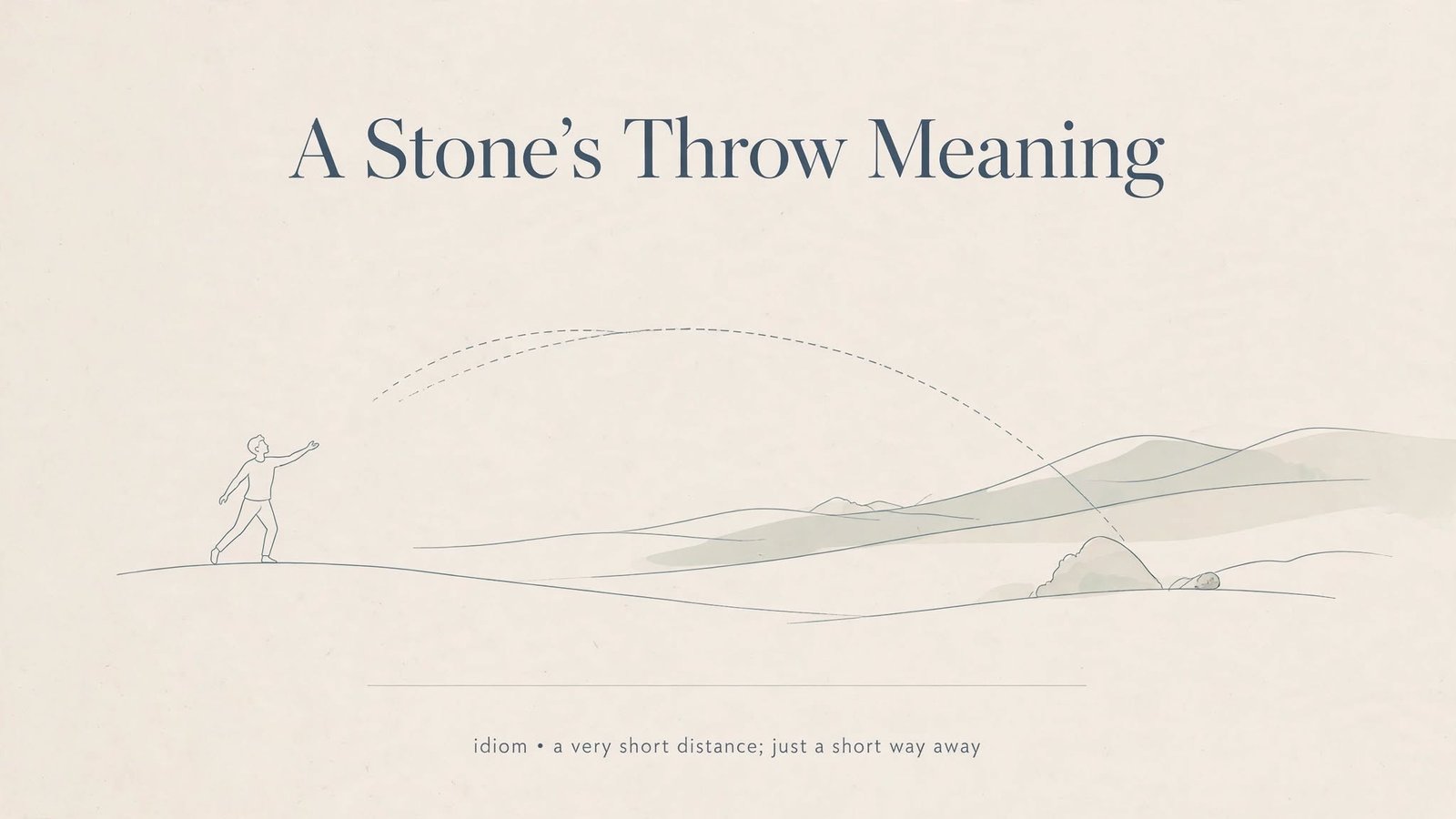
A stone’s throw meaning refers to a very short distance between two people, places, or things. It often means that something is nearby or within easy reach.
The phrase is an idiom because its meaning is not completely literal. A stone may travel only a limited distance when thrown by a person, so the expression uses that idea to describe closeness.
For example:
The school is a stone’s throw from my house.
This sentence means that the school is very close to the speaker’s house. It does not tell us the exact distance. The speaker simply wants to emphasize that reaching the school is easy.
The expression can describe many kinds of locations and objects. You might hear it when someone talks about:
- A house near a shop
- A hotel near a beach
- An office near a train station
- A restaurant near a park
- A town near a city
- A workplace near someone’s home
The exact distance depends on the situation. One person may use the phrase for a distance of a few meters, while another may use it for a short walk.
A Stone’s Throw Meaning in Simple English
In simple English, a stone’s throw meaning can be understood as “very close” or “a short distance away.” It is usually used when two places or things are near each other.
Imagine standing outside your home and seeing a small shop just down the street. You could say:
The grocery store is a stone’s throw from my house.
This means the grocery store is close enough that getting there does not require a long journey.
The expression often adds a sense of convenience. If someone says that a hotel is a stone’s throw from the airport, they want to point out that the hotel is located close to the airport.
It can also appear in descriptions, travel writing, advertisements, and everyday conversations. However, the phrase does not provide a precise measurement. It is better for general description than for giving directions.
For exact information, you would say something like “500 meters away” or “a five-minute walk away.”
Where Did A Stone’s Throw Come From?
The expression comes from the simple idea of measuring distance by how far a person can throw a stone. Older forms of English used throwing objects as a practical way to describe short distances.
The exact historical starting point of the modern phrase is difficult to pin down with certainty. However, the image is straightforward: if a place is close enough to reach with a thrown stone, it must be nearby.
Over time, the expression became figurative. People stopped using it as an actual measurement and began using it to mean “very close.”
Today, the phrase survives because the image remains easy to understand. Most readers immediately understand that a stone cannot travel a huge distance when thrown by an ordinary person.
The expression also has a conversational quality. Saying “the café is a stone’s throw away” can sound more natural and colorful than simply saying “the café is nearby.”
How to Use A Stone’s Throw in a Sentence
A stone’s throw meaning becomes clearer when you see how the phrase works in different sentence patterns. It commonly appears after “a” or with the phrase “within a stone’s throw.”
Here are several useful patterns:
“A Stone’s Throw From”
This is one of the most common structures.
The library is a stone’s throw from the city center.
Their apartment is a stone’s throw from the subway station.
We found a small café a stone’s throw from the hotel.
In each example, the phrase shows that the second location is very close to the first.
“A Stone’s Throw Away”
You can also use the phrase with “away.”
The beach is only a stone’s throw away.
There is a pharmacy a stone’s throw away from here.
This form focuses on the short distance between the speaker and the location.
“Within a Stone’s Throw”
Another structure is “within a stone’s throw.”
Several restaurants are within a stone’s throw of the hotel.
This form means that the restaurants are located very close to the hotel.
It is especially useful when describing several nearby places.
A Stone’s Throw Meaning With Real-Life Examples
The best way to understand a stone’s throw meaning is to look at practical examples from daily life. The phrase can fit naturally into many situations.
Example 1: Talking About a Home
My sister lives a stone’s throw from our parents’ house.
This means her home is very close to their parents’ home.
Example 2: Talking About Travel
The hotel is a stone’s throw from the train station.
The hotel is located close to the station, making travel easier.
Example 3: Talking About Food
There is a great Italian restaurant a stone’s throw from my office.
The restaurant is very near the office.
Example 4: Talking About School
The new bookstore is a stone’s throw from the university.
The bookstore is close to the university campus.
Example 5: Talking About Nature
Our cabin was a stone’s throw from the lake.
The lake was very close to the cabin.
Example 6: Talking About Work
Her new apartment is a stone’s throw from her workplace.
Her home is conveniently located near her workplace.
These examples show that the phrase works in both casual and descriptive language.
A Stone’s Throw vs. Similar Expressions
A stone’s throw meaning is close to several other English expressions, but each one has a slightly different tone or use. Understanding these differences can help you choose the right phrase.
| Expression | Basic Meaning | Common Use |
| A stone’s throw | Very close | General descriptions |
| Nearby | Close to something | Everyday speech |
| Close by | At a short distance | Casual conversation |
| Around the corner | Very close, often nearby on the same street | Places and directions |
| Within walking distance | Close enough to walk to | Practical distance |
| A short distance away | Not far | Neutral descriptions |
| Next door | Immediately beside something | Homes and businesses |
“Nearby” is usually the simplest option. It works in almost any situation.
“Within walking distance” gives more practical information because it suggests that someone can reach the place on foot.
“Around the corner” can suggest that something is close but not necessarily visible from the current location.
“Next door” describes a much more specific relationship. It usually means directly beside or immediately adjacent to another building or place.
Is A Stone’s Throw Formal or Informal?
The phrase can appear in both everyday and written English. It is not slang, but it has a figurative and conversational feel.
You may find it in:
- Casual conversations
- Travel articles
- Property descriptions
- Newspaper writing
- Restaurant descriptions
- Business websites
- Personal stories
- Fiction
For example, a property advertisement might say:
The house is a stone’s throw from the local park.
A travel article might say:
The museum is a stone’s throw from the main square.
In highly technical writing, however, the expression may not be suitable because technical documents often require exact measurements.
For example, a construction report should state a measured distance rather than saying that one building is “a stone’s throw” from another.
The phrase is therefore useful when the goal is to communicate general closeness rather than precise physical distance.
Common Mistakes When Using the Phrase
Learning a stone’s throw meaning also means understanding how to avoid common usage errors. The phrase is simple, but learners sometimes use it in unnatural ways.
Mistake 1: Treating It as an Exact Measurement
The phrase does not provide a fixed distance.
Incorrect idea:
A stone’s throw always means exactly 20 meters.
There is no universal measurement attached to the expression. Its meaning depends on context.
Mistake 2: Using It for Very Long Distances
The expression normally describes something nearby.
For example, saying:
Australia is a stone’s throw from Europe.
would sound humorous or clearly exaggerated because the two places are extremely far apart.
Mistake 3: Forgetting the Possessive Apostrophe
The standard form is:
a stone’s throw
The apostrophe shows possession. It refers to the throw associated with a stone.
Mistake 4: Thinking It Must Involve an Actual Stone
The expression is figurative in normal use.
If someone says:
The café is a stone’s throw away.
They are not suggesting that you should throw a stone toward the café.
Mistake 5: Using It When Precision Matters
If someone asks for the exact distance between two buildings, “a stone’s throw” is too vague.
Instead, use:
The buildings are 300 meters apart.
This gives clear and measurable information.
Why Do People Use This Expression?
People use the phrase because it communicates closeness in a vivid and memorable way. Instead of giving an exact number, the speaker gives the listener a familiar mental image.
Compare these two sentences:
The restaurant is 300 meters from the hotel.
The restaurant is a stone’s throw from the hotel.
The first sentence gives a precise measurement. The second creates a stronger sense of convenience and closeness.
Neither sentence is automatically better. The appropriate choice depends on the purpose.
If you are giving directions, exact information may be more useful. If you are describing a location in a story or travel article, the idiom may sound more natural.
This is one reason idioms remain important in English. They can add personality and imagery to otherwise simple ideas.
A Stone’s Throw in Everyday Conversations
Native and fluent English speakers may use this expression when talking about places that are close to one another.
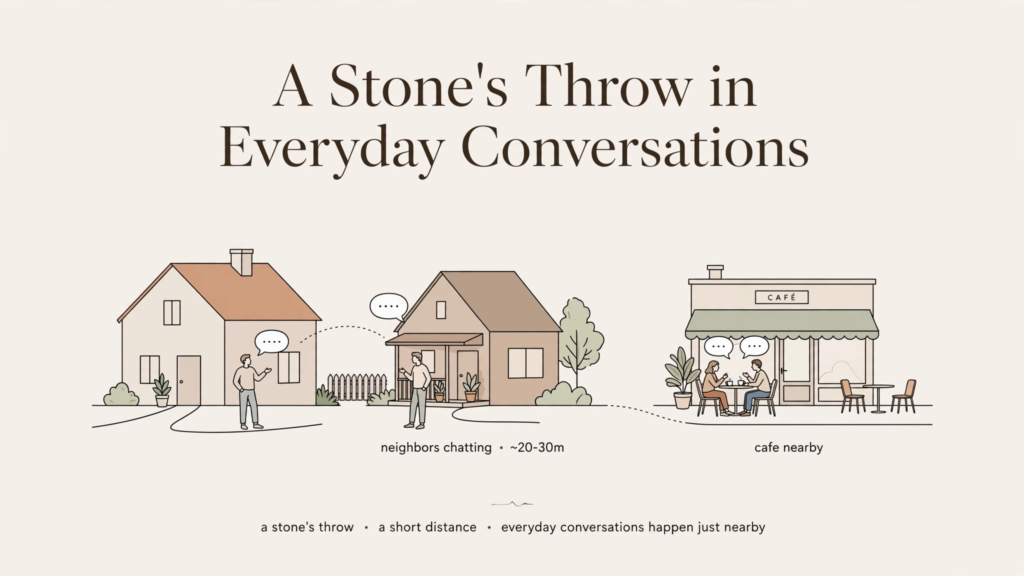
For example:
Person A: Where is the new coffee shop?
Person B: It’s a stone’s throw from the library.
The speaker does not need to give a detailed explanation. The listener understands that the coffee shop is very close to the library.
Another example:
Person A: Is your new office far from your home?
Person B: No, it’s a stone’s throw away.
Here, the phrase answers the question quickly while emphasizing convenience.
You can also use it when talking about events:
The concert venue is a stone’s throw from our hotel.
Or when describing a neighborhood:
The park is a stone’s throw from several local shops.
These examples show why the phrase works well in natural conversation.
Literal Meaning vs. Figurative Meaning
Understanding the difference between literal and figurative language is important when learning idioms.
The literal idea involves throwing a stone through the air. The stone travels a relatively short distance.
The figurative meaning applies that image to other situations. When someone says a place is “a stone’s throw away,” they mean that the place is very close.
Consider this sentence:
The village is a stone’s throw from the river.
A literal interpretation would suggest throwing a stone from the village toward the river. But that is not the intended message.
The intended message is simply that the village and river are close.
This type of figurative language appears throughout English. Expressions such as “break the ice,” “hit the road,” and “under the weather” also have meanings that differ from their literal words.
Learning the figurative meaning is therefore essential for understanding natural English.
When Should You Use A Stone’s Throw?
A stone’s throw meaning fits best when you want to describe a short distance in a natural, expressive way. It works especially well in informal and descriptive contexts.
Use it when:
- You want to emphasize that something is nearby.
- The exact distance is not important.
- You are describing a location.
- You want your writing to sound more vivid.
- You are having a casual conversation.
Avoid it when:
- You need an exact measurement.
- You are writing technical instructions.
- The distance is extremely large.
- The audience may not understand idiomatic English.
- Precision is more important than style.
For beginner English learners, “nearby” is often easier. Once you become comfortable with common idioms, this phrase can make your English sound more natural and expressive.
Quick Guide to the Phrase
Here is a simple summary of the main points:
- Meaning: Very close or a short distance away.
- Type: English idiom.
- Literal image: The short distance a person can throw a stone.
- Exact distance: No fixed measurement.
- Common pattern: “A stone’s throw from.”
- Another pattern: “A stone’s throw away.”
- Tone: Natural, figurative, and commonly used.
- Best use: Describing nearby people, places, or things.
- Avoid: Technical situations that require precise measurements.
Remember that context determines how close “a stone’s throw” feels. The phrase emphasizes proximity rather than providing a numerical distance.
Frequently Asked Questions
What is the simple meaning of a stone’s throw?
A stone’s throw meaning is a very short distance. When something is described this way, it means that the place or object is very close to another location.
Is a stone’s throw an idiom?
Yes. It is an English idiom that uses the image of throwing a stone to describe something that is nearby.
Does a stone’s throw have an exact distance?
No. The phrase does not have a fixed measurement. It simply suggests that something is very close.
Can I use a stone’s throw in formal writing?
Yes, but context matters. It can appear in descriptive or professional writing, such as travel or property descriptions. Technical writing should use exact measurements instead.
What is another word for a stone’s throw?
Common alternatives include “nearby,” “close by,” “a short distance away,” “within walking distance,” and “around the corner.” The best choice depends on the context.
What is an example of a stone’s throw?
A simple example is: “The supermarket is a stone’s throw from my house.” This means the supermarket is very close to the speaker’s home.
Conclusion
The phrase a stone’s throw meaning is simple: it describes something that is very close or only a short distance away. The expression comes from the image of a stone traveling a short distance when someone throws it. Today, speakers normally use the phrase figuratively rather than as an exact measurement. The phrase works well in conversations and descriptive writing because it makes the idea of closeness easy to picture. However, it should not replace precise measurements when exact distance matters. If you understand this difference, you can use the expression naturally and confidently. In short, whenever you want to say that something is very near without giving a specific measurement, this familiar idiom can be a useful choice.