Learning 100 action words in English can improve your vocabulary and help you express yourself more confidently. Students use them in school assignments, teachers use them in lessons, and writers use them to make their content more engaging. Action words are one of the most important parts of the English language. They help us describe what people, animals, and things do every day. Whether you are speaking, writing, reading, or learning English, action words make communication clear and meaningful.
In this article, you will discover 100 action words along with simple meanings and examples. The words are grouped into categories to make learning easier. You will also learn why action words matter, interesting facts about verbs, and answers to common questions about English action verbs.
What Are Action Words?
Action words are words that describe what someone or something does. They show actions, activities, movements, or behaviors.
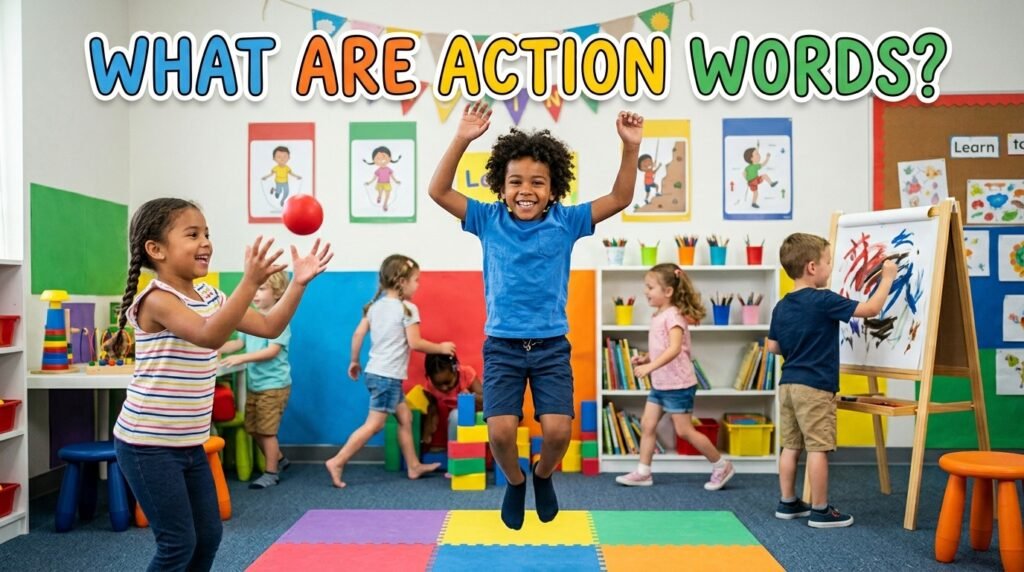
In grammar, action words are called verbs. They tell us what is happening in a sentence.
Simple Examples of Action Words
- Run
- Jump
- Eat
- Write
- Read
- Sing
- Dance
- Play
- Walk
- Swim
Examples in Sentences
- I run every morning.
- The children jump over the rope.
- We eat dinner at 7 p.m.
- She writes stories.
- They play football after school.
Understanding action words is the first step toward building stronger communication skills. That is why many learners begin with an action words list when studying English.
100 Action Words in English
The following 100 action words in English are grouped into useful categories. Each word includes a simple example sentence.
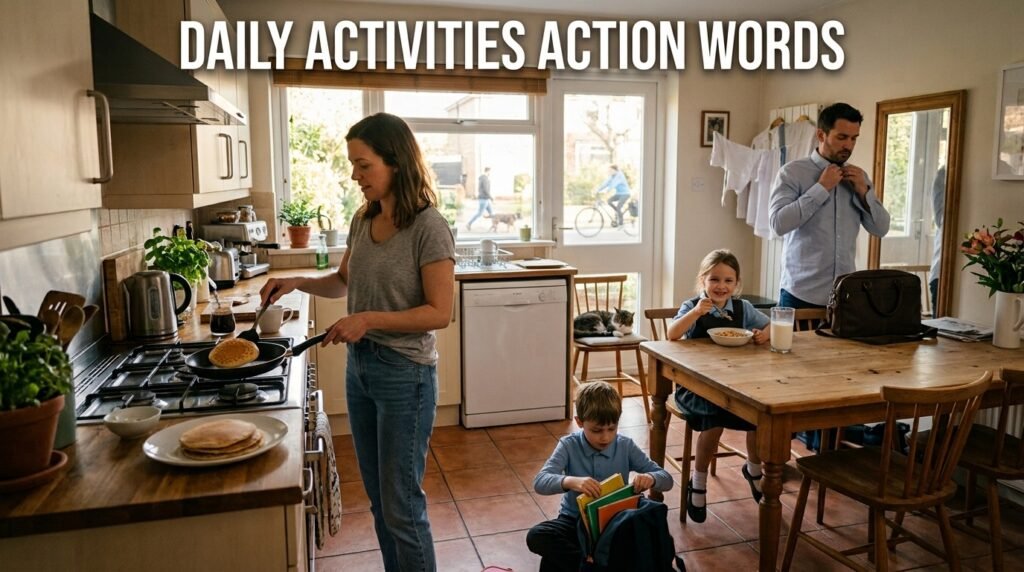
Daily Activities Action Words
These are common action words used in everyday life.
| Action Word | Example |
| 1. Wake | I wake up at 6 a.m. |
| 2. Brush | She brushes her teeth daily. |
| 3. Wash | We wash our hands before meals. |
| 4. Cook | My mother cooks dinner every evening. |
| 5. Eat | They eat lunch together. |
| 6. Drink | He drinks water regularly. |
| 7. Sleep | The baby sleeps peacefully. |
| 8. Clean | I clean my room every weekend. |
| 9. Dress | She dresses quickly for school. |
| 10. Shop | We shop for groceries on Sunday. |
| 11. Open | Please open the window. |
| 12. Close | Close the door gently. |
| 13. Carry | He carries a heavy bag. |
| 14. Pack | They pack their luggage carefully. |
| 15. Drive | My father drives to work. |
| 16. Ride | She rides her bicycle daily. |
| 17. Call | I call my friend every week. |
Movement Action Words
Movement verbs describe physical motion from one place to another.

| Action Word | Example |
| 18. Walk | We walk to school. |
| 19. Run | He runs very fast. |
| 20. Jump | The athlete jumps high. |
| 21. Climb | They climb mountains. |
| 22. Crawl | The baby crawls on the floor. |
| 23. Skip | Children skip happily. |
| 24. Hop | The rabbit hops across the field. |
| 25. March | Soldiers march together. |
| 26. Slide | The kids slide down the playground slide. |
| 27. Swing | She swings in the park. |
| 28. Spin | The dancer spins gracefully. |
| 29. Fly | Birds fly in the sky. |
| 30. Swim | Fish swim in water. |
| 31. Dive | He dives into the pool. |
| 32. Float | The boat floats on the lake. |
| 33. Travel | We travel during vacations. |
| 34. Wander | Tourists wander through the city. |
Learning and Communication Action Words
These English action verbs are useful in school, work, and conversations.

| Action Word | Example |
| 35. Read | I read books every day. |
| 36. Write | She writes in her notebook. |
| 37. Study | Students study for exams. |
| 38. Learn | Children learn new skills. |
| 39. Teach | Teachers teach important lessons. |
| 40. Listen | Please listen carefully. |
| 41. Speak | He speaks English fluently. |
| 42. Talk | We talk after class. |
| 43. Ask | She asks good questions. |
| 44. Answer | He answers politely. |
| 45. Explain | The teacher explains the topic. |
| 46. Discuss | We discuss ideas together. |
| 47. Share | They share information online. |
| 48. Describe | Can you describe the picture? |
| 49. Translate | She translates English into Spanish. |
| 50. Memorize | Students memorize vocabulary. |
| 51. Observe | Scientists observe nature. |
The words above are some of the most useful verbs for students and language learners.
Work and Productivity Action Words
These action words are commonly used in workplaces and daily responsibilities.

| Action Word | Example |
| 52. Work | I work from home. |
| 53. Plan | We plan our project carefully. |
| 54. Organize | She organizes the files. |
| 55. Create | They create new designs. |
| 56. Build | Workers build houses. |
| 57. Manage | He manages a team. |
| 58. Prepare | We prepare for meetings. |
| 59. Schedule | She schedules appointments. |
| 60. Complete | They complete tasks on time. |
| 61. Improve | Practice improves skills. |
| 62. Develop | Companies develop products. |
| 63. Design | He designs websites. |
| 64. Calculate | Students calculate answers. |
| 65. Analyze | Researchers analyze data. |
| 66. Solve | We solve problems together. |
| 67. Deliver | The company delivers packages. |
| 68. Achieve | She achieves her goals. |
Learning 100 action words in English helps people communicate more effectively in professional situations.
Sports and Physical Action Words
Sports and fitness activities use many energetic action words.

| Action Word | Example |
| 69. Kick | He kicks the ball. |
| 70. Throw | She throws the ball far. |
| 71. Catch | I catch the ball easily. |
| 72. Hit | The player hits the ball. |
| 73. Shoot | He shoots toward the goal. |
| 74. Pass | She passes the ball. |
| 75. Score | Our team scored twice. |
| 76. Race | Athletes race on the track. |
| 77. Lift | He lifts weights at the gym. |
| 78. Stretch | Always stretch before exercise. |
| 79. Push | Push the cart carefully. |
| 80. Pull | Pull the rope slowly. |
| 81. Balance | She balances on one foot. |
| 82. Exercise | We exercise daily. |
| 83. Wrestle | The athletes wrestle competitively. |
| 84. Box | They box in the ring. |
Creative Action Words
Creative verbs are often used in art, music, storytelling, and imagination.

| Action Word | Example |
| 85. Draw | I draw pictures for fun. |
| 86. Paint | She paints beautiful landscapes. |
| 87. Sketch | He sketches buildings. |
| 88. Color | Children color their worksheets. |
| 89. Sing | They sing together. |
| 90. Dance | We dance at celebrations. |
| 91. Compose | She composes music. |
| 92. Perform | The band performs live. |
| 93. Act | He acts in school plays. |
| 94. Imagine | Children imagine adventures. |
| 95. Invent | Scientists invent new tools. |
| 96. Decorate | They decorate the room. |
| 97. Craft | She crafts handmade gifts. |
| 98. Photograph | He photographs wildlife. |
| 99. Edit | Writers edit their work. |
| 100. Publish | Authors publish books. |
These action words with examples can help learners communicate more creatively and confidently.
Why Action Words Are Important
Action words play a major role in effective communication. Here are some reasons why they matter.
1. Improve Communication Skills
Action words help people clearly express what they are doing, thinking, or experiencing.
2. Make Writing More Engaging
Strong verbs make writing lively and interesting. Instead of saying “He was going fast,” you can say “He raced.”
3. Help Children Build Vocabulary
Children learn language faster when they understand and use common action words in daily conversations.
4. Strengthen Speaking and Storytelling
Good storytellers use action verbs to create movement and excitement in their stories.
5. Improve English Learning and Comprehension
Learning 100 action words in English gives learners a strong foundation for reading, writing, listening, and speaking.
6. Increase Confidence
When learners know more verbs, they can communicate ideas more accurately and confidently.
Interesting Facts About Action Words
Here are some fun and educational facts about action words and verbs.
- Verbs are one of the most important parts of a sentence.
- Every complete sentence usually contains a verb.
- English has thousands of action verbs.
- Some verbs describe physical actions, while others describe mental actions.
- The word “run” has hundreds of different meanings and uses.
- Children often learn action words before learning complex grammar rules.
- Action verbs make stories more vivid and exciting.
- Many English action verbs come from Old English words.
- Writers use strong verbs to create clearer images in readers’ minds.
- Learning an action words list is one of the fastest ways to improve vocabulary.
FAQs about 100 action words in English
1. What are action words in English?
Action words are verbs that show what a person, animal, or thing does. Examples include run, eat, write, and jump.
2. Why are action words important?
They help us communicate actions, ideas, and activities clearly in speech and writing.
3. What is the difference between action verbs and helping verbs?
Action verbs show an action, while helping verbs support the main verb. For example, in “She is running,” “running” is the action verb and “is” is the helping verb.
4. How can children learn action words quickly?
Children can learn action words through reading, games, flashcards, storytelling, and daily conversations.
5. What are some common action words used every day?
Common examples include eat, drink, walk, talk, read, write, work, sleep, and play.
6. Can action words improve writing skills?
Yes. Strong action verbs make writing clearer, more engaging, and easier to understand.
7. How many action words are there in English?
There are thousands of action verbs in English, and new words continue to be added over time.
8. What are the best action words for beginners?
Run, walk, eat, drink, read, write, play, speak, listen, and learn are excellent beginner verbs.
Conclusion
Learning 100 action words in English is one of the most effective ways to improve communication skills. Action words help us describe what people, animals, and things do every day. They make sentences meaningful, conversations clearer, and writing more engaging. Whether you are a student, teacher, parent, or English learner, understanding action verbs can strengthen your vocabulary and boost your confidence. From simple words like run, eat, and play to more advanced verbs like analyze, achieve, and publish, every action word adds power to your communication. Remember that language learning is a gradual process. The more action words you use, the more natural they will become. Try adding a few new verbs to your vocabulary each week and use them in sentences. Reading books, writing short paragraphs, and speaking English daily can help reinforce what you learn.
Love to read more Things to Eat That Are Soft and Healthy: Easy Meal Ideas.