
Finding things that start with ax can be surprisingly interesting because the letter combination “ax” is much less common at the beginning of English words than combinations such as “an,” “al,” or “ar.” Yet, it appears in a fascinating collection of words connected with tools, transportation, science, nature, animals, food, and language.
The most familiar example is the ax, a traditional cutting tool used for chopping wood. From there, the vocabulary expands into terms such as axle, axial, axon, axiom, axolotl, and axinite. Some are everyday words, while others belong to specialized areas of science, mathematics, biology, geology, and engineering.
This guide explores 40+ things that start with ax, including objects, animals, natural examples, foods, scientific terms, and useful vocabulary. It is designed to show just how much meaning can be packed into this relatively uncommon beginning.
Why Words Starting With AX Are Special and Useful
It is especially interesting because many words beginning with “ax” trace their origins to Greek roots, scientific terminology, or words borrowed from other languages.

The familiar word ax is related to the older Germanic word family associated with cutting tools. English also has axe, the spelling commonly preferred in British English, while ax is particularly common in American English. Another interesting feature is that “ax” can appear as the beginning of completely different types of vocabulary. Axle belongs to engineering, axon belongs to biology, axiom belongs to mathematics and philosophy, and axolotl refers to an unusual aquatic salamander.
Did you know? The spelling ax and axe represent the same basic tool. The shorter spelling is standard in American English, while axe is widely used in British English and several other varieties of English.
Examples in Nature
Nature provides several fascinating examples of words beginning with ax, particularly in zoology and geology. Some are familiar to science enthusiasts, while others are considerably more specialized.
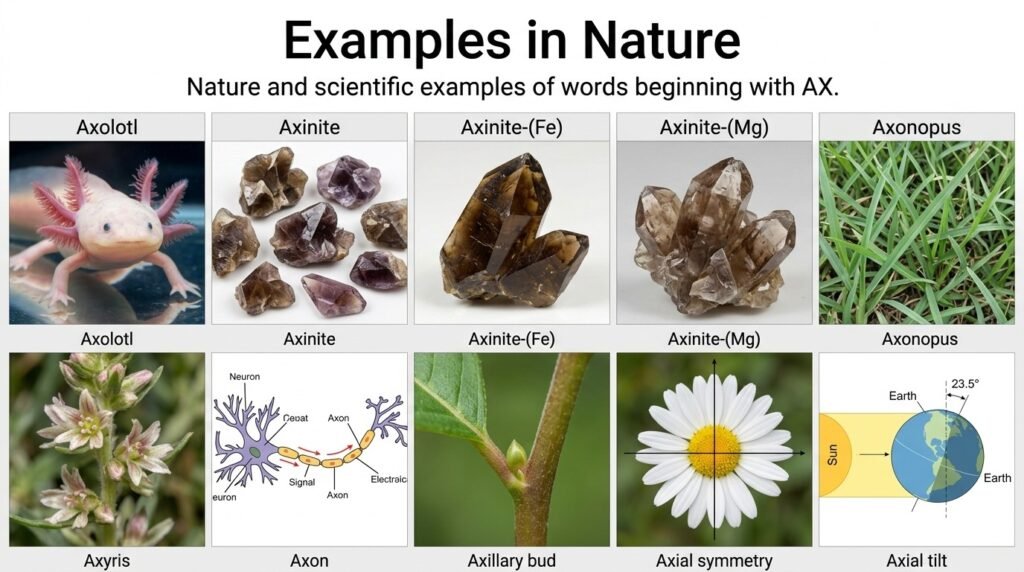
- Axolotl — The axolotl is an aquatic salamander famous for its ability to regenerate certain body tissues. It lives in the lake system around Mexico City and has distinctive external feathery gills.
- Axinite — Axinite is a group of minerals that typically forms distinctive crystals and appears in brown, violet-brown, or reddish-brown colors. Mineral collectors value it, while geologists study its formation and composition.
- Axinite-(Fe) — This iron-rich member of the axinite mineral group occurs in metamorphic environments and forms characteristic wedge-shaped crystals.
- Axinite-(Mg) — Also known as magnesium-rich axinite, this mineral contains more magnesium than iron-dominant members of the group.
- Axonopus — Axonopus is a genus of grasses that includes species found primarily in tropical and subtropical regions. Several species are useful as forage or turf grasses.
- Axyris — Axyris is a genus of flowering plants in the amaranth family. Species in this genus occur naturally across parts of Eurasia.
- Axon — Although primarily a biological term, an axon represents one of the most important structures in the nervous system. It carries electrical signals away from a neuron’s cell body.
- Axillary bud — An axillary bud develops in the angle between a plant leaf and its stem. It can develop into a new shoot, branch, or flower-bearing structure.
- Axial symmetry — Axial symmetry describes a natural structural pattern in which parts arrange themselves around a central axis. This pattern appears in many biological forms and physical structures.
- Axial tilt — Earth’s axial tilt is the angle between its rotational axis and the perpendicular to the plane of its orbit. This tilt plays a major role in producing Earth’s seasons.
Animals
The animal world contains some especially memorable things that start with ax, with the axolotl being by far the best-known example. Many other “ax” animal terms are scientific names or names associated with particular anatomical structures.
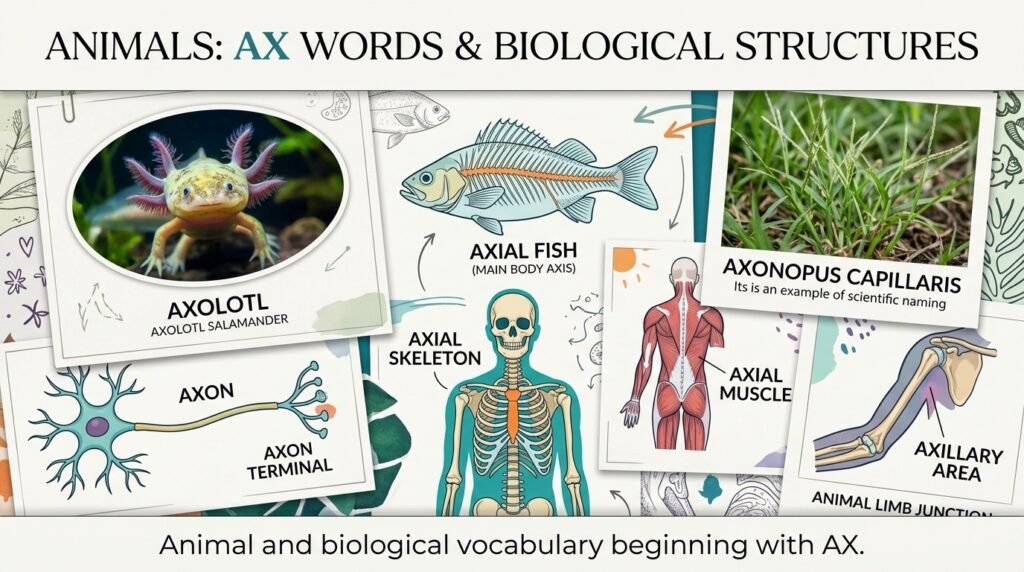
- Axolotl — This Mexican salamander spends its life primarily in water and is famous for retaining juvenile characteristics into adulthood.
- Axolotl salamander — This descriptive name is another way of referring to the axolotl, emphasizing its classification as a salamander.
- Axonopus capillaris — Although its name refers to a grass rather than an animal, scientists use the scientific naming pattern to classify it biologically under the genus “Axonopus.”
- Axial fish — Zoologists use the term “axial” to describe structures associated with an animal’s main body axis. It is therefore common in scientific descriptions of animal anatomy.
- Axial skeleton — The axial skeleton is the central framework of a vertebrate body, including structures such as the skull, vertebral column, ribs, and sternum.
- Axial muscle — Axial muscles are muscles associated with the body’s central axis and play important roles in posture and movement.
- Axon — An axon is part of a nerve cell rather than an animal itself, but it is fundamental to animal nervous systems because it transmits signals from neurons.
- Axon terminal — An axon terminal is the end portion of a neuron that communicates with another cell, usually across a synapse.
- Axillary organ — In zoological terminology, “axillary” can describe structures located near the junction between a limb and the body.
Everyday Objects
Fewer ordinary household objects begin with ax than there are words beginning with many other letter combinations. However, several useful tools, vehicle components, mechanical parts, and related objects fit the category.
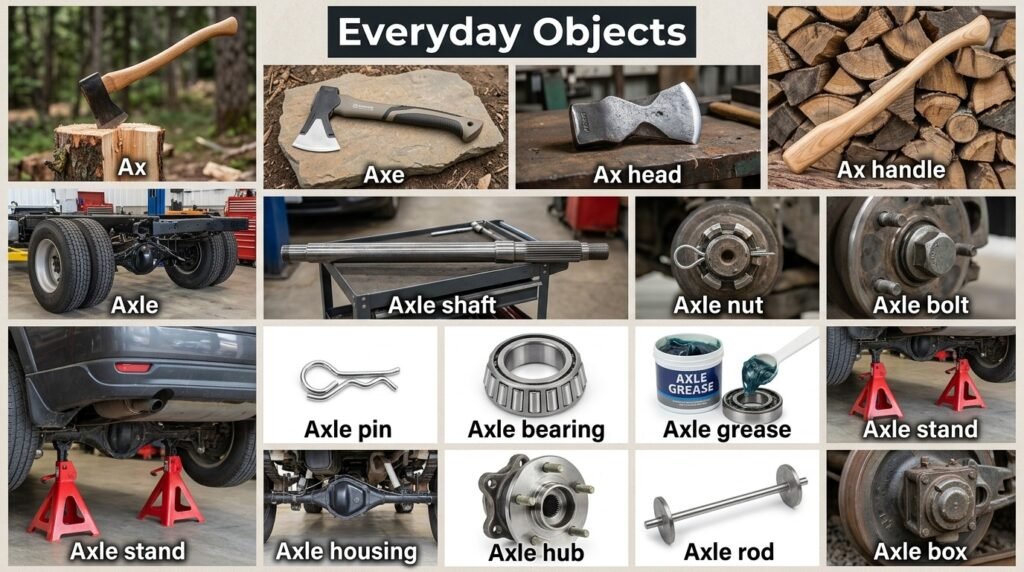
- Ax — An ax is a handheld cutting tool with a sharp blade attached to a handle.
- Axe — Axe is the alternative spelling of ax and is especially common in British English.
- Ax head — The ax head is the heavy cutting portion of an ax, normally made from metal.
- Ax handle — An ax handle provides the grip and leverage needed to swing an ax safely.
- Axle — An axle is a shaft that supports rotating wheels or gears.
- Axle shaft — An axle shaft transfers rotational force to a wheel.
- Axle nut — An axle nut secures an axle or wheel assembly in many mechanical.
- Axle bolt — An axle bolt is a fastening component used in certain wheels and bicycles.
- Axle pin — An axle pin is a pin-shaped component used to secure or position an axle.
- Axle bearing — An axle bearing supports rotating movement and helps reduce friction around an axle.
- Axle grease — Axle grease is a lubricant used in appropriate mechanical applications to reduce friction.
- Axle stand — An axle stand is a support device used to hold a vehicle safely after it has been raised.
- Axle housing — An axle housing surrounds and supports parts of an axle assembly, especially in vehicle designs.
- Axle box — An axle box is a mechanical housing associated with an axle, particularly in railway and mechanical systems.
- Axle collar — An axle collar is a ring-shaped mechanical component used to position or secure parts on a shaft.
- Axle hub — An axle hub is the central component associated with a wheel’s mounting.
- Axle sleeve — An axle sleeve is a tubular component used in certain mechanical assemblies.
- Axle rod — An axle rod is a rod or shaft serving as an axle in mechanical applications.
Food Examples
Food vocabulary beginning with ax is considerably rarer than everyday mechanical terminology. However, several authentic culinary and ingredient-related terms can be found in regional cuisines and food traditions.
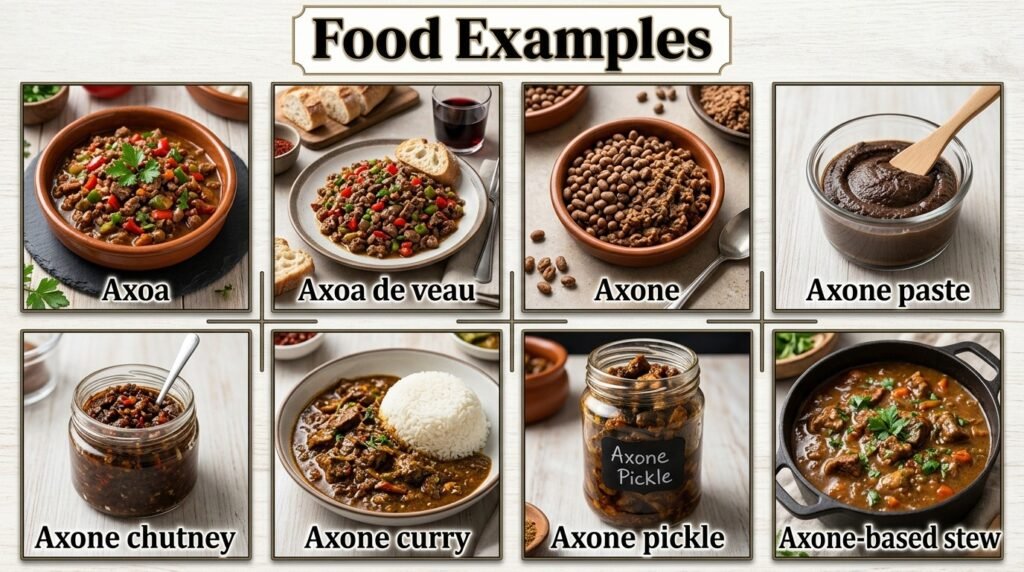
- Axon — Axon is a traditional Basque dish, commonly prepared with finely chopped veal or another meat and peppers. It is particularly associated with the Basque region of France.
- Axone — People in Nagaland use axone, also called akhuni, as a fermented soybean product in traditional Naga cuisine of northeastern India. They add it to various dishes to create a distinctive, flavorful taste.
- Axon chutney — People make this chutney using axon, incorporating the fermented soybean ingredient into a strongly flavored condiment.
- Axon curry — Cooks incorporate axon into meat and vegetable preparations to provide a distinctive fermented flavor.
- Axone pickle — Fermented soybean preparations such as axone may also be used in regional pickle-style foods and accompaniments.
- Axone paste — Axone may be mashed or processed into a paste before being incorporated into traditional recipes.
- Axon-based stew — Traditional northeastern Indian cooking uses fermented soybean products in hearty stews and meat preparations.
- Axoa de veau — This is the French/Basque name associated with the veal version of axoa, a regional specialty characterized by chopped meat and peppers.
Food Fun Fact
Axone is particularly interesting because fermentation changes both the flavor and aroma of soybeans. In Naga cuisine, it is valued as a distinctive ingredient rather than simply being treated as an ordinary soybean product.
Science and Technology
The ax beginning becomes much more productive in scientific vocabulary. Biology, mathematics, physics, astronomy, engineering, and computing all contain important words beginning with these two letters.

1. Axial
Axial means relating to an axis or central line. In science and engineering, the term can describe forces, structures, directions, or arrangements aligned with an axis.
For example, axial load refers to a force directed along the main axis of a structure or component.
2. Axiom
An axiom is a statement that people accept as a starting point within a particular mathematical or logical system. These statements provide a foundation from which people can logically derive other conclusions.
The word also has a broader meaning, referring to a principle that people accept as true or self-evident within a particular framework.
3. Axon
An axon is a long projection of a neuron that transmits electrical signals away from the cell body. Some axons can extend considerable distances relative to the size of the neuron.
Axons are fundamental to communication within the nervous system.
4. Axonometric
Axonometric describes a type of graphical projection used to represent three-dimensional objects on a two-dimensional surface. It is useful in technical drawing, architecture, engineering, and computer graphics.
An axonometric drawing can show multiple dimensions of an object without relying on ordinary perspective rendering.
5. Axle
An axle is an engineering component designed to support or transmit rotational motion. Vehicles, machinery, bicycles, and many mechanical systems rely on axle-related components.
Modern axle systems can vary considerably depending on whether an axle is primarily supporting weight, transmitting power, or performing both functions.
Interesting Facts About Words Starting With AX
Words starting with “Ax” are interesting because this letter combination appears in a relatively small but diverse group of English words. The prefix “ax” can appear at the beginning of words connected to tools, actions, measurements, and other everyday concepts.

- Ax and axe are two accepted spellings for the same cutting tool.
- Ax is particularly common in American English, while axe is widely preferred in British English.
- The word axolotl comes from Nahuatl, the language associated with the Aztec civilization and still spoken by many people today.
- An axolotl is a salamander rather than a fish, despite spending its life in water.
- Axial describes something related to an axis, which is a central line around which an object can be arranged or rotated.
- An axiom serves as a foundational statement in a mathematical or logical system.
- An axon is a major part of a neuron and is responsible for carrying signals away from the cell body.
- Axinite is a recognized group of minerals studied in geology and mineralogy.
- Axoa represents a traditional dish from Basque cuisine.
- Axone is a fermented soybean food strongly associated with Naga cuisine in northeastern India.
- The x in “ax” gives the word a distinctive visual appearance despite the word itself being very short.
- Many specialized “ax” terms are formed from scientific roots rather than ordinary household vocabulary.
Educational Importance of Learning AX Words
Learning things that start with ax can be useful for children and language learners because it connects spelling with pronunciation, vocabulary, science, and everyday objects.
Simple words such as ax and axle can introduce learners to tools and machines, while words such as axon, axiom, and axial demonstrate how vocabulary changes across different academic subjects.
These words can also encourage cross-subject learning. A student might encounter an axolotl in biology, an axiom in mathematics, an axle in engineering, and axoa while exploring world cuisines.
For younger learners, unusual word beginnings can also make vocabulary exercises more memorable. Instead of learning isolated letters, students can see how the same opening combination appears in completely different contexts.
FAQs About Things That Start With AX
1. What are some common things that start with ax?
Some recognizable examples include ax, axe, axle, ax head, ax handle, axle shaft, and axle bearing. Many additional “ax” words are scientific or specialized terms.
2. Is ax a real word?
Yes. Ax is a standard English noun referring to a cutting tool. Axe is another accepted spelling, especially common in British English.
3. Why are there fewer words starting with ax?
The letter combination ax is relatively uncommon at the beginning of English words. Many words that do begin with it come from Greek, Latin, Indigenous languages, or specialized scientific terminology.
4. What animal starts with ax?
The axolotl is the best-known animal whose name begins with “ax.” It is an aquatic salamander native to the region around Mexico City.
5. What food starts with ax?
Axoa is a traditional Basque dish, while axone is a fermented soybean food traditionally associated with Naga cuisine in northeastern India.
6. What does axial mean?
Axial means related to an axis or central line. The term is frequently used in mathematics, physics, engineering, biology, and anatomy.
7. What is an axon?
An axon is a projection from a neuron that carries electrical signals away from the neuron’s cell body. It is an essential part of the nervous system.
Final Thoughts
Exploring things that start with ax reveals a surprisingly diverse collection of vocabulary. A short beginning such as “ax” can lead from an ordinary ax and mechanical axle to the remarkable axolotl, the mineral axinite, the mathematical axiom, and the biological axon. Whether you are building vocabulary, creating a classroom activity, solving a word game, or simply exploring unusual English words, things that start with ax offer an excellent reminder that even the smallest combinations of letters can have a surprisingly large world behind them.