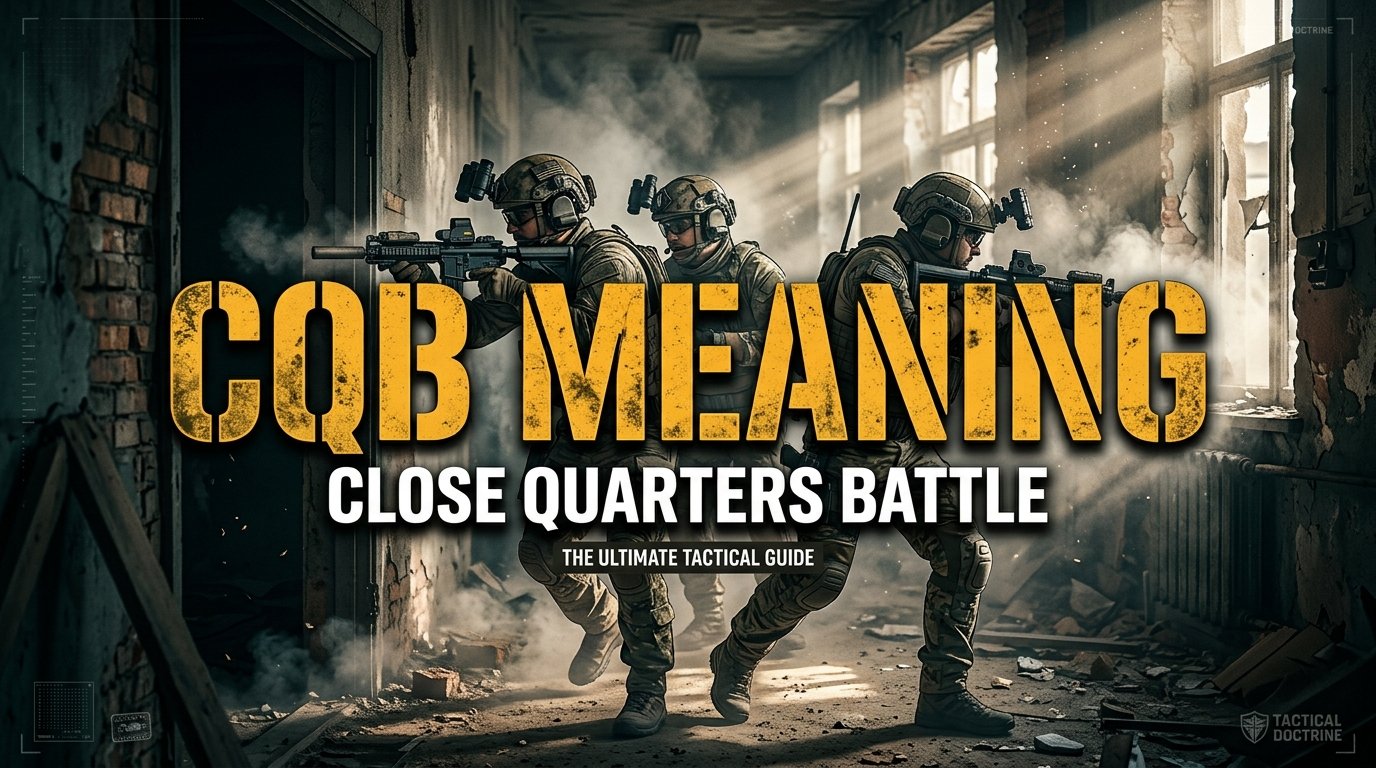
CQB is one such term. It commonly refers to Close Quarters Battle, a military and tactical concept used to describe armed encounters in confined spaces. You may see this abbreviation in military discussions, law enforcement reports, training materials, action films, and video games. Understanding CQB Meaning helps readers recognize the situations, environments, and professional activities associated with this term.
1. What Does CQB Mean?
CQB meaning Close Quarters Battle. It describes armed confrontations that take place at short distances, often inside buildings, rooms, vehicles, or other restricted environments. These settings create different challenges from encounters in open areas.
The term appears mainly in military, law enforcement, and security contexts. It describes a type of engagement rather than one particular weapon, organization, or piece of equipment.
For example, consider a military unit operating in a densely populated urban area. Its personnel may encounter threats inside buildings or other enclosed locations. Military professionals may describe these situations as close-quarters engagements.
The term can also appear in professional training programs. These programs discuss the unique demands of confined environments, including limited visibility, restricted movement, communication difficulties, and the presence of civilians.
Several important points help explain the concept:
- Close distance: Encounters happen within relatively short distances.
- Restricted environments: Buildings, corridors, rooms, and similar spaces often form the setting.
- Limited visibility: Walls, furniture, doors, and other obstacles can affect what people can see.
- Rapid decisions: Participants may have very little time to assess changing situations.
- High awareness: Identifying people, surroundings, and possible dangers becomes especially important.
One important distinction is that CQB does not describe every situation involving close physical contact. It specifically relates to armed engagements and the professional environments associated with them.
Understanding the definition also helps prevent confusion with other military abbreviations. Although several tactical terms describe related activities, they do not always mean the same thing.
2. The History and Development of Close Quarters Battle
The development of close-quarters combat connects to the long history of warfare in towns, fortifications, ships, and other confined locations. As military operations changed, specialized approaches to these environments became increasingly important.
However, modern urban warfare created new challenges. Growing cities introduced complex buildings, underground spaces, crowded streets, and civilian populations. Military organizations needed to understand how these environments affected operations.
Several developments influenced this evolution:
Urban growth: Larger cities created more complicated operating environments.
Modern architecture: Multi-story buildings, underground facilities, and enclosed structures introduced additional challenges.
Changing security threats: Military and law enforcement agencies faced different types of threats in populated areas.
Specialized training: Organizations developed dedicated programs to prepare personnel for difficult environments.
Improved communication: Modern equipment helped personnel share information and maintain awareness.
Today, close-quarters operations remain an important subject in military education and security discussions. Their development reflects changes in technology, architecture, public safety, and the nature of modern conflict.
It is also important to remember that the historical development of these practices varies across countries and organizations. Different military forces have developed their own terminology, training standards, and professional approaches.
3. CQB Meaning in Military Operations
In military settings, the abbreviation refers to close-range armed engagements, particularly those involving enclosed or built-up environments. It helps military professionals identify a distinct operational challenge.
Military operations can take place across many different environments. Open fields, forests, deserts, mountains, and urban areas each create different demands. Confined spaces add another layer of complexity because physical barriers can limit visibility and movement.
For example, an operation involving a large industrial building may present different challenges from one involving an open field. The structure itself can affect communication, visibility, and the ability to understand the surrounding environment.
Military discussions of this subject commonly include several broad areas:
- Urban environments: Cities contain buildings, streets, underground facilities, and crowded public spaces.
- Building interiors: Enclosed structures can create visibility and communication challenges.
- Operational awareness: Personnel must understand their surroundings and recognize changing conditions.
- Coordination: Different team members need clear communication and defined responsibilities.
- Civilian considerations: Military operations may take place near people who are not involved in the conflict.
These factors explain why military organizations treat confined engagements as a specialized subject.
The concept also appears in military documentaries, professional publications, historical accounts, and discussions of modern conflicts. In these sources, it provides a useful way to describe the nature of an engagement without explaining every operational detail.
It does not automatically indicate a particular military unit or mission. Rather, it identifies the type of environment and encounter being discussed.
4. CQB Meaning in Law Enforcement and Security
The term also appears in law enforcement and professional security discussions. Police officers and other authorized personnel may encounter dangerous situations in buildings, public facilities, and other confined locations.
For example, a law enforcement agency may discuss confined-environment risks when reviewing an incident inside a public building. The discussion might focus on officer safety, civilian protection, communication, and the need to follow established legal procedures.
Security professionals may also use related terminology when discussing:
- Protection of important facilities.
- Emergency response planning.
- Security risks inside large buildings.
- Threat assessment in crowded locations.
- Coordination with police and emergency services.
- Safety procedures for restricted areas.
The same abbreviation does not mean that every organization follows identical practices. A military training program and a police training program may use similar language while applying different rules, responsibilities, and standards.
For general readers, this distinction matters. It prevents the assumption that all close-range security situations belong to the same professional category.
The term should also not be confused with ordinary building security. Monitoring entrances, checking identification, and managing visitors are security activities, but they are not automatically examples of close-quarters battle.
5. Common Environments Associated With CQB
The environment plays a major role in understanding close-quarters engagements. Confined spaces create challenges that differ from those found in open locations.
Buildings are among the most commonly discussed environments. They may contain several rooms, narrow corridors, staircases, and different levels. These features can make it difficult to maintain a clear understanding of the surroundings.
Each environment has its own characteristics. A large warehouse, for instance, differs greatly from a small residential apartment. The number of occupants, building design, available exits, and surrounding conditions all affect the nature of an incident.
Understanding these environments also helps readers recognize why the subject receives attention in military education, emergency planning, and professional safety discussions.
6. Important Concepts and Terminology Related to CQB
Learning related terminology makes military and security discussions easier to understand. Several expressions frequently appear alongside the abbreviation, although each has a distinct meaning.
Close Quarters Combat (CQC)
CQC stands for Close Quarters Combat. It is a broader expression for physical confrontations at short distances. Depending on the context, it may include armed or unarmed encounters.
Urban Warfare
Urban warfare refers to military operations conducted in towns and cities. It includes a wider range of activities than close-quarters engagements.
Hostage Rescue
Hostage rescue refers to efforts to protect and recover people held against their will. Depending on the situation, these incidents may involve confined locations.
These terms may appear in the same article, documentary, or professional discussion. However, they describe different activities or areas of military and security work.
Language also matters when people research unfamiliar abbreviations. For example, online readers often encounter expressions such as texting abbreviations and their meanings that have completely different uses from professional military terminology.
Recognizing the context helps readers understand which definition applies.
7. CQB vs. CQC: What Is the Difference?
People sometimes use Close Quarters Battle and Close Quarters Combat interchangeably. However, the terms can carry slightly different meanings depending on the organization and context.
CQB generally emphasizes armed engagements in confined environments. CQC has a broader meaning and may describe close-range physical confrontations, including situations involving unarmed combat.
The distinction is useful when reading military publications, training materials, or security-related discussions.
| Feature | CQB | CQC |
| Full form | Close Quarters Battle | Close Quarters Combat |
| Main emphasis | Close-range armed engagements | Close-range physical confrontations |
| Common context | Military and tactical discussions | Military, martial arts, and self-defense |
| Environment | Often enclosed or restricted spaces | Can involve various close-range settings |
| Scope | More specialized in many military contexts | Often broader |
| Armed situations | Commonly associated | May involve armed or unarmed encounters |
Why Are the Terms Sometimes Confused?
The words battle and combat overlap in everyday language. Both can describe conflict or fighting. As a result, people may assume that the abbreviations have exactly the same meaning.
Another reason is that different organizations use terminology according to their own training systems. Some publications may use one expression more broadly than others.
Context is therefore essential. A military article about building engagements may use CQB, while a martial arts discussion may use CQC to describe close-range fighting.
Neither abbreviation should be interpreted without considering the subject being discussed.
8. Common Misunderstandings About CQB
Abbreviations often create confusion because people encounter them in different settings. Understanding common mistakes makes it easier to interpret the term accurately.
Here are several misunderstandings worth avoiding.
Mistake 1: Assuming CQB meaning hand-to-hand fighting
This is incorrect. The abbreviation refers to Close Quarters Battle, not simply physical fighting. Hand-to-hand combat is a separate concept.
Mistake 2: Thinking it only applies to military forces
Military organizations commonly use the term, but law enforcement and professional security discussions may also refer to it.
Mistake 3: Treating CQB and urban warfare as identical
Urban warfare covers a broad range of military activities in cities. CQB describes a more specific type of close-range engagement.
Mistake 4: Assuming every indoor incident is CQB
An incident inside a building does not automatically qualify. The nature of the encounter matters, particularly whether it involves an armed engagement.
Mistake 5: Confusing the abbreviation with a specific weapon
CQB does not refer to one particular firearm, tool, or equipment model. It describes an operational concept.
Mistake 6: Assuming every organization uses identical definitions
Military forces, police agencies, and training institutions may apply their own terminology. Their professional responsibilities also differ.
Another common source of confusion involves abbreviations found in casual online conversations. Expressions such as common internet shorthand belong to a different language context. Readers should not assume that every three-letter abbreviation has the same type of meaning.
A careful reading of the surrounding sentence usually provides the best clue.
9. Examples of CQB in Everyday Reading and Media
People often encounter the abbreviation outside professional environments. Films, television programs, documentaries, military games, and online discussions have made tactical terminology more familiar.
However, fictional entertainment does not always present technical terms accurately.
Consider these examples:
Example 1: Military documentary
A documentary describes an armed engagement inside a building as a close-quarters situation. The abbreviation helps viewers understand the environment being discussed.
Example 2: News report
A report discusses a security incident involving armed personnel in an enclosed public facility. A journalist may use the term when explaining the nature of the encounter.
Example 3: Video game
A military-themed game describes a mission in a building as a CQB scenario. Here, the abbreviation refers to the fictional setting and gameplay environment.
Example 4: Professional training discussion
A training instructor discusses the difficulties of confined environments, including communication, visibility, and civilian safety.
Example 5: Military history book
An author explains how soldiers experienced close-range engagements during an urban conflict. The term helps categorize that type of encounter.
Example 6: Online conversation
Someone asks why a particular military unit specializes in CQB. The question refers to its professional focus on confined-environment operations.
These examples demonstrate how the abbreviation can appear in different forms of communication.
Its meaning generally remains connected to close-range armed engagements, but the level of technical detail depends on the source.
Readers should also consider whether a source is educational, fictional, historical, or professional. This distinction helps prevent entertainment-based assumptions from becoming factual misunderstandings.
Frequently Asked Questions
1. What is the full form of CQB?
CQB stands for Close Quarters Battle. It describes armed engagements at short distances, commonly in confined environments such as buildings, rooms, and other restricted spaces.
2. Is CQB the same as CQC?
No. CQB usually refers to Close Quarters Battle and focuses on armed engagements. CQC means Close Quarters Combat and can include a wider range of close-range physical confrontations, including unarmed situations.
3. Where is CQB commonly used?
The abbreviation commonly appears in military publications, law enforcement discussions, professional security training, documentaries, action films, and military-themed video games.
4. Does CQB only happen inside buildings?
No. Buildings are common examples, but the concept can also relate to other restricted environments, including ships, underground facilities, and enclosed transportation spaces.
5. Is CQB a military technique or a type of weapon?
CQB is an operational concept, not a weapon. It describes a type of close-range armed engagement. Different organizations may have specialized training programs related to this subject.
6. Why is CQB important in modern security?
Confined environments create challenges involving visibility, communication, coordination, and civilian safety. Understanding the term helps readers follow discussions about military operations and professional security responsibilities.
Conclusion
Understanding CQB Meaning provides useful insight into military terminology and modern security discussions. CQB stands for Close Quarters Battle, a term associated with armed engagements at short distances, especially in restricted environments. Buildings, ships, underground facilities, and other enclosed locations can create unique challenges for military and security personnel.
For anyone interested in military language, public safety, or security terminology, learning this expression provides a helpful starting point. It also makes related discussions easier to follow. As with other specialized abbreviations, understanding the words behind the letters is the simplest way to avoid confusion. Exploring the meaning of unfamiliar expressions can further improve your understanding of language used across different subjects.