This guide explains the ngl meaning in text in simple English. You will learn how to use NGL in a sentence, explore real-life examples, compare it with similar slang terms, and discover when it is appropriate to use. By the end, you will feel more confident using NGL in your daily conversations.
NGL Meaning in Text: Simple Examples
The easiest way to understand NGL is to look at how people use it in everyday messages. Its meaning can change slightly with context, but it usually introduces an honest feeling or opinion.
Here are some simple examples:
1. NGL, your new haircut looks great. Meaning: I honestly think your haircut looks great.
2. NGL, I am tired today. Meaning: To be honest, I feel tired today.
3. NGL, that test was really difficult. Meaning: I genuinely found the test hard.
4. NGL, I miss our old days. Meaning: I honestly miss the time we spent together.
5. NGL, this song makes me emotional. Meaning: I truly feel emotional when I hear this song.
6. NGL, I thought the movie would be boring. Meaning: I expected the movie to be boring, and I am sharing my honest thoughts.
7. NGL, you were right about that. Meaning: I admit that your opinion was correct.
8. NGL, I love this outfit. Meaning: I genuinely like the outfit.
9. NGL, today was a bad day. Meaning: Honestly, I had a difficult day.
10. NGL, I was nervous before the interview. Meaning: I truly felt nervous before the interview.
These examples show that NGL works with positive, negative, and emotional statements. It does not automatically mean something bad is coming. The words that follow it determine the message.
How to Use NGL in a Sentence
You can place NGL at the beginning of a sentence or use it within a casual message. It helps introduce a personal thought without making the sentence sound too formal or serious.
1. Use NGL at the Beginning
Starting with NGL is the most common and simple approach. It tells the reader that you are about to share your honest opinion or reaction.
Examples:
- NGL, I really enjoyed the party. You are saying that you genuinely had a good time.
- NGL, this food tastes amazing. You are expressing your real opinion about the food.
- NGL, I did not expect that result. You are honestly sharing your surprise.
- NGL, I need a break. You are admitting that you feel tired or overwhelmed.
- NGL, your advice helped me a lot. You are openly acknowledging someone’s help.
This sentence pattern works well in text messages, online comments, and conversations with friends.
2. Use NGL in the Middle of a Sentence
You can also put NGL after the opening words of a sentence. This placement sounds natural in informal writing, although it is less common than starting with the abbreviation.
Examples:
- I, NGL, really enjoyed that performance. The speaker emphasizes their genuine enjoyment.
- That was, NGL, the best meal I have had in weeks. The speaker strongly praises the meal.
- It was NGL a difficult decision. The speaker means the decision was genuinely difficult, although this construction is less natural than “NGL, it was a difficult decision.”
For clear and natural English, place NGL at the beginning whenever possible.
3. Use NGL to Admit Something
NGL often appears when people admit something they might not usually say aloud. It can introduce a small confession, an unexpected feeling, or an honest reaction.
Examples:
- NGL, I was jealous when I saw your pictures.
- NGL, I forgot about the meeting.
- NGL, I was scared to try it.
- NGL, I thought you were angry with me.
- NGL, I almost gave up.
In each example, the abbreviation makes the admission feel informal. It can soften the opening, but it does not change the truth of what follows.
NGL Meaning in Text Messages and Social Media
The ngl meaning in text stays mostly the same across messaging apps and social platforms. However, people often use it differently depending on the conversation, audience, and subject.
NGL on WhatsApp
Casual chats and personal messages
On WhatsApp, people use NGL when talking with friends, family members, or partners. It helps them express their feelings quickly without typing a longer phrase.
Examples:
- NGL, I had a great time talking to you.
- NGL, I am worried about tomorrow.
- NGL, your message made me smile.
- NGL, I really needed to hear that.
You can use it in a private chat when the conversation already feels relaxed. In a serious discussion, writing the full phrase may feel more thoughtful.
NGL on Instagram
Captions, comments, and direct messages
Instagram users may add NGL to comments, captions, or direct messages. It often introduces compliments, opinions about photos, and reactions to posts.
Examples:
- NGL, this picture deserves more likes.
- NGL, your travel photos look incredible.
- NGL, this outfit is a whole vibe.
- NGL, I want to visit this place too.
The abbreviation helps create a friendly, conversational tone. However, readers may interpret a compliment differently depending on your relationship and the rest of the message.
NGL on TikTok
Videos, reactions, and opinions
TikTok creators and viewers may use NGL in comments, video captions, and discussions. It can introduce a strong reaction, an unpopular opinion, or an honest review.
Examples:
- NGL, this trend is actually fun.
- NGL, I watched this video five times.
- NGL, the ending surprised me.
- NGL, this recipe looks easier than I expected.
NGL suits informal content because it is short and widely recognizable among many internet users. Not everyone knows every abbreviation, so clear wording still matters.
NGL in Snapchat Messages
Snapchat conversations often use short expressions and slang. NGL fits this style because it lets users share an honest reaction without writing a long message.
Examples:
- NGL, that was hilarious.
- NGL, I miss hanging out with you.
- NGL, your snap made my day.
Use the abbreviation naturally rather than adding it to every message. One well-placed NGL often communicates more clearly than repeated slang.
NGL Examples for Different Situations
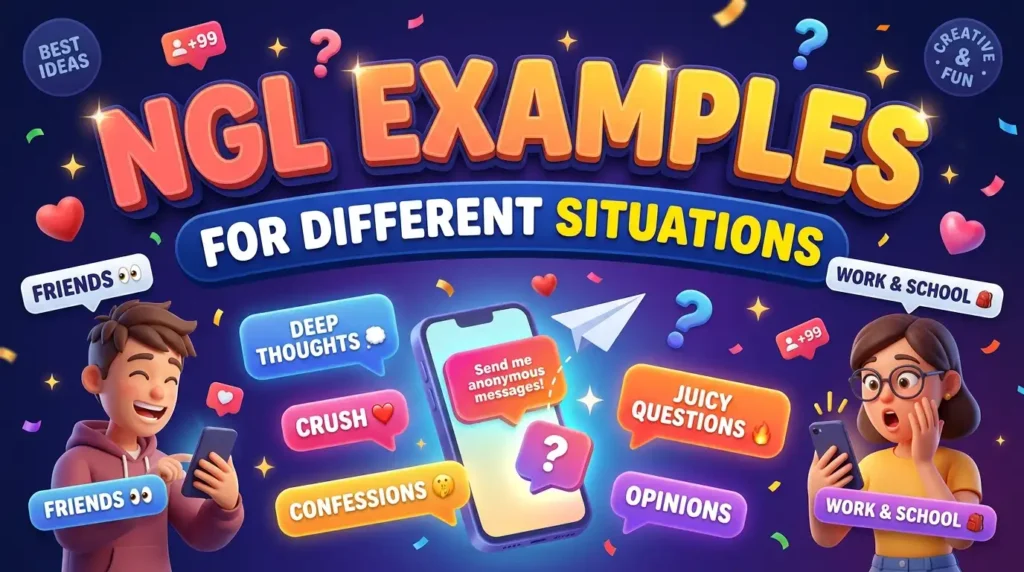
The meaning of NGL becomes easier to remember when you see how it works in different situations. These examples cover friendships, relationships, school, work, and everyday life.
NGL Examples for Friends
Friends often use NGL to share honest opinions or playful confessions. The abbreviation can make a message sound relaxed and personal.
- NGL, you are the funniest person I know.
- NGL, I did not like that movie either.
- NGL, I was waiting for your reply.
- NGL, our last trip was unforgettable.
These messages work best when both people feel comfortable speaking casually. A teasing comment can still hurt someone if it targets a sensitive subject.
NGL Examples for Love and Relationships
In romantic conversations, NGL can introduce affection, admiration, or a personal feeling. It helps people express emotions without sounding overly formal.
- NGL, talking to you makes my day better.
- NGL, I smile whenever I see your name.
- NGL, I have been thinking about you all day.
- NGL, you mean more to me than you realize.
- NGL, I feel lucky to have you in my life.
These examples sound natural in an informal chat with a partner. For an important conversation, explain your feelings fully instead of relying on an abbreviation alone.
NGL Examples for School and College
Students may use NGL when discussing classes, exams, assignments, and everyday campus life. It makes their messages sound friendly and direct.
- NGL, that exam was harder than I expected.
- NGL, I need more time to finish this assignment.
- NGL, our teacher explained that topic really well.
- NGL, I am excited about graduation.
These sentences are suitable for casual conversations with classmates. For emails to teachers or formal academic work, choose standard English instead.
NGL Examples for Work
Coworkers sometimes use NGL in informal team chats. It can help introduce feedback, a personal reaction, or an honest observation.
- NGL, that presentation was impressive.
- NGL, we may need more time to complete this task.
- NGL, the new process is easier to follow.
Be careful when communicating with clients, managers, or unfamiliar colleagues. In formal settings, “To be honest” or “In my view” usually sounds more professional.
NGL vs. Other Common Text Abbreviations
Many internet abbreviations look similar, but each has a different purpose. Understanding these differences helps you choose the right expression for your message.
| Slang term | Full form | Meaning |
| NGL | Not Gonna Lie | Introduces an honest opinion or admission |
| TBH | To Be Honest | Expresses an honest thought |
| IMO | In My Opinion | Introduces a personal viewpoint |
| FR | For Real | Shows agreement or emphasizes something |
| IDK | I Don’t Know | Shows uncertainty or lack of knowledge |
| BTA | But Then Again | Adds another point to a conversation |
| IMO | In My Opinion | Signals that a statement reflects personal judgment |
NGL vs. TBH
NGL and TBH are close in meaning. Both can introduce an honest thought, but NGL often sounds more casual and conversational.
Examples:
- NGL, this game is difficult.
- TBH, this game is difficult.
Both sentences express the same basic idea. The difference is small, and many people use these expressions interchangeably in casual chats.
NGL vs. IMO
IMO means “In My Opinion.” It highlights a viewpoint rather than specifically suggesting honesty.
Compare these sentences:
- NGL, this is the best restaurant in town. The speaker emphasizes an honest opinion.
- IMO, this is the best restaurant in town. The speaker presents a personal judgment.
The first focuses on sincerity. The second focuses on the fact that the statement is an opinion.
NGL vs. FR
FR stands for “For Real.” People use it to express agreement, surprise, or emphasis.
For example:
- NGL, that concert was incredible.
- FR, that concert was incredible.
The first introduces the speaker’s honest reaction. The second can emphasize that the concert really was incredible, or show agreement with another person’s statement.
Common Mistakes to Avoid When Using NGL
Although NGL is simple, using it in the wrong situation can make your message sound awkward. A few basic rules will help you use it more naturally.
1. Do not use NGL in every sentence. Repeating it too often can make your writing feel forced. Use it when you genuinely want to emphasize an honest opinion or admission.
2. Avoid it in formal writing. Academic essays, official reports, business proposals, and job applications usually require standard English. Write “To be honest” or explain your point directly.
3. Do not assume NGL always introduces criticism. A message like “NGL, you look amazing” is a compliment. The abbreviation can introduce praise, disappointment, surprise, or affection.
4. Do not confuse NGL with a guarantee of truth. Someone can write NGL and still be mistaken, exaggerate, or share a misleading claim. The abbreviation communicates the speaker’s intended tone, not proof that a statement is accurate.
5. Pay attention to context. “NGL, that was terrible” may sound blunt or hurtful. If you want to offer constructive feedback, explain what went wrong and suggest a helpful improvement.
6. Remember your audience. Close friends may understand internet slang immediately. A teacher, client, older relative, or unfamiliar reader may prefer the full phrase.
These simple habits make your messages clearer and help you avoid misunderstandings.
When Should You Use NGL?
The ngl meaning in text makes it useful for casual conversations, but not every situation calls for it. Think about your audience, purpose, and tone before adding the abbreviation.
Use NGL when you want to:
- Share a genuine reaction to a movie, song, meal, or event.
- Admit a small mistake or an unexpected feeling.
- Give a friendly compliment to someone.
- Express a personal opinion in a relaxed discussion.
- Add emphasis to a social media comment or caption.
- Make a casual message sound more conversational.
For example, you could write, “NGL, I was nervous before my first driving lesson.” This sounds natural in a chat with a friend.
However, imagine writing to your manager about a missed deadline. Instead of saying, “NGL, I could not finish the report,” you could write, “To be honest, I need another day to finish the report.” The second version sounds more professional and gives the reader useful information.
The main rule is simple: use NGL when it fits the relationship and the situation. Clear communication matters more than using popular slang.
Is NGL Still Used in Online Conversations?
NGL remains a recognizable abbreviation in internet slang. People use it in text messages, social media comments, captions, and online discussions to express honest reactions or personal opinions.
Internet slang changes over time. Some expressions become less common, while others remain useful because they are short and easy to understand. NGL continues to serve a clear purpose: it lets people introduce an opinion without typing the full phrase.
You may also see it written in lowercase as “ngl.” Both uppercase and lowercase versions communicate the same meaning. The choice usually depends on a person’s typing style.
The abbreviation can also appear with punctuation. For example, “NGL, I love this song” uses a comma after the opening phrase. In quick chats, people may skip the comma and write “ngl this song is amazing.” Both versions are easy to understand in informal settings.
There is no need to memorize every internet abbreviation. Learn the terms you see often, consider their context, and use them only when they help you express your thoughts.
NGL Meaning in Text: Quick Rules to Remember
Understanding the ngl meaning in text is easier when you remember a few simple rules. These tips will help you recognize the abbreviation and use it correctly in everyday English.
- Full form: Not Gonna Lie.
- Main purpose: To introduce an honest thought, opinion, or admission.
- Common placement: Usually at the beginning of a sentence.
- Writing style: Informal and conversational.
- Common platforms: WhatsApp, Instagram, TikTok, Snapchat, and other online spaces.
- Similar expression: TBH, which means “To Be Honest.”
- Formal alternative: “Honestly” or “To be honest.”
For example, “NGL, I enjoyed the show” communicates a genuine positive reaction. You can replace NGL with “Honestly” to make the sentence sound more suitable for a wider range of readers.
Frequently Asked Questions (FAQs)
1. What does NGL mean in text messages?
NGL means “Not Gonna Lie.” People use it in messages to introduce an honest opinion, feeling, or admission. For example, “NGL, I miss you” means “Honestly, I miss you.”
2. What is the ngl meaning in text on Instagram?
On Instagram, NGL has the same meaning: “Not Gonna Lie.” Users add it to captions, comments, and direct messages to share honest reactions, compliments, or personal opinions.
3. Is NGL positive or negative?
NGL can introduce both positive and negative statements. “NGL, you look amazing” expresses praise, while “NGL, I did not enjoy the movie” expresses disappointment. The rest of the sentence determines the tone.
4. What is the difference between NGL and TBH?
NGL means “Not Gonna Lie,” while TBH means “To Be Honest.” Both introduce honest thoughts and often serve the same purpose in casual conversations. Their tone and meaning overlap considerably.
5. Can I use NGL in formal writing?
It is better to avoid NGL in formal emails, academic assignments, official documents, and professional reports. Use “To be honest,” “Honestly,” or a direct statement instead.
6. How do I use NGL in a sentence?
Place NGL at the beginning of an informal sentence. For example, “NGL, this book is amazing.” The sentence means that you genuinely think the book is amazing.
Conclusion
NGL is a simple and useful abbreviation that makes online conversations feel natural and relaxed. It stands for “Not Gonna Lie” and usually introduces an honest opinion, personal feeling, or unexpected admission. You can use it to praise a friend, discuss a movie, share your feelings, or express a reaction on social media.
The ngl meaning in text is easy to remember once you understand its purpose. It signals that you want to share a thought openly, although it does not guarantee that the statement is true. Context still matters, especially when discussing sensitive topics or giving feedback.
Use NGL in casual messages with friends, family, and people who understand internet slang. For formal conversations, choose expressions such as “Honestly” or “To be honest.” Avoid overusing the abbreviation, and make sure your message remains clear.