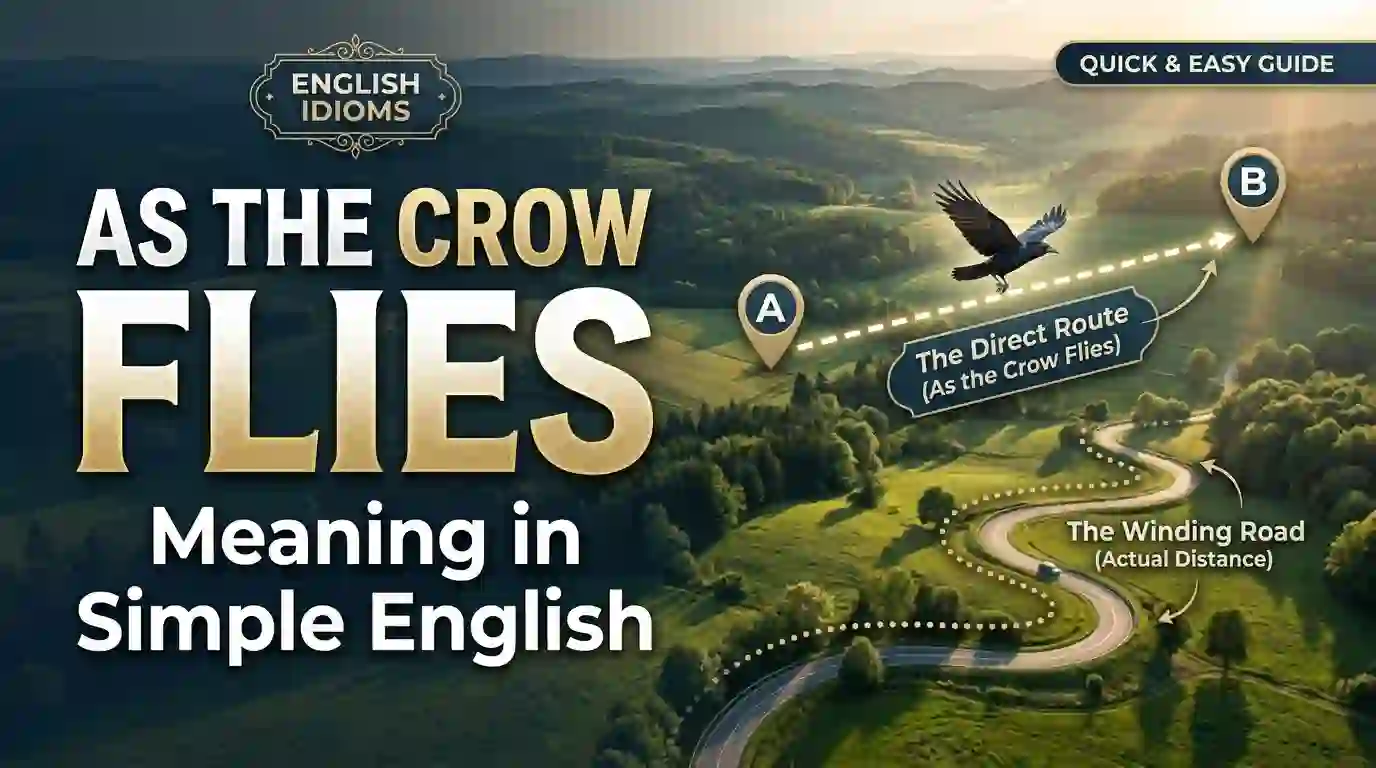
When it comes to understanding English expressions, some phrases can seem strange at first. As the crow flies meaning is one example. It describes the shortest distance between two places in a straight line. It does not follow roads, paths, rivers, or other routes that people use to travel.
What Does As the Crow Flies Mean?
The phrase describes the shortest distance between two points when measured in a straight line. It ignores roads, buildings, hills, and other obstacles that may make a real journey longer.
Imagine your home is on one side of a hill and your friend’s home is on the other. The homes may be two miles apart in a straight line. However, you may need to drive six miles to reach your friend because the road goes around the hill. The straight-line distance is the distance as the crow flies.
The expression helps people understand how far apart two places are. It does not tell you how long a journey will take or which route you should follow.
A Simple Definition
In simple English, “ as the crow flies meaning ” the direct distance between two places, measured in a straight line. It does not include the extra distance caused by roads, bends, or obstacles.
For example, a school may be three miles from your home as the crow flies. However, the nearest road may take you four miles to reach the school. Both distances are correct because they measure different things.
You can use this expression when talking about towns, buildings, landmarks, homes, or other locations. It is especially useful when you want to compare the direct distance with the distance you must travel.
Why Does the Phrase Mention a Crow?
The phrase uses a crow because a crow can fly directly toward a destination instead of following roads. People use this image to explain a straight-line measurement between two places.
A crow can travel over fields, rivers, hills, and buildings. A person walking or driving usually needs to follow available paths and roads. This creates a difference between the direct distance and the actual route.
The expression is figurative. It does not mean that someone must watch a crow or measure the exact path taken by a bird. It simply gives readers an easy way to picture the shortest distance between two points.
What Is the Origin of As the Crow Flies?
The expression comes from the familiar idea that a flying bird can travel directly between locations. Unlike people on foot or in vehicles, birds do not need to follow a road network.
The phrase became part of English through the use of birds as examples of direct travel. Its exact historical development is less important to its modern as the crow flies meaning than the simple image it creates.
Historical Background
People have long used animals and nature to explain human experiences. Birds often appear in expressions about freedom, movement, distance, and direction. This phrase follows the same pattern by using a crow as a familiar example of an animal that flies.
The expression has appeared in English usage for centuries. Today, it remains common because it explains a practical idea in only a few words.
Why a Crow Instead of Another Bird?
A crow is a familiar bird in many parts of the world. It can fly across open spaces and move between locations without following human roads.
The phrase does not suggest that crows always fly in perfectly straight lines. Real birds may change direction, search for food, avoid danger, or respond to weather. The expression uses an imagined direct flight as a simple comparison.
People understand this image quickly, which makes the phrase useful in ordinary conversation. As the crow flies meaning depends on the idea of a straight line, not on the actual behavior of every crow.
How to Use As the Crow Flies in a Sentence
You can use this expression when describing the distance between two places. It usually appears after a distance or location, often with the word “is” or “lies.”
For example, you might say, “The village is five miles away as the crow flies.” This tells the listener that the village is five miles away in a straight line. It does not mean the road journey is exactly five miles.
The phrase works well in conversations about travel, property, geography, and local landmarks. It is also useful when a map shows that two places are close together but the available route is much longer.
Everyday Examples
Here are some simple examples that show how people use the expression in daily life.
- “My office is two miles from home as the crow flies.”
- “The beach is about four miles away as the crow flies.”
- “The two villages are only six miles apart as the crow flies.”
- “The airport is ten miles from the hotel as the crow flies.”
- “Our school is close to the river as the crow flies.”
- “The mountain village lies eight miles from town as the crow flies.”
Each sentence describes a direct distance. The actual journey may be longer because of roads, bridges, buildings, or natural features.
Examples in Conversations
The phrase also fits naturally into casual conversations. It can help explain why a place that seems close on a map takes longer to reach.
Example 1
Alex: “How far is your house from the lake?”
Sam: “About two miles as the crow flies, but the road takes almost five miles.”
Example 2
Mia: “Is the next town far away?”
Noah: “Not really. It is seven miles away as the crow flies.”
Example 3
Lily: “Why does the trip take so long if the airport is nearby?”
Jack: “The airport is close as the crow flies, but the road goes around the hills.”
These examples show how the expression explains the difference between physical distance and travel distance.
As the Crow Flies Meaning in Different Situations
The phrase is not limited to one type of journey. People use it in several situations where a direct measurement helps explain the relationship between locations.
In Travel and Directions
Travelers may use this expression to describe how far a destination is from their current location. It is useful when a place looks close on a map but requires a longer drive.
For example, a campsite may be four miles from a town as the crow flies. However, visitors may need to drive 12 miles because the road follows a winding route through the hills.
The phrase gives travelers a basic idea of the locations’ physical separation. However, it cannot replace road directions, route planning, or travel-time estimates.
In Real Estate
Property descriptions sometimes use straight-line distances to show how close a home is to a landmark, beach, school, or town center.
For example, a house may be one mile from the beach as the crow flies. That sounds close, but the nearest public entrance might be three miles away by road.
When reading property listings, check whether the stated distance refers to a direct measurement or an actual walking route. This helps you avoid misunderstandings about access and convenience.
In Geography and Mapping
Geographers and map users often compare direct distances between locations. A straight-line measurement helps describe the basic separation between two points.
For example, a map may show that two cities are 30 miles apart as the crow flies. Their road distance could be much greater because highways curve, cross rivers, or pass through other towns.
The expression is useful for general comparisons. However, accurate geographic work may use specific measurement methods that account for the Earth’s curved surface.
In News and Reports
News reports may use this phrase to explain the distance between an event and a nearby town, landmark, or public facility.
For example, a report might state that a forest fire started five miles from a village as the crow flies. This describes the direct distance between the fire’s location and the village.
It does not necessarily mean the fire is five miles away by road. Nor does it tell readers how quickly the fire might spread. Terrain, wind, and other conditions can affect the real situation.
As the Crow Flies vs. Actual Travel Distance
The main difference is simple: one measures a straight line, while the other measures a route. Understanding this difference helps you interpret distances correctly.
What Is Straight-Line Distance?
Straight-line distance measures the direct separation between two points. Imagine drawing a line on a map from your home to a shop. The length of that line represents the basic idea behind the expression.
This measurement ignores the roads and paths you would use to reach the shop. It also ignores physical obstacles that may prevent you from traveling directly between the two points.
Straight-line distance is useful for comparing locations. It can help you understand whether two places are geographically close, even when traveling between them is difficult.
What Is Road Distance?
Road distance measures the length of a route along roads that connect two places. It may include turns, bends, bridges, roundabouts, and detours.
For example, a hospital may be three miles from your home in a straight line. However, the road distance may be five miles because the river between you and the hospital has only one nearby bridge.
Road distance is usually more useful when planning a car journey. For walking or cycling, you should check the relevant route because it may differ from the road route.
Comparison Table
| Feature | As the crow flies | Actual travel distance |
| Measurement | Straight line | Route taken |
| Roads considered | No | Yes |
| Obstacles considered | No | Yes |
| Common use | Comparing locations | Planning journeys |
| Typical result | Shorter or equal | Longer or equal |
| Best tool | Map measurement | Navigation app |
In most ordinary situations, the direct distance is shorter than the travel route. If a route follows a perfectly straight path between two points, the two distances may be equal.
How to Calculate Distance As the Crow Flies
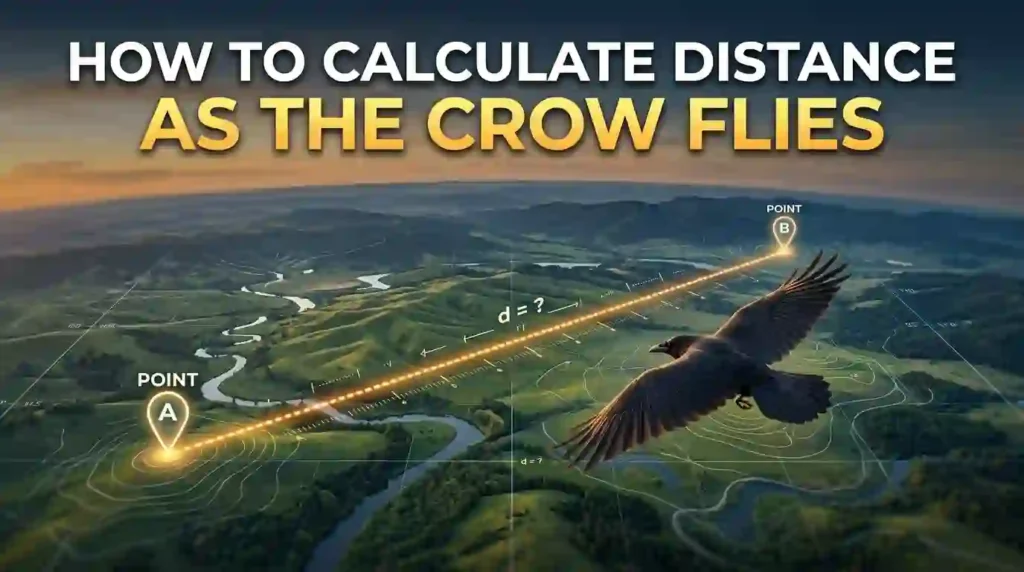
You do not need to follow a bird to measure a direct distance. You can use a map, a digital mapping tool, or geographic coordinates to estimate the separation between two locations.
Use a Map
A paper map can help you estimate a straight-line distance. First, find both locations. Then draw a straight line between them and measure its length using the map’s scale.
For example, suppose one centimeter on your map represents two kilometers. If the line between two towns measures three centimeters, their direct distance is approximately six kilometers.
This method is easy to understand, but the result depends on the map’s scale and your measurement accuracy. A digital map may provide a more convenient estimate.
Use an Online Map Tool
Many digital maps offer a distance-measuring feature. You can select two locations and measure the distance between them without following a road route.
A simple process looks like this:
- Open a map service that supports distance measurement.
- Find the first location.
- Select the distance-measuring tool.
- Mark the second location.
- Read the displayed distance.
Make sure you select a direct measurement rather than driving, walking, or cycling directions. Route planners usually calculate distances along available paths instead of measuring a straight line.
Calculate Distance With Coordinates
For more precise work, you can use the latitude and longitude of two locations. These coordinates identify positions on the Earth’s surface.
A geographic distance formula, such as the haversine formula, can estimate the shortest surface distance between two points while accounting for the Earth’s curvature. This is more suitable for geographic coordinates than treating the entire Earth as a flat map.
For everyday use, you rarely need to calculate the distance manually. A map tool is usually enough. Remember that the result is a geographic measurement, not a promise about how quickly you can reach the destination.
Common Mistakes When Using the Phrase
Although the expression is easy to understand, people sometimes confuse as the crow flies meaning with other types of distance. A few simple rules can help you use it correctly.
Mistaking It for Driving Distance
The most common mistake is assuming that the phrase gives the length of a road journey. It does not.
If a town is five miles away as the crow flies, you may need to drive seven, ten, or even more miles to reach it. The actual distance depends on the available road network and the location of bridges or crossings.
When giving driving directions, use road distance or travel time instead.
Assuming the Journey Will Be Short
A small direct distance does not always mean an easy journey. A river, mountain, private property, or restricted area may separate two nearby places.
For example, a village might be two miles from a train station in a straight line. Yet reaching the station may require a long trip to the nearest road crossing.
Always consider access and obstacles before deciding whether a destination is easy to reach.
Using the Phrase for Travel Time
The expression describes distance, not time. It cannot tell you how many minutes a journey will take.
Two places may be one mile apart in a straight line, but reaching one from the other could take five minutes or an hour. Traffic, road conditions, terrain, and transport options all affect the journey.
If you need a time estimate, check a navigation tool or calculate the expected travel time using the appropriate route.
Similar Expressions and Their Meanings
English has several expressions that describe distance or location. Some are close in as the crow flies meaning, while others describe different ideas.
In a Straight Line
“In a straight line” is the closest simple alternative. It describes a direct line between two points without following bends or curves.
For example, “The school is three miles from my house in a straight line” means almost the same as saying the school is three miles away as the crow flies.
This alternative is especially helpful for people who are learning English. It communicates the idea clearly without using an animal-based expression.
Direct Distance
“Direct distance” is a more neutral phrase for the separation between two locations. It often appears in explanations, technical discussions, and mapping contexts.
For example, you could say, “The direct distance between the airport and the hotel is eight miles.” This statement focuses on the measurement rather than the route.
The phrase is easy to understand, although it may sound slightly more formal than the traditional expression.
As the Bird Flies
“As the bird flies” uses the same basic image of direct flight. People may understand it as a variation of the familiar phrase, but “as the crow flies” is the established expression in everyday English.
If you want to sound natural, use the standard form. If you are explaining as the crow flies meaning to a beginner, “in a straight line” is often the clearest choice.
Tips for Using As the Crow Flies Naturally
You can make your English sound more natural by using this expression in situations where direct distance matters.
- Place it after the distance: Say, “The town is six miles away as the crow flies.”
- Compare it with the road route: Explain that a destination is nearby in a straight line but farther away by road.
- Use it for locations: It works well for towns, homes, landmarks, and other geographic points.
- Avoid using it for time: Do not use the expression to mean a short journey or a quick trip.
- Choose simple alternatives when needed: “In a straight line” is clear and suitable for beginners.
- Check the route separately: Use a navigation tool if you need driving, walking, or cycling directions.
Practice by describing places near your home. For example, think about the distance to a park, school, shop, or station. Compare the direct distance with the route you would actually take. This will help you understand the phrase and remember when to use it.
Conclusion
As the crow flies meaning describes the direct distance between two places, measured in a straight line. It ignores roads, paths, rivers, hills, and other obstacles that may make an actual journey longer. For example, two towns may be five miles apart as the crow flies, even if the road between them covers eight miles.
The phrase is useful in everyday conversations, travel descriptions, real estate listings, geography, and news reports. It helps people understand how close two locations are without describing the route between them. However, it does not tell you how long a trip will take or whether you can travel directly between the places.
To use the expression correctly, remember one simple rule: it measures distance, not the journey itself. If you need to drive, walk, or cycle somewhere, check the actual route. If you only want to describe the direct distance between two points, this familiar English phrase is a clear and natural choice.
Frequently Asked Questions
1. What is as the crow flies meaning in simple English?
It means the straight-line distance between two places. It ignores roads, paths, and obstacles that may make the actual journey longer.
2. Why do people say as the crow flies?
The phrase compares direct travel between two locations with the way a flying bird can move across open spaces. It gives people an easy image of a straight-line distance.
3. Is as the crow flies the same as driving distance?
No. Driving distance follows roads, while the expression describes a direct line between two points. The driving distance is often longer.
4. How do you use as the crow flies in a sentence?
You could say, “The airport is ten miles away as the crow flies.” This means the airport is ten miles away in a straight line, although the road route may be longer.
5. Can I measure a distance as the crow flies on Google Maps?
Yes. Use a distance-measuring feature to mark two locations and check the direct distance. Do not confuse it with the driving or walking distance shown by route directions.
6. Does as the crow flies mean a short distance?
Not necessarily. It describes how distance is measured, not whether the distance is short. You can use it for places a mile apart or hundreds of miles apart.