When it comes to internet slang, some words move from gaming communities into everyday chats, comments, memes, and social media. NPC meaning is one example. The term originally came from video games, where an NPC is a character controlled by the game rather than by a human player.
What Does NPC Mean in Text?
In text messages and online conversations, NPC usually refers to a person who seems predictable, follows common patterns, or repeats familiar behavior without showing much independent thought or reaction.
The abbreviation comes from non-player character, a term used in video games. An NPC is controlled by the game’s programming rather than by a person sitting behind the character. NPCs often follow programmed routines, give the same dialogue, or perform specific tasks whenever players interact with them.
Over time, internet users started using the word outside gaming. Someone might call another person an NPC when they think that person’s behavior looks:
- Predictable
- Repetitive
- Scripted
- Unoriginal
- Emotionally detached
- Heavily influenced by trends
- Similar to everyone else’s behavior
For example, someone might post:
“He gives NPC energy.”
This does not mean the person is literally a video game character. It usually means the speaker thinks the person’s behavior looks unusually predictable or scripted.
The term can be playful, humorous, teasing, or insulting. The surrounding conversation is important.
NPC Meaning and the Gaming Origin
The original gaming use is straightforward: an NPC is a character that exists in a game world but is not controlled directly by a human player during normal gameplay.
NPCs can serve many purposes. They may provide information, sell items, assign quests, protect locations, create obstacles, or simply make a virtual world feel populated.
For example, a fantasy game might contain a shopkeeper who always stands behind a counter. When the player approaches, the shopkeeper may say the same greeting and offer the same menu of items.
That character is an NPC.
Other examples include:
- A village resident who follows a daily routine
- A guard who protects a gate
- A character who gives a quest
- A merchant who sells equipment
- A character who provides background information
- A computer-controlled enemy or ally
The key idea is that the game’s system controls the character’s behavior.
Modern slang borrowed this idea. When people call someone an NPC, they compare that person’s behavior to a character who follows a programmed routine.
The comparison is usually figurative rather than literal.
NPC Meaning in Different Texting Situations
The meaning can shift depending on where and how the word appears. Context often matters more than the abbreviation itself.
A message such as:
“NPC lol”
may be playful.
A comment such as:
“Stop acting like an NPC.”
may sound more critical.
A gaming message such as:
“The NPC gave me a new quest.”
uses the original meaning and has nothing to do with internet slang.
Here are some common contexts:
| Context | Likely meaning |
| Video game chat | Non-player character |
| Friend’s text | Playful comment about predictable behavior |
| Social media comment | Someone acting repetitively or following trends |
| Meme | Humorous comparison to a programmed character |
| Argument | Possible insult about conformity or independent thinking |
| Gaming discussion | Usually the literal game character |
This is why you should not automatically assume that every use of NPC is an insult.
The surrounding words, relationship, and topic can change the tone completely.
Common Examples of NPC in Text
Examples make slang easier to understand because the same abbreviation can appear in very different situations.
Here are several realistic examples:
Example 1: Repeating a phrase
“You have said ‘I’m tired’ five times today. NPC behavior.”
The speaker is joking about repetition.
Example 2: Following a routine
“Every morning he gets coffee at the exact same time. Bro is an NPC.”
This describes predictable behavior.
Example 3: Social media trends
“Everyone is posting the same video with the same caption. NPC vibes.”
The speaker thinks people are copying a trend.
Example 4: Gaming
“Talk to the NPC near the castle.”
Here, NPC has its original gaming meaning.
Example 5: Predictable answer
“I asked him what he wanted for dinner, and he said pizza again. NPC.”
The joke comes from the repeated response.
Example 6: Scripted conversation
“She gives the same answer every time. It feels like talking to an NPC.”
The speaker compares the conversation to a game character with limited dialogue.
Example 7: Meme language
“POV: You walk into the store, and the NPC starts explaining the same deal.”
This uses the gaming idea for comedy.
These examples show why context matters. The word itself does not automatically tell you whether the speaker is being serious, funny, or insulting.
NPC Meaning vs. Main Character
NPC and “main character” often appear together in internet culture, but they describe different ideas.
The phrase main character generally describes someone who sees themselves as central to a situation or behaves with strong confidence and individuality. It can be positive, humorous, or critical depending on context.
NPC usually suggests the opposite image: someone who appears predictable, passive, repetitive, or heavily influenced by others.
Consider these simplified examples:
- Main character: “I’m going to do what I want.”
- NPC: “I just do what everyone else does.”
These are internet metaphors, not psychological categories.
People often use both expressions for jokes rather than literal descriptions of personality.
For example:
“Main character on weekends, NPC at work.”
This could simply be a humorous way to describe how someone’s behavior changes in different settings.
It is also common for people to exaggerate these labels in memes. Therefore, readers should avoid treating the terms as formal descriptions of a person’s character.
How to Reply When Someone Says NPC
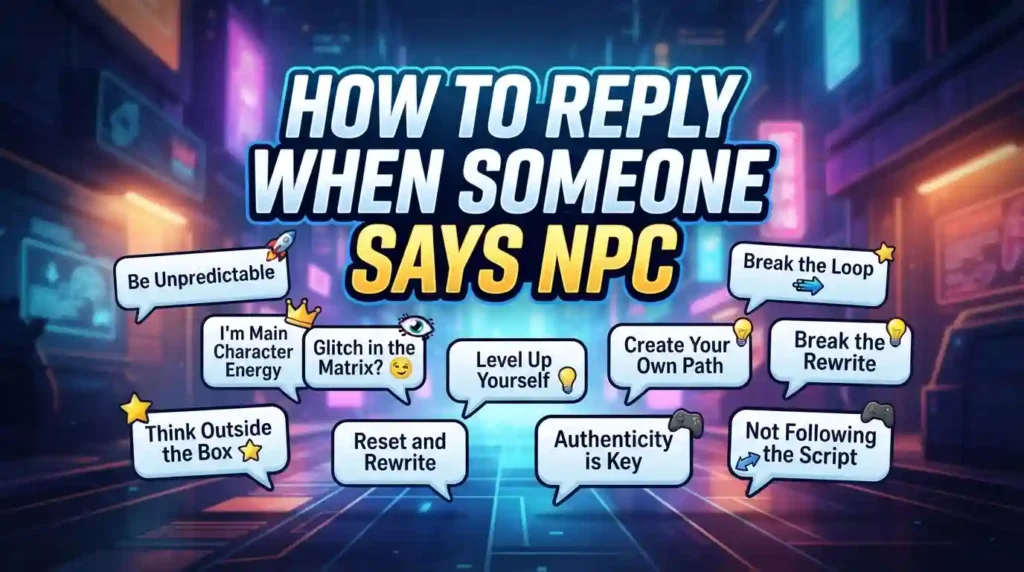
Your response should match the tone of the conversation. If the person is joking, a funny reply can keep the conversation light. When someone says “NPC” to you, your reply depends on the tone. If they are joking, answer with humor. You can say, “At least I’m consistent!” If they mean it negatively, stay calm and ask what they mean.
For example:
“At least my programming is efficient.”
Or:
“Wait until my next update.”
If someone uses NPC as a gaming reference, you can simply continue the gaming conversation.
If someone uses it as an insult, you can ask what they mean rather than immediately arguing.
For example:
“What makes you say that?”
This gives the other person a chance to explain their comment.
You can also respond calmly:
“I see it differently.”
If the conversation has become hostile, you do not need to turn the slang into a larger argument.
The best response depends on the relationship and context. A playful message from a close friend may need a playful answer. A serious criticism may need a direct conversation.
Why People Use NPC as Slang
Internet slang works because it communicates an idea quickly. NPC is useful because many people understand the basic video game concept.
Instead of writing:
“You are behaving predictably and seem to be repeating a common response.”
Someone can simply write:
“NPC behavior.”
The metaphor communicates the idea in two words.
The term also works well in memes because video game imagery is easy to understand and exaggerate.
People may use NPC to describe:
- Repetitive routines
- Copying popular behavior
- Repeating common phrases
- Predictable reactions
- Limited conversation
- Trend-following
- Script-like behavior
- Passive participation
The humor often comes from treating ordinary human behavior as though it were controlled by game programming.
However, the slang should not be taken as a factual statement about how a person thinks. It is usually an informal comparison.
Common Mistakes When Understanding NPC
One common mistake is assuming that NPC always means “stupid.” That interpretation is too narrow.
The term can criticize independent thinking, but it can also describe repetition, routine, trend-following, or a funny situation.
Another mistake is assuming that NPC always refers to a real person. In gaming, it usually refers to a computer-controlled character.
A third mistake is ignoring tone.
Consider these two messages:
“The NPC at the shop gave me a sword.”
and:
“You’re an NPC.”
The first is clearly about a game character. The second is figurative and may be playful or insulting.
Another mistake is taking internet slang too literally. Slang often relies on exaggeration, irony, memes, and shared cultural references.
When you see an unfamiliar use, look at the whole sentence instead of focusing only on the abbreviation.
Frequently Asked Questions
What is NPC meaning in text?
NPC meaning in text usually refers to someone who seems predictable, repetitive, scripted, or heavily influenced by common behavior. The term comes from video games, where NPC means non-player character.
Does NPC always mean an insult?
No. NPC can be a joke, playful tease, gaming term, or criticism. The intended meaning depends on context, tone, and the relationship between the people involved.
What does NPC stand for?
NPC stands for non-player character. In video games, it normally describes a character controlled by the game’s software instead of directly controlled by a human player.
What does NPC behavior mean?
NPC behavior usually describes actions that seem repetitive, predictable, automatic, or copied from others. People often use the phrase as internet slang rather than as a literal gaming reference.
Is NPC the same as bot?
Not exactly. Both words can describe mechanical or repetitive behavior in slang, but they come from different concepts. NPC comes from video games, while bot usually refers to automated software.
How should I respond if someone calls me an NPC?
First, consider the tone. If it is a joke, you can respond with humor. If it seems insulting, ask what they mean and explain your point calmly instead of assuming their intention.
Conclusion
Understanding NPC meaning becomes much easier when you know both sides of the term. In gaming, NPC stands for non-player character and refers to a character controlled by the game’s system rather than directly by a human player. Online, the word has developed into slang for behavior that seems predictable, repetitive, scripted, or heavily influenced by trends and other people.
NPC also belongs to a larger group of internet expressions, including “bot,” “main character,” “normie,” and other terms that use simple metaphors to describe social behavior. These labels are informal and can vary between communities.
Once you understand the original gaming reference and its modern slang use, you can recognize NPC in texts, comments, memes, gaming chats, and everyday online conversations without automatically assuming it’s positive or negative.