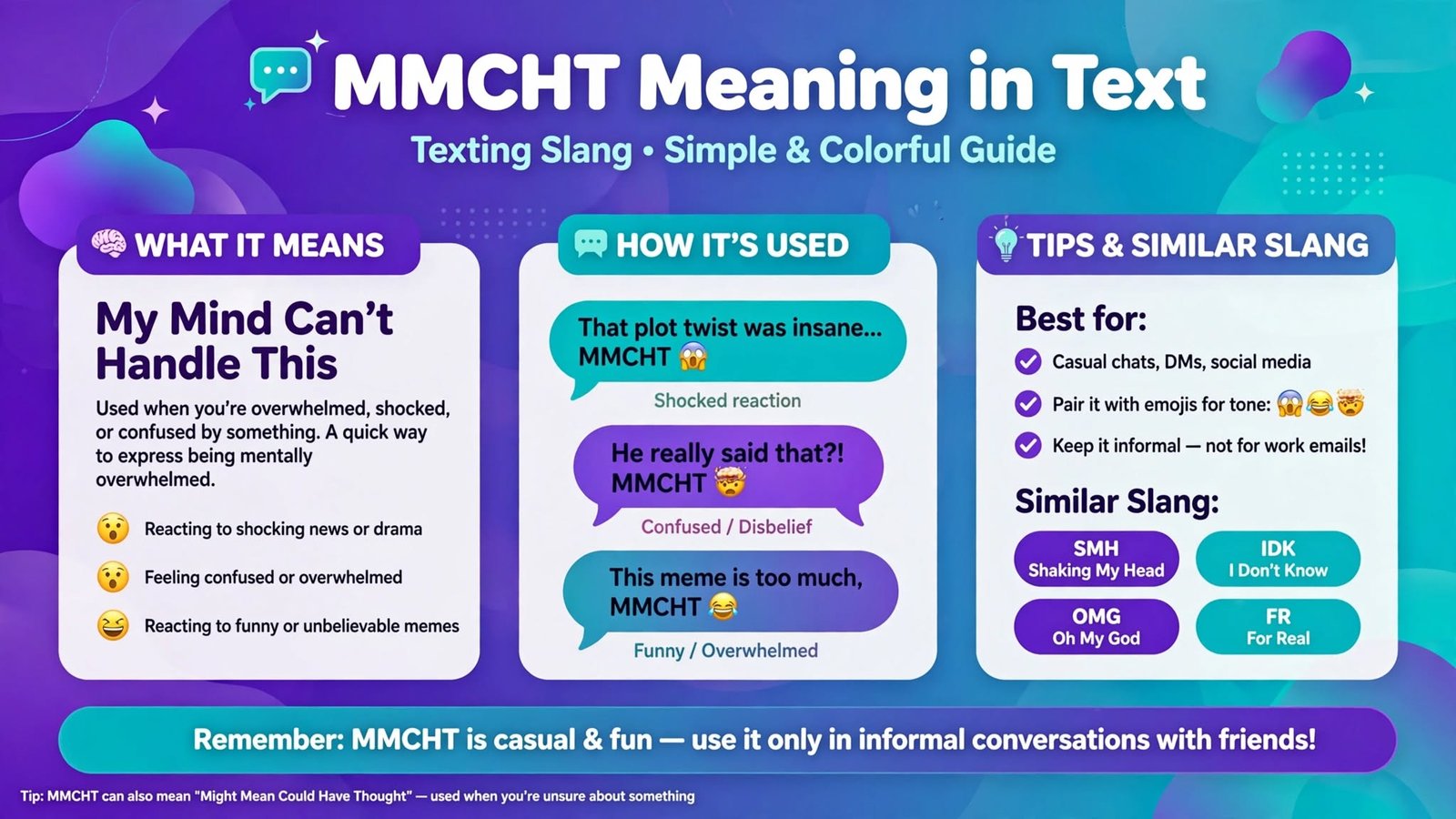
When it comes to MMCHT meaning in text, many beginners may feel confused because the term looks like an acronym but does not behave like common shortcuts such as LOL, BRB, or IDK. MMCHT is usually a written version of a sound made by clicking or sucking the teeth. People use it to show annoyance, disbelief, disapproval, frustration, skepticism, or a dismissive reaction.
What Does MMCHT Meaning in Text Actually Mean?
MMCHT meaning in text usually refers to a typed sound that represents a tongue-clicking, teeth-sucking, or lip-smacking reaction. It often shows that someone feels unimpressed, annoyed, doubtful, or disapproving.
The easiest way to understand MMCHT is to imagine someone hearing something they dislike and making a quick clicking sound with their mouth. Instead of describing the feeling with a full sentence, they type the sound.
Depending on the conversation, MMCHT can communicate feelings such as:
- “Seriously?”
- “I don’t believe that.”
- “Come on.”
- “That’s not okay.”
- “You cannot be serious.”
- “I’m not impressed.”
- “Really?”
- “Whatever.”
It can also have a playful meaning between friends. Therefore, you should not automatically assume that someone is angry when they write MMCHT.
Why Do People Use MMCHT in Text Messages?
The main reason people use MMCHT is simple: typing a reaction can be faster than explaining an emotion. A short sound can communicate attitude without requiring a long sentence.
Digital communication removes many physical signals that people normally use during face-to-face conversations. When someone speaks, their facial expression, voice, body movement, and tone help explain their feelings. Text removes most of those clues.
Expressions such as MMCHT help bring some of that emotional information back into a conversation.
It Can Show Annoyance
One common use is to express mild or strong annoyance. The person may feel frustrated with something that another person said or did.
For example:
“You forgot to send the file again.”
“Mmcht…”
Here, the reaction may suggest disappointment or irritation.
The sender does not need to write a full explanation. The sound itself communicates that they are not happy.
It Can Show Disbelief
MMCHT can also communicate disbelief when someone makes an unbelievable claim.
For example:
“I finished the entire project in ten minutes.”
“MMCHT, really?”
In this case, the sender may not literally be angry. They may simply doubt the statement.
This use is close to expressions such as “seriously?” or “you expect me to believe that?”
It Can Show Disapproval
Another common use involves disagreement or disapproval.
For example:
“I think I’ll cancel our plans five minutes before we leave.”
“Mmcht. Don’t do that.”
The reaction adds emotional weight. It tells the other person that the idea is not being received positively.
MMCHT Meaning in Text and Its Different Tones
The meaning of MMCHT changes with context. A single word can sound playful in one conversation and rude in another. That is why reading the surrounding messages is important.
Annoyed Tone
An annoyed MMCHT often appears after someone does something frustrating.
Example:
“You changed the plan without telling me.”
“Mmcht.”
The short reply can suggest that the sender feels irritated and does not want to explain the feeling further.
Playful Tone
Friends can also use MMCHT as a joke. In this situation, emojis and surrounding words often make the playful tone clear.
Example:
“I ate the last slice of pizza.”
“MMCHT 😂 You better run.”
The expression here is probably exaggerated for humor.
Skeptical Tone
Someone may use MMCHT when they do not believe what another person says.
Example:
“I swear I didn’t eat your cookies.”
“Mmcht… sure.”
The reaction suggests doubt rather than direct anger.
Dismissive Tone
MMCHT can also signal that someone is not interested in accepting an argument.
Example:
“You should definitely give me your seat.”
“Mmcht. Nope.”
Here, the expression adds a firm and dismissive attitude.
Examples of MMCHT in Everyday Texting
Examples make this expression much easier to understand. The following situations show how MMCHT can work in casual digital conversations.
Example 1: When Someone Is Annoyed
Alex: You forgot my birthday again.
Sam: Mmcht… I’m sorry 😭
Here, MMCHT suggests disappointment or frustration.
Example 2: When Someone Is Skeptical
Alex: I can run five miles without training.
Sam: MMCHT, okay 😂
The response sounds doubtful and playful.
Example 3: When Someone Is Disappointed
Alex: The concert was canceled.
Sam: Mmcht. That’s disappointing.
The expression shows an emotional reaction to bad news.
Example 4: When Someone Is Teasing
Alex: I’m definitely the smartest person in this group.
Sam: MMCHT 😂
Here, the expression can mean something like “Yeah, right.”
Example 5: When Someone Rejects an Idea
Alex: Let’s submit the assignment tomorrow morning.
Sam: Mmcht. We should finish it tonight.
The expression signals disagreement.
Example 6: When Someone Makes a Strange Claim
Alex: My dog understands every word I say.
Sam: MMCHT, does he now?
This version communicates playful skepticism.
Is MMCHT Rude in Texting?
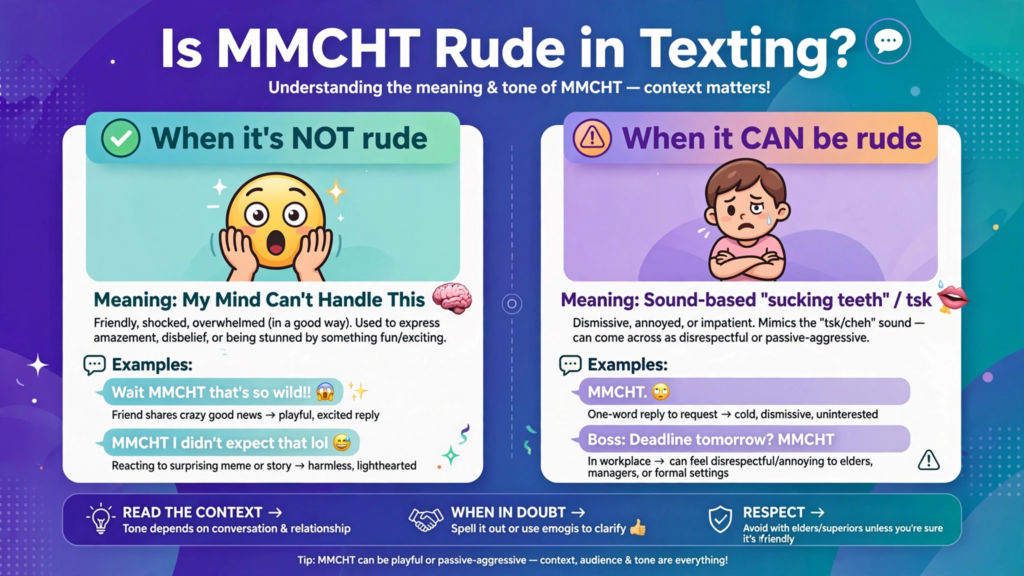
MMCHT can sound rude, but it is not automatically rude. Its tone depends on the relationship, subject, punctuation, and surrounding language.
If someone sends only:
“MMCHT.”
it may feel cold or dismissive.
However:
“MMCHT 😂 you’re crazy”
could be friendly teasing.
When MMCHT May Sound Rude
It can sound rude when:
- Someone uses it during an argument.
- The sender adds insulting words.
- The message contains angry emojis.
- The sender uses it to dismiss a serious concern.
- The conversation is already tense.
- The recipient does not know the sender well.
In professional communication, it is safer to avoid MMCHT because its emotional tone may be misunderstood.
When It May Sound Friendly
Among close friends, MMCHT can be harmless.
For example:
“You really bought another pair of sneakers?”
“MMCHT 😂 leave me alone.”
The expression adds personality and humor.
Common Mistakes People Make With MMCHT
New users often make mistakes because MMCHT looks like a conventional abbreviation. Understanding these errors can help you interpret the expression more accurately.
Assuming It Has One Official Full Form
The biggest mistake is assuming every letter must represent a word. Current references do not support one universally accepted expansion. Instead, MMCHT is mainly described as a written reaction sound.
Assuming It Always Means Anger
MMCHT can communicate annoyance, but it may also express disbelief, skepticism, disappointment, teasing, or playful sarcasm.
The conversation determines the exact tone.
Using It in Formal Communication
Avoid MMCHT in emails, business documents, academic assignments, and other formal situations. The recipient may not understand it, and the informal tone may appear unprofessional.
Reading It Literally
MMCHT does not need to be pronounced as a normal English word. It represents a sound. Thinking of it as an expressive reaction makes its usage easier to understand.
How Should You Reply When Someone Sends MMCHT?
Your response should depend on the situation. If the sender seems playful, you can respond casually. If the sender seems annoyed, acknowledge the issue instead of joking immediately.
If They Are Joking
You can respond with another light reaction:
“😂 What did I do now?”
If They Seem Annoyed
A calm response may work better:
“Okay, what happened?”
or:
“Did I upset you?”
If They Seem Skeptical
You can clarify your statement:
“I’m serious. I actually did it.”
If You Still Do Not Understand
There is nothing wrong with asking directly:
“What do you mean by mmcht?”
That is often better than guessing and creating unnecessary confusion.
Tips for Using MMCHT Naturally
MMCHT works best when the conversation is already informal. Use it as an emotional reaction rather than treating it like a standard abbreviation.
Keep the Context Casual
Use MMCHT with friends or people who understand your style of communication. It is not suitable for every audience.
Let Context Carry the Meaning
Do not force a specific definition into every situation. The expression can communicate different shades of annoyance, disbelief, or sarcasm.
Use Emojis Carefully
An emoji can make your intention clearer. A laughing emoji may make the expression playful, while an annoyed emoji may make it sound more serious.
Avoid Overusing It
Like most slang, repeated use can make messages feel unnatural. Use it when the reaction fits the moment.
Frequently Asked Questions About MMCHT
What is the MMCHT meaning in text?
MMCHT usually represents a tongue-clicking, teeth-sucking, or lip-smacking reaction. It can express annoyance, disbelief, disapproval, frustration, skepticism, or dismissal.
Is MMCHT an acronym?
No. It is generally better understood as a phonetic or onomatopoeic expression rather than a conventional acronym. It represents a sound instead of a fixed phrase.
Does MMCHT mean someone is angry?
Not necessarily. It can show anger or irritation, but it may also express disbelief, disappointment, skepticism, sarcasm, or playful teasing. Context determines the tone.
Can I use MMCHT with friends?
Yes. MMCHT is mainly suited to casual communication. Friends may use it as a humorous or expressive reaction during informal conversations.
Is MMCHT appropriate for work messages?
Usually, no. Professional conversations should use clear language because slang expressions can be misunderstood. A direct phrase such as “I disagree” or “I’m concerned about that” is clearer.
Is MMCHT the same as SMH?
Not exactly. SMH is a recognized abbreviation for “shaking my head.” MMCHT generally represents a clicking or teeth-sucking reaction. Both can express disappointment or disbelief, but they are formed differently.
Conclusion
Understanding MMCHT meaning in text becomes much easier once you stop treating it like a traditional acronym. MMCHT is generally a written reaction sound that imitates clicking or sucking the teeth. People use it to express annoyance, disbelief, disappointment, skepticism, disapproval, or a dismissive attitude. Older slang references also connect the term with the sound of smacking the teeth or lips.
The exact feeling depends on context. A message such as “MMCHT 😒” may sound irritated, while “MMCHT 😂” can sound playful. Your relationship with the sender and the messages around it also help reveal the intended tone.