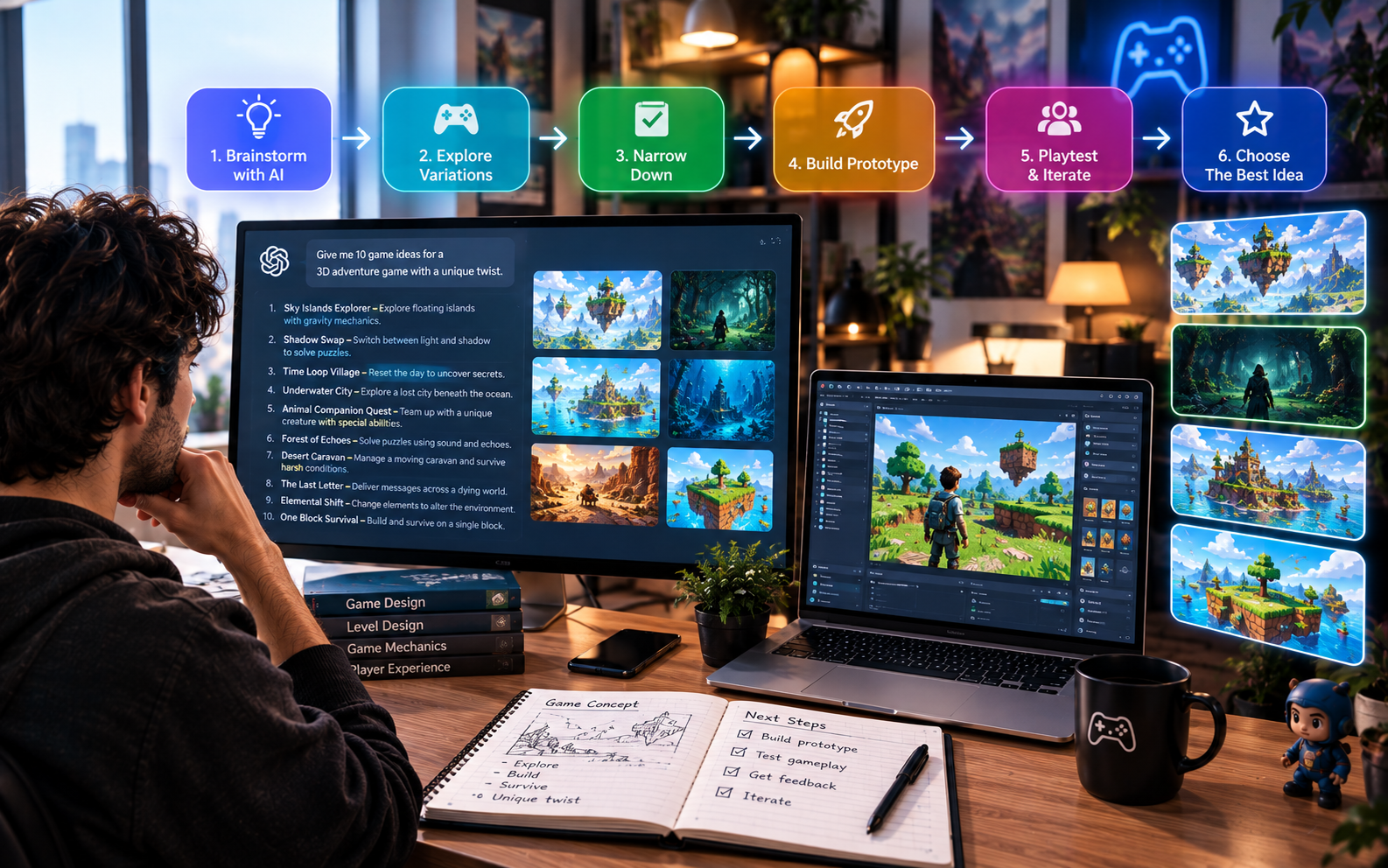
Coming up with a good game idea has always been the hardest part of game development, harder than the coding, harder than the art, harder than the marketing. Most creators don’t struggle because they lack technical skill. They struggle because they don’t know which of their ideas is actually worth building. A concept that sounds exciting in your head can fall flat the moment it becomes playable, and a creator who spends months building the wrong idea often doesn’t realize the mistake until it’s too late to fix cheaply.
AI has started to change that equation in a meaningful way. It’s not generating brilliant game concepts out of thin air, but it is giving creators a much faster way to explore, test, and refine the raw material that good ideas come from. That shift is worth understanding in detail, especially for anyone who has felt stuck staring at a blank page wondering what to build next.
Why Good Game Ideas Are So Hard to Find
The Difference Between an Idea and a Concept
Most people confuse having an idea with having a concept. An idea is a vague notion, something like “a game about survival” or “a puzzle game with a twist.” A concept is that idea translated into something specific enough to actually build, tested against real constraints like scope, audience, and mechanics that work together. The gap between the two is where most projects stall.
Why Creators Get Stuck in Loops
Without a fast way to test ideas, creators often fall into a loop of overthinking. They imagine a mechanic, second-guess whether it’s original enough, compare it to existing games, and either abandon it too early or commit to it too long without validating whether it’s actually fun. This loop wastes enormous creative energy that could otherwise go into building.
How AI Changes the Ideation Process
The biggest value AI brings to idea generation isn’t creativity itself, it’s speed and volume. A creator can describe a rough concept and get back several variations, twists, or related mechanics almost instantly. That doesn’t replace human judgment, but it gives the human something concrete to react to instead of a blank page.
Rapid Brainstorming at Scale
Instead of sitting with a notebook trying to force original thoughts, a creator can describe a genre, theme, or mechanic and get a wide spread of directions back immediately. Some of those directions will be obvious, some will be strange, and a few will spark something the creator wouldn’t have thought of alone. The value isn’t in any single suggestion, it’s in the volume that lets a creator quickly spot patterns in what excites them.
Combining Familiar Elements in New Ways
Many of the most successful games aren’t wildly original, they take familiar mechanics and combine them in a fresh way. AI is particularly good at helping creators explore these combinations quickly, testing what happens when you merge a survival mechanic with a puzzle structure, or a builder game with a social multiplayer layer. Creators can run through dozens of these combinations in the time it used to take to fully flesh out just one.
Testing an Idea Before Committing to It
One of the most underrated uses of AI in ideation is stress-testing a concept before any real development begins. A creator can describe a mechanic and ask what breaks it, what makes it repetitive, or what similar games have already tried and why they succeeded or failed. This kind of quick critique used to require a mentor, a knowledgeable friend, or expensive market research. Now it’s available on demand.
From Idea to Playable Prototype
Having a good idea means very little if it takes months to find out whether it actually works when played. This is where AI-assisted platforms have made the biggest practical difference for creators.
Why Fast Prototyping Matters More Than Perfect Planning
No amount of planning fully predicts whether a mechanic will feel good in practice. The only real way to know is to play it. AI-assisted game creation tools let a designer go from a described concept to something playable far faster than traditional development, which means ideas get validated by actual play rather than by guesswork on paper.
A Platform Built Around This Workflow
Astrocade is a good example of a game builder designed around exactly this kind of fast idea-to-prototype workflow. Rather than requiring a creator to fully plan out a game before writing a single line of code, it allows ideas to be described and turned into playable experiences quickly, which means the idea itself gets tested honestly instead of theorized about for weeks.
Learning From What Others Have Already Built
Looking at existing games built this way is one of the best ways to understand what a good starting idea actually looks like in practice. Minecraft One Block Survival is a strong example of this kind of thinking. It takes a mechanic players already understand and know how to enjoy, and narrows the scope down into a tight, focused survival challenge built around a single block as the only resource. It’s not a wildly original premise, but it’s an idea that was clearly executed with a clear hook in mind, which is often more valuable than pure originality.
What Makes an AI-Assisted Idea Actually Good
Generating lots of ideas quickly is only useful if a creator knows how to recognize which ones are worth pursuing. AI can widen the pool of possibilities, but the judgment for narrowing that pool down still belongs entirely to the human behind the project.
Look for a Clear Hook
A good idea can usually be explained in one sentence that immediately makes someone want to try it. If a concept takes several minutes to explain before it sounds interesting, it probably needs to be simplified, regardless of how many AI-generated variations were explored to get there.
Check If the Scope Matches Your Resources
AI can generate ambitious, sprawling concepts just as easily as small, focused ones. Part of a creator’s job is filtering those ideas against what’s actually realistic to build and finish, especially for solo creators or small teams working without a large studio behind them.
Prioritize Ideas You Can Test Quickly
The best ideas coming out of an AI-assisted brainstorming session are the ones that can be prototyped and played within a day or two. If an idea requires months of foundational work before it can even be evaluated, it carries far more risk, no matter how promising it sounds on paper.
Common Mistakes Creators Make With AI Ideation
Treating AI Suggestions as Final Answers
AI-generated ideas are starting points, not finished concepts. Creators who take the first suggestion and build it exactly as described often end up with something generic, because the real value comes from iterating on the suggestion, not accepting it wholesale.
Skipping the Playtest Step
Some creators get so caught up in generating and refining ideas that they delay actually building and testing anything. Ideation should always lead quickly into a playable version, even a rough one, because no amount of discussion reveals what playtesting does in minutes.
Ignoring Their Own Instincts
AI can widen the range of options, but it doesn’t know what excites a particular creator or what audience they understand best. Creators who override their own instincts in favor of whatever AI suggests most often end up with concepts they aren’t personally invested in, which usually shows in the final product.
A Practical Workflow for Better Game Ideas
A realistic approach for creators looking to use AI effectively in the ideation phase looks something like this. Start with a rough theme or mechanic you’re personally drawn to, then use AI to generate several variations and combinations around that starting point. Narrow the list down to two or three that have a clear hook and a realistic scope, then build a rough playable version of each as quickly as possible. Test them with real players, pay attention to what actually holds their attention, and commit fully to the one that performs best rather than the one that sounded best on paper.
This workflow keeps the creative decision-making in human hands while letting AI handle the heavy lifting of generating options and accelerating the path to something playable.
Final Thoughts
AI hasn’t solved the hardest part of game design, which is still knowing what makes an idea genuinely fun. What it has done is remove the friction between having a rough idea and finding out whether that idea actually works. For creators willing to combine fast AI-assisted brainstorming with their own judgment and a willingness to playtest early, better game ideas are more reachable than ever.