When it comes to online conversations, short forms help people share their feelings in just a few letters. AWL is one such abbreviation that can add warmth to a text message. It commonly stands for “Always With Love.” People may use it when texting friends, family members, romantic partners, or someone they care about. Understanding the AWL meaning in text can help you read messages correctly and respond with confidence.
What Does AWL Mean in Text Messages?
AWL usually means “Always With Love” in personal messages. It expresses affection, care, or emotional support. People often add it to a message when they want their words to feel warm, sincere, and thoughtful.
For example:
- “Take care of yourself. AWL!”
- “I hope everything works out for you. AWL.”
- “You will always have my support. AWL ❤️”
In these examples, the sender uses AWL to show that their feelings are genuine. The abbreviation can make a message feel more personal without adding a long closing sentence.
However, context matters. Not everyone uses abbreviations in the same way, and AWL may have a different meaning in a particular conversation or online community. If someone sends it after a heartfelt message, “Always With Love” is a reasonable interpretation.
Why Do People Use AWL?
People use AWL because it offers a short way to express affection. It can fit naturally into a text, a handwritten-style digital note, or a social media message.
Common reasons include:
- Showing love and appreciation.
- Ending a caring message.
- Offering comfort during a difficult time.
- Sending warm wishes to someone special.
- Making a personal note feel more affectionate.
For instance, a friend might write, “Good luck with your new job. AWL!” The message shares encouragement and adds a personal touch.
AWL Meaning in Text From Friends and Family
The meaning of AWL can feel slightly different depending on who sends it. Between friends, it may express loyalty and appreciation. Within a family, it can communicate lasting affection. The main idea remains warmth rather than a specific romantic commitment.
AWL Between Friends
Friends may use AWL when they want to offer support or remind someone that the friendship matters. It can appear after a thoughtful conversation, a birthday wish, or a message of encouragement.
Examples:
- “Thanks for listening when I needed someone. AWL!”
- “You are such a great friend. AWL ❤️”
- “Good luck tomorrow. I know you can do it. AWL.”
- “No matter how busy life gets, I am here for you. AWL.”
These messages show that AWL does not have to suggest romance. It can simply express a close friendship and a caring attitude.
AWL in Family Messages
Family members may use AWL to share affection across distances or at the end of an emotional message. Parents, siblings, cousins, and other relatives can use it when sending wishes or offering reassurance.
Examples:
- “Travel safely and call me when you arrive. AWL.”
- “Happy birthday! I hope your day is full of joy. AWL ❤️”
- “You can always count on your family. AWL.”
- “I miss our time together. Sending you a big hug. AWL.”
In these situations, the abbreviation works as a warm sign-off. It does not replace the message itself; it adds an affectionate ending.
AWL Meaning in Text From a Romantic Partner
When a romantic partner uses AWL, it can express affection, closeness, or reassurance. The abbreviation may appear in a goodnight text, a loving note, or a message sent during a busy day.
For example:
- “I loved spending time with you today. AWL ❤️”
- “Distance cannot change how much you mean to me. AWL.”
- “Sleep well, my love. Talk to you tomorrow. AWL.”
- “Thank you for being part of my life. AWL.”
The meaning depends on the relationship and the surrounding words. A partner who regularly sends affectionate messages may use AWL as a familiar expression of love.
Still, AWL does not automatically prove romantic interest. Friends and relatives may use the same abbreviation. If you are unsure about someone’s feelings, consider the broader conversation instead of relying on three letters alone.
Does AWL Mean “I Love You”?
AWL can communicate a loving feeling, but it is not always a direct substitute for “I love you.” The phrase “Always With Love” focuses on the warmth behind a message. “I love you” is more direct and may carry a clearer meaning in a romantic relationship.
Compare these examples:
- “Thanks for everything. AWL.” — A warm expression of appreciation.
- “I love you, and I am always here for you.” — A direct statement of love and support.
- “Wishing you happiness wherever life takes you. AWL.” — A caring sign-off.
The sender’s usual communication style also matters. Some people express affection through abbreviations, while others prefer complete words.
AWL Text Message Examples for Different Situations
Seeing the abbreviation in complete sentences makes it easier to understand. The examples below show how people might use it in different everyday situations.
Sweet AWL Messages
Sweet messages use gentle language to show affection and appreciation. AWL can add a loving ending without making the message sound overly formal.
- “You make ordinary days feel special. AWL ❤️”
- “I hope you always find reasons to smile. AWL.”
- “Thank you for being such a wonderful part of my life. AWL.”
- “Sending you happiness, peace, and lots of love. AWL!”
- “You deserve kindness today and every day. AWL.”
Supportive AWL Messages
Supportive messages can help someone feel valued during a stressful or uncertain time. Here, AWL adds warmth to words of encouragement.
- “Take things one step at a time. I believe in you. AWL.”
- “You do not have to handle everything alone. AWL ❤️”
- “I am here whenever you need someone to talk to. AWL.”
- “Better days can still be ahead. Keep going. AWL.”
- “Be kind to yourself while you work through this. AWL.”
AWL Messages for Special Occasions
Special occasions offer a natural reason to send a thoughtful note. You can add AWL after a greeting, a wish, or a message of gratitude.
- “Happy anniversary! I wish you both years of happiness. AWL.”
- “Merry Christmas! May your home be filled with warmth. AWL.”
- “Congratulations on your achievement. You worked hard for it. AWL!”
- “Happy birthday to someone who means so much to me. AWL ❤️”
- “Wishing you a wonderful new chapter in life. AWL.”
These are suggested examples, not fixed phrases. You can change the wording to match your relationship and the occasion.
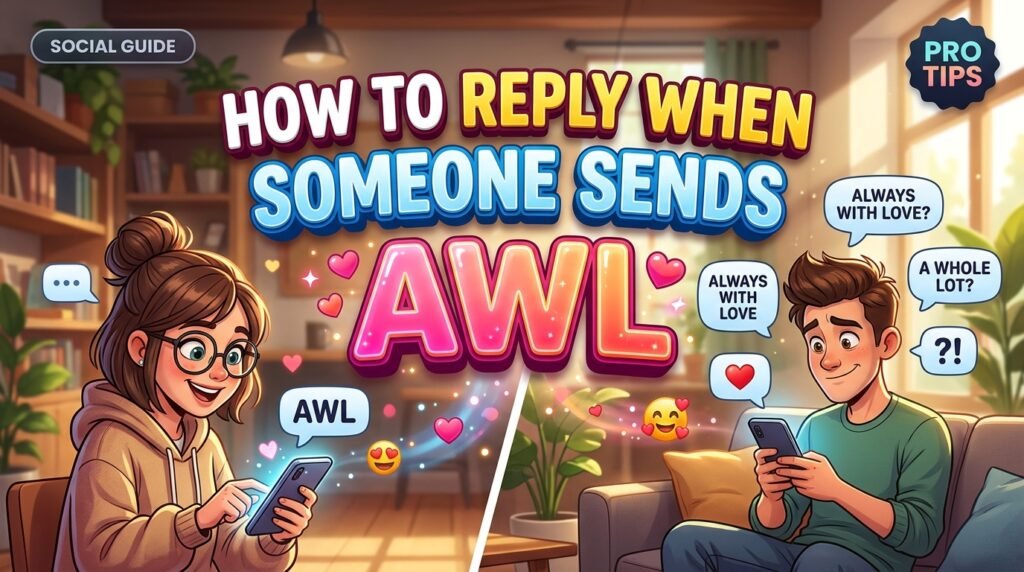
How to Reply When Someone Sends AWL
Your reply depends on the sender, the conversation, and how comfortable you feel expressing affection. You do not need to use the same abbreviation if it does not match your usual style.
Friendly Replies to AWL
If a friend sends AWL, you can respond with appreciation or return the warm feeling.
Examples:
- “That is so sweet of you. Thank you!”
- “Sending love right back!”
- “You are such a good friend ❤️”
- “I appreciate you always being there.”
- “Same to you! Take care.”
These replies keep the conversation friendly and natural. They also work when you understand the message but do not usually use abbreviations yourself.
Romantic Replies to AWL
If your partner sends AWL, you can answer with a loving message that feels genuine to you.
Examples:
- “Always sending love your way too ❤️”
- “You mean so much to me.”
- “Love you lots!”
- “You always know how to make me smile.”
- “Sending you the biggest hug.”
You do not have to mirror the exact phrase. A personal response often feels more meaningful than copying the sender’s words.
What If You Do Not Understand AWL?
If the abbreviation appears in a confusing conversation, it is perfectly fine to ask what the sender means. A simple question avoids guessing and shows that you want to understand.
You could reply:
- “What does AWL mean here?”
- “Do you mean ‘Always With Love’?”
- “I have not seen that abbreviation before. Can you explain it?”
This approach is useful because abbreviations can vary across groups, platforms, and personal texting habits.
AWL vs. Other Common Text Abbreviations
AWL belongs to a wider group of short expressions used in digital communication. Some communicate affection, while others focus on a quick response or a casual sign-off.
| Abbreviation | Common meaning | Typical use |
| AWL | Always With Love | Warm or affectionate sign-off |
| LOL | Laughing Out Loud | Humor or amusement |
| BTW | By The Way | Adding information |
| TTYL | Talk To You Later | Ending a conversation temporarily |
| ILY | I Love You | Direct expression of love |
| XOXO | Hugs and Kisses | Affectionate closing |
| BRB | Be Right Back | Briefly leaving a conversation |
| TBH | To Be Honest | Introducing an honest opinion |
These abbreviations are not interchangeable. For example, TTYL signals that someone expects to talk later, while AWL communicates affection. ILY directly expresses love, whereas AWL can be a softer closing.
AWL vs. ILY
ILY stands for “I Love You.” People often use it with romantic partners, close friends, or family members. AWL, by contrast, usually expands to “Always With Love” and often appears at the end of a longer message.
Consider these examples:
- “Goodnight. ILY ❤️” — A direct expression of love.
- “Thank you for making today special. AWL.” — A loving sign-off.
- “ILY, and I am proud of you.” — Love stated directly, followed by encouragement.
- “Wishing you all the happiness in the world. AWL.” — Affection expressed through a closing.
Both can feel heartfelt, but the right choice depends on what you want to say.
AWL vs. XOXO
XOXO is commonly associated with hugs and kisses. It often appears at the end of friendly, family, or romantic messages. AWL emphasizes love in a broader sense rather than referring specifically to hugs and kisses.
For example, “Miss you! XOXO” gives a playful, affectionate feeling. “Miss you! AWL” emphasizes lasting care. The difference is subtle, and personal habits can influence how each phrase feels.
Common Mistakes to Avoid When Using AWL
Although AWL is short, using it well requires some attention to context. A few simple choices can prevent confusion and help your messages sound natural.
Assuming Everyone Knows the Meaning
Not everyone recognizes the same abbreviations. A person may understand common forms such as LOL or BRB but have never encountered AWL.
If the other person seems confused, explain the phrase in full. In an important message, writing “Always With Love” may be clearer than using the abbreviation alone.
Using AWL in Formal Communication
AWL is generally better suited to personal messages than formal business communication. A client, supervisor, or new professional contact may find it too intimate or unfamiliar.
For a formal note, choose a closing such as “Best regards,” “Thank you,” or “Kind regards.” Save AWL for situations where warmth and personal affection fit the relationship.
Reading Too Much Into the Abbreviation
A message containing AWL may feel meaningful, but it cannot tell you everything about the sender’s intentions. Someone might use it out of friendship, family affection, or a habit of ending messages warmly.
Look at the complete message and the relationship. If a romantic meaning matters, a respectful conversation is more reliable than interpreting an abbreviation on its own.
Overusing Abbreviations
Using many short forms in one message can make your words harder to read. For example, combining several unfamiliar abbreviations may distract from the feeling you want to express.
Use AWL when it adds something to the message. If a simple sentence already sounds warm and clear, you do not need to add an abbreviation.
Tips for Understanding Texting Slang and Online Language
Texting language changes as people develop new habits, join different communities, and communicate across social platforms. The same abbreviation may also have different meanings in separate settings.
To interpret a message more accurately:
- Read the whole conversation. The surrounding words often explain the sender’s intent.
- Consider your relationship. A message from a close friend may carry a different tone from one sent by a colleague.
- Notice the placement. An abbreviation at the end of a heartfelt message may work as a sign-off.
- Pay attention to emojis. A heart can support an affectionate interpretation, although it does not prove romantic interest.
- Ask when necessary. A quick question is better than making an important assumption.
- Use abbreviations that feel natural. You do not need to adopt every texting trend.
Learning slang is not just about memorizing letters. It is also about understanding tone, social context, and how people communicate with each other.
Conclusion: Understanding AWL in Everyday Texts
The AWL meaning in text is commonly understood as “Always With Love.” It is a short, affectionate expression that people may use when texting friends, relatives, or romantic partners. It often appears at the end of a thoughtful message, a supportive note, or a special greeting.
AWL can make a conversation feel warmer without requiring a long closing sentence. Still, its exact meaning depends on context and the habits of the person using it. It does not always signal romantic interest, nor does it replace a direct statement such as “I love you.”
When you receive AWL, read the full message before deciding what the sender means. You can reply with a simple thank-you, return the affection, or ask for clarification if you are unsure. When using it yourself, choose a setting where a warm and personal tone feels appropriate.
The most important rule is to communicate clearly. Abbreviations can make texting quick and expressive, but sincere words and mutual understanding matter far more than the letters themselves.
Frequently Asked Questions
1. What does AWL mean in text messages?
AWL commonly stands for “Always With Love.” People use it to express affection, care, or warmth, often at the end of a personal message.
2. Does AWL mean love?
Yes, the phrase usually expresses love or affection. However, it does not always indicate romantic love. Friends and family members may use it to show care and support.
3. What is AWL meaning in text from a girl?
If a girl sends AWL, she may be expressing warmth, appreciation, friendship, or romantic affection. The surrounding conversation and your relationship help clarify what she means.
4. How should I reply when someone texts AWL?
You can reply with “Sending love back,” “Thank you, that means a lot,” or “Same to you ❤️.” Choose a response that feels natural for your relationship.
5. Is AWL the same as ILY?
No. ILY means “I Love You,” while AWL commonly means “Always With Love.” Both can express affection, but ILY is a more direct statement of love.
6. Can I use AWL in professional messages?
It is usually better to avoid AWL in formal work messages because it may feel too personal or unfamiliar. Use a professional closing, such as “Kind regards,” when writing to clients or colleagues.